
Yamaha A-S801
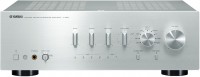 | Outdated Product Device type: integrated amplifier; Element base: transistor; Number of channels: 2; Frequency range (Hz): 20 – 20000; Power per channel, 8 ohms (W): 100; Signal to noise ratio (dB): 104; Signal-to-noise ratio (Phono MM/MC), dB: 82; Damping factor: 240; RCA (pairs): 5; to subwoofer; For acoustics: 4 |


We recommend products in stockAmplifiers Yamaha →
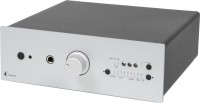
integral, channels: 2, per channel 8Ω 40 W, per channel 4Ω 60 W, inputs: optical, USB, RCA 3 pairs, Bluetooth, Phono MC
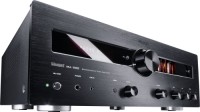
integral, hybrid, channels: 2, per channel 8Ω 130 W, per channel 4Ω 200 W, inputs: Main RCA, optical, Bluetooth, Phono MC
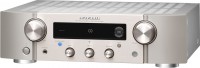
integral, channels: 2, per channel 8Ω 60 W, per channel 4Ω 80 W, dumping: 100, inputs: optical, RCA 3 pairs, Bluetooth
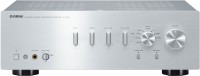
integral, channels: 2, per channel 8Ω 100 W, dumping: 240, inputs: Main RCA, optical, RCA 4 pairs

integral, channels: 2, per channel 8Ω 100 W, per channel 4Ω 120 W, inputs: RCA 4 pairs, Gain Control

integral, channels: 4, per channel 8Ω 80 W, per channel 4Ω 120 W, dumping: 110, inputs: Main RCA/XLR, optical, USB, RCA 4 pairs, Bluetooth
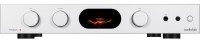
integral, channels: per channel 8Ω 70 W, per channel 4Ω 110 W, inputs: optical, USB, RCA 4 pairs, Bluetooth

integral, channels: 2, per channel 8Ω 25 W, per channel 4Ω 50 W, inputs: optical, RCA 1 pairs, Bluetooth, Gain Control
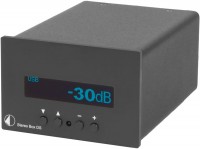
integral, channels: 2, per channel 8Ω 35 W, per channel 4Ω 60 W, inputs: USB, RCA 4 pairs, external power supply
Yamaha A-S801
Type:integral
Number of channels:2
Power per channel (8 ohms):100 W
Coef. damping:240
To amplifier (Main):RCA
Inputs:optical, USB
RCA inputs:5 steam(а)
REC outputs:2 steam(а)
All specifications
Specifications A-S801
|
| ||||||||||||||||||||||||||||||||||||||||||||||||||||||||||||||||||||||||||||||||||||||||||||||


The information in the model description is for reference purposes.
Always clarify the specifications and configuration of the product with the online store manager before purchasing.
Catalog Yamaha 2026 - new arrivals, bestsellers, and the most relevant models Yamaha.
Always clarify the specifications and configuration of the product with the online store manager before purchasing.
Catalog Yamaha 2026 - new arrivals, bestsellers, and the most relevant models Yamaha.
Model overview based on user reviews
The Yamaha A-S801 amplifier is praised for its clear and reliable sound quality, with users appreciating the absence of background noise during pauses and the smooth operation of the Mute function. It features effective tone adjustments that eliminate the need for an additional equalizer. The built-in DAC is a notable advantage, enhancing the overall audio experience. However, some users have noted that the volume knob lacks visibility for its position, and there are mixed opinions on its bass performance, with some finding it lacking in depth and power. The amplifier is described as beautiful, big, and heavy, but its sound can be perceived as harsh or shouty at higher volumes, particularly with certain genres like rock. Despite these criticisms, it remains a popular choice for its overall sound quality and features, though some users suggest upgrading the power cable for improved bass performance.
Pros
Cons
I spent a long time choosing an amplifier for myself and bought it in February 2019 at a promotion in the CSN for 49 thousand rubles. Previously I had a Bark 068-50U amplifier, the playback quality of the Japanese is much higher. There is no background at all during pauses between songs. I like that the sound rises and falls smoothly when the Mute button is turned on. The HF and LF tone adjustments are enough to compensate for dips in compositions and there is no need for the Orbit 002 equalizer. My acoustics remain the same Supersound-150 (S-90 Latvia), well preserved, later I will change them to Heco MS 1000 or Dynavoice Definition DF-8. The wire that connects the AC, PVS 2x4 No disadvantages. use Yamaha A-S801 less than month |
To get good bass, you need to replace the power cable with Supra 3x2.5 1m. Good clear sound. DAC. Reliable. You can't see what position the volume knob is in. use Yamaha A-S801 more than year |
the 801 sounds harsh/shouty, there is no low bass. The power, with a stretch, allows this amplifier to be used with floor-standing speakers, but this ragged, noisy presentation begins already at a third of the power, which makes listening tiring. Genre preferences: pop, techno, rap. Rock sounds simply terrifying, it’s impossible to listen to - it’s a mess and a scream. It was paired with HECO Elementa 300 and then with Celan Rev 3 for TV as a second system. I listened to Dali Optikon 8 from the main system. Moreover, his character is loud, ragged, and cannot be called sterile. Cambridge Audio CXA 80 is sterile, but without harshness or loudness. Beautiful, big and heavy. DAC. Loud, nervous delivery without low bass. The power is overestimated, and greatly. For floor-standing speakers with 20cm, the bass is frankly weak. At half power the sound character becomes even worse.  Viktor: use Yamaha A-S801 more than year Viktor: use Yamaha A-S801 more than year |
Add Review
Video reviews

Impossible! Did Someone Finally Do It? A new Amp that Sounds like a Vintage Receiver! Yamaha AS801
9 June 2022393 959 view

Review! The Yamaha A-S801 Integrated Amplifier!
9 June 2019265 306 view
Are Expensive Yamaha Amps WORTH IT? YAMAHA A-S801 Amplifier Review
19 September 2021253 328 view

Yamaha A-S801 Integrated Amplifier Review
26 September 2015142 873 view

ADS L1530 speakers and Yamaha A-S801 integrated amp, DSD 2.8Mhz
4 February 201771 167 view

Yamaha A-S801 Reaction - @andrewrobinsonreviews #RecoveringAudiophile
27 April 202263 567 view

B&W 606 (White) + Cambridge Audio CXN (V2) + Yamaha A-S801
26 November 201961 259 view

YAMAHA A-S801! YAMAHA CD-S303 ! MARTIN-LOGAN MOTION 15I SPEAKERS!
29 October 202248 845 view

Klipsch RP-160M & Yamaha A-S801 Integrated Amp
16 December 201847 566 view

Yamaha A-S301 vs A-S501 (A-S701 A-S801 Detailed Review Amplifier UPDATE https://youtu.be/dExKPdbvXzM
13 August 202337 619 view

YAMAHA A-S801! YAMAHA CDX-1060! FROM 1993 AND MARTIN-LOGAN MOTION 15I SPEAKERS!
8 January 202316 850 view

Why do we only modify the Yamaha AS301, AS501 and AS801 integrated amps
24 April 202416 473 view

How to listen to Hi Res Audio on Yamaha A-S801, R-N602 & WXC-50
23 April 202214 238 view

Two Yamaha AS801 Integrated Amplifiers Compare
22 January 202413 451 view

Modification of a Yamaha AS801 Integrated Amplifier
13 June 20239 442 view
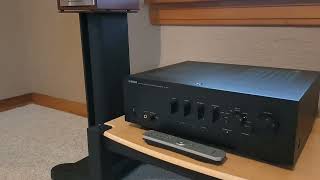
YAMAHA A-S801! ZENITH DVB211 DVD FROM 2002 AND MARTIN-LOGAN MOTION 15I SPEAKERS !
20 May 20235 736 view

Overnight Sensations Speakers + Yamaha A-S801 Sound Test
22 December 20221 920 view
Additional features amplifier Yamaha A-S801:
- USB port for charging connected devices