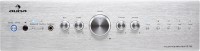
Yamaha A-S201
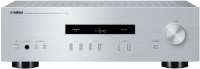 |


The model belongs to budget-friendly options, yet at the same time can boast a maximum output power of 100W with a signal-to-noise ratio of 100 dB, which is actually a very good indicator. The attractive design of the device is complemented by an informative display and convenient rotary switches, and a remote control is also included. A special Phono input allows for the connection of a vinyl record player. There are 4 outputs for acoustics, allowing up to 4 speakers to be connected.
|
| ||||||||||||||||||||||||||||||||||||||||||||||||||||||||||||||||||||||||||||||||||||||||


Always clarify the specifications and configuration of the product with the online store manager before purchasing.
Catalog Yamaha 2026 - new arrivals, bestsellers, and the most relevant models Yamaha.
0 1 4 10 |
For ordinary (not audiophile) listeners, this is a good budget option. The amplifier runs on upgraded Microlab Pro 3 (tweeters and crossovers replaced) and original Yamaha NS-6490. The sound character is different - the NS-6490 is more sonorous in the mids and highs. But there is more bass on the Pro 3. The subwoofer amplifier on the TDA3116D2 is connected through the line output - this is when you want more bass. But usually the low frequencies are enough as is. The Yamaha's tone controls are implemented in an unusual (but practical) way - they certainly won't rustle. A big plus is the control panel (albeit a little cut down). At power levels up to medium levels there is little heating. The limitation of the load (acoustic) resistance is 8 ohms and with two pairs of acoustics it is 16 ohms. My acoustics when connected in pairs give 4 ohms. Having studied the theory and recommendations, I came to the conclusion that a 4-ohm pair connection can be used, but with a volume limit to about 70% so as not to overload the amplifier. I tried to attach additional resistance to each speaker (to reach a total resistance of 8 ohms) - the sound seems to be good, but on all forums they write that the frequency response changes unpredictably, so I returned everything back - for my room, 20 square meters of average volume level is enough and the amplifier is not overloaded and at 4 Ohm load. Simplicity and budget price. I have several different amplifiers and it is not rational to buy another box. And even more so pay a lot of money (well, this is for whom, of course). Large sizes - there is a lot of emptiness inside and could have been made more compact. A classic but outdated design (this is not for everyone) - it could have been made more smooth. But on the other hand, ease of disassembly + a lot of space inside makes it possible to modernize and add elements (the same capacitors, for example). The absence of a screen at the transformer to reduce interference and interference. Yes, and the trance would be better than a toroidal one. But this is all nitpicking, of course - look at the price of the device - it probably couldn’t be cheaper + Malaysian assembly (I hope no worse than Chinese) + 24 months warranty. I couldn’t find a wiring diagram on the Internet - it looks like the amplifier has been assembled for several years, but no one has posted the diagram. There is a service manual, but everything is simplified there. There is little information on the Internet about repairs - maybe the amplifier rarely breaks down? Then this is even a plus. |
I bought this model in July 2019 for 4913 UAH, and at the moment it costs 4508 UAH on that website. I connected Radiotehnika S-50B (8 ohm) speakers with a 2x2.31 cable. It drives the speakers, the reset light on the speakers triggers, and the sound source is a laptop. With the equalizer set on the laptop, there are not enough frequencies, so I have to add lows and highs on the amplifier. Many sites state: Frequency range, Hz: 10-100000. With such high frequencies, the tweeters would probably burn out instantly. I don't understand where such numbers come from. The book states: Minimum RMS output power (8 ohm from 40 Hz to 20 kHz), which is much closer to reality. Before this, I had Radiotehnika U-7111 with a declared range of 10-30000 Hz, which produced much more pleasant and "deeper" lows until it burned out. But after it was repaired, the bass was gone. And if you add more bass on the Yamaha, it seems like the speakers are "choking." But in principle, the sound is not bad, it reproduces cleanly. It's a pity there's nothing else to compare it with. I've been using it for 5 months already. I don't plan to change it in the coming years. Compared to other models, the price is reasonable for such characteristics. Power is more than 50 Soviet watts at 8 ohms. But the declared 100 watts is unlikely to give out. Bad radiator, it gets very hot when 50 watt speakers at 8 ohms are turned on at full power, especially in summer. Speaker wire clamps leave a lot to be desired. Grey-marked front panel. I would like a slightly wider range of reproducible frequencies.  Vlad: use Yamaha A-S201 few months Vlad: use Yamaha A-S201 few months |
Excellent classic amplifier and I have something to compare it with. The only adequate downside is the lack of tone compensation. I took it along with a Denon 520. I have two systems, and having listened to each, I didn't give a clear preference to either of them. Both are certainly no worse than the Soviet Radiotekhnika and Amphiton, which they were purchased to replace. Liked the sound, and that's the main thing for an amplifier, provided of course that the speakers are of good quality, as well as the signal sources and recorded material. For this price, nothing even the lack of thincomps |


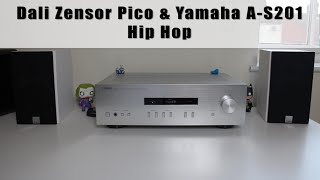


The Yamaha A-S201 amplifier for a moderate price ($300) received a universal design, a rich set of settings and interfaces, which makes it a contender for leadership in the low-cost class. Let's see what his chances are.
Design matters too
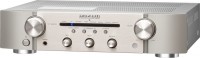
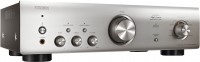
The amplifier is assembled perfectly, the aluminium case does not bend, does not play, there are no gaps. Massive supports provide excellent stability. The product is offered in two colours: black or silver matte. The design is concise and stylish — strict straight lines and a rectangular shape are in perfect harmony with modern, high-tech, loft interiors.
All control is placed on the front panel. From left to right are the headphone output, speaker power buttons, bass / treble settings, signal source selection buttons (Input), volume wheel. All modes are displayed on a thin neat display. For greater convenience, a remote control is provided, from which settings are available even for those functions that are not on the panel: balance adjustment, sleep timer, access to the settings menu.
Pure sound without embellishment
The amplifier supports dynamic power of 125 watts per channel into 8 ohms and 165 watts into 4 ohms and the ability to operate in a frequency range of 20 – 20,000 Hz. More is not needed, since the human ear does not perceive sound beyond these boundaries, and the power is enough for a large living room or yard.
Thanks to the Pure Direct mode, the sound signal bypasses the tone control circuits (bass and treble), balance and buffer amplifier, which allows you to fully reveal the sound of any high-quality bookshelf or floorstander. At the same time, all instruments sound legible even in complex compositions and at high volumes. The bass pleases with depth and clarity, the middle — with breadth and openness, and the high — with brightness and transparency. But the lack of subtlety frankly surprised. The setting is not the most sought after among beginner audiophiles, but is present in most devices.
We connect everything
The presence of 4 pairs of screw terminals indicates that the device can be the heart of almost any audio system, allowing you to adjust the sound for two stereo sets at once and switch between them using the A and B buttons. And the built-in MM phono stage is sure to please vinyl lovers. A rich interface of 5 analogue inputs and one output allows you to connect DACs, players, tuners and other devices to the amplifier, as well as record.
Scrupulous Japanese took care of energy saving. The amplifier supports automatic standby mode, which reduces power consumption to 0.5W. You can set the interval to 2, 4, 8 or 12 hours, or disable the operation altogether.
But a fixed network cable can cause trouble with repairs in the event of a malfunction. But this is perhaps the only negative that we managed to find.
Otherwise, the Yamaha A-S201 fully justifies the title of leader among low-cost amplifiers. The device is almost perfect in terms of price-quality ratio, and will definitely not disappoint a beginner in the world of Hi-Fi sound.