
Comparison JBL Link 300 vs JBL Link 20
Add to comparison | 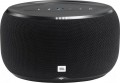 | 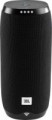 |
|---|---|---|
| JBL Link 300 | JBL Link 20 | |
from £89.99 | from £99.00 | |
| TOP sellers | ||
High sound quality. Support for devices with Google Cast. The voice assistant only works in English. Lack of autonomous power supply. | High sound quality. Autonomous power supply (up to 10 hours). Support for devices with Google Cast. Water protection. Built-in battery. The voice assistant only works in English. | |
| Features | smart speaker | smart speaker |
| Number of channels | 2.0 | 2.0 |
Tech specs | ||
| System power | 50 W | 20 W |
| Power per channel | 25 W | 10 W |
| Number of bands | 2 | 1 |
| Frequency range | 55 – 20000 Hz | 65 – 20000 Hz |
Interfaces and features | ||
| Interfaces | Google Cast (Chromecast) Wi-Fi Bluetooth network streaming audio speakerphone | Google Cast (Chromecast) Wi-Fi Bluetooth network streaming audio speakerphone |
| More features | Google Assistant voice control mobile app Multiroom | Google Assistant voice control mobile app Multiroom |
General | ||
| Autonomous power supply | battery | |
| Dustproof, waterproof |  |  |
| Dimensions (HxWxD) | 134x236x154 mm | 210x93x93 mm |
| Weight | 1.7 kg | 0.95 kg |
| Color | ||
| Added to E-Catalog | january 2018 | december 2017 |


Compare JBL Link 300 and Link 20
You may be interested in
My comparisons
JBL Link 300 often compared

JBL Link 20 often compared


Glossary
System power
The total sound power provided by the audio system at maximum volume, in other words, the total power of all the speakers provided by the device (including the subwoofer).
The higher the power, the louder the system will sound and the larger the area it can cover. On the other hand, high power significantly affects the price, dimensions, weight and power consumption of the device. In addition, when evaluating and comparing according to this indicator, it is worth considering some nuances. Firstly, some manufacturers go to the trick and give in the characteristics not the average, but the peak sound power; such numbers can be quite impressive, but they have very little to do with real loudness. So if it seems to you that the claimed power is too high, it's ok to clarify what exactly is meant in this case. Secondly, when comparing, it is worth considering the presence of a subwoofer — it plays an auxiliary role, but it can account for more than half of the total system power. Because of this, for equal total power, a device with a subwoofer may be quieter than a model without a subwoofer: for example, a 2.0 40W system will have 20W per main channel, while a 2.1 40W model may have 20W per subwoofer, and only 10 watts for the main speakers.
The higher the power, the louder the system will sound and the larger the area it can cover. On the other hand, high power significantly affects the price, dimensions, weight and power consumption of the device. In addition, when evaluating and comparing according to this indicator, it is worth considering some nuances. Firstly, some manufacturers go to the trick and give in the characteristics not the average, but the peak sound power; such numbers can be quite impressive, but they have very little to do with real loudness. So if it seems to you that the claimed power is too high, it's ok to clarify what exactly is meant in this case. Secondly, when comparing, it is worth considering the presence of a subwoofer — it plays an auxiliary role, but it can account for more than half of the total system power. Because of this, for equal total power, a device with a subwoofer may be quieter than a model without a subwoofer: for example, a 2.0 40W system will have 20W per main channel, while a 2.1 40W model may have 20W per subwoofer, and only 10 watts for the main speakers.
Power per channel
Nominal sound power (see "System power") on each of the main channels of the audio system. This indicator is most often indicated in models with a subwoofer (see "Number of channels"); knowing it, you can estimate the power distribution between the main speakers and the subwoofer.
Number of bands
The number of distinct frequency ranges (bands) into which sound is divided when played through the acoustics of an audio system. For each such band, a separate speaker is provided, and sometimes several.
The simplest option provides 1 lane; it is very popular in modern audio systems, because. requires a minimum number of speakers, and the sound quality can be quite good. More advanced options provide 2-3 bands (low and high frequencies, or bass, treble and medium), and in high-end models, the number of bands can be up to five. Note that, in addition to integers, models are also produced with a fractional number of stripes — for example, 2.5 or 3.5. This marking indicates the presence in the design of a speaker responsible for two bands at once: for example, model 2.5 has separate speakers for bass and treble plus a combined bass + midrange (similar in design to bass, but also loaded with mid frequencies).
Anyway, the abundance of bands, usually, indicates a high class of acoustics: the more separate frequency ranges, the narrower the specialization of each speaker, the more accurately it is able to reproduce its part of the signal, and the more complex the system is.
The simplest option provides 1 lane; it is very popular in modern audio systems, because. requires a minimum number of speakers, and the sound quality can be quite good. More advanced options provide 2-3 bands (low and high frequencies, or bass, treble and medium), and in high-end models, the number of bands can be up to five. Note that, in addition to integers, models are also produced with a fractional number of stripes — for example, 2.5 or 3.5. This marking indicates the presence in the design of a speaker responsible for two bands at once: for example, model 2.5 has separate speakers for bass and treble plus a combined bass + midrange (similar in design to bass, but also loaded with mid frequencies).
Anyway, the abundance of bands, usually, indicates a high class of acoustics: the more separate frequency ranges, the narrower the specialization of each speaker, the more accurately it is able to reproduce its part of the signal, and the more complex the system is.
Frequency range
The total frequency range reproduced by the acoustics of an audio system. Measured from the lower threshold of the lowest frequency speaker to the upper threshold of the highest frequency: for example, in a 2.1 system with main speakers at 100 – 22000 Hz and a subwoofer at 20 – 150 Hz, the total value will be 20 – 22000 Hz.
In general, the wider the frequency range, the fuller the reproduced sound will be, the less low and high frequencies will be lost due to insufficient acoustic capabilities. On the other hand, do not forget that the actual sound quality also depends on a number of other parameters — primarily the frequency response. In addition, human audible frequencies range from 16 Hz to 22 kHz; deviations from these values are very small, and the upper limit also decreases with age. Therefore, from a practical point of view, it does not make sense to provide too large a frequency range; and impressive performances like 10 – 50000 Hz, found in top-class models, are usually more of a kind of "side effect" of high-quality speakers (and at the same time — a marketing ploy) than a really significant moment.
In general, the wider the frequency range, the fuller the reproduced sound will be, the less low and high frequencies will be lost due to insufficient acoustic capabilities. On the other hand, do not forget that the actual sound quality also depends on a number of other parameters — primarily the frequency response. In addition, human audible frequencies range from 16 Hz to 22 kHz; deviations from these values are very small, and the upper limit also decreases with age. Therefore, from a practical point of view, it does not make sense to provide too large a frequency range; and impressive performances like 10 – 50000 Hz, found in top-class models, are usually more of a kind of "side effect" of high-quality speakers (and at the same time — a marketing ploy) than a really significant moment.
Autonomous power supply
Type of independent power sourceused in the audio system. Such power is usually not the only option — it only complements the ability to work from the network.
— AA batteries. Replaceable elements of a standard size, colloquially known as "finger". Available in a variety of options, varying in quality and price, available not only as disposable batteries, but also as rechargeable batteries; sold almost everywhere. The main advantage of all replaceable cells is the ability to quickly change dead batteries for fresh ones (of course, if there is a reserve), while the original battery has to be charged — and this takes time and an external power source. As for AA, they have a relatively low power and capacity. These characteristics are sufficient for relatively compact devices; however, for models that need to power mechanical drives (for example, for CDs) and/or provide high sound power, “AA” batteries are poorly suited, and therefore are rarely used in them.
— AAA batteries. Replaceable elements, known as "mini-finger" or "little fingers". In general, they are similar to the AAs described above and differ from them only in small sizes and, as a result, less power. Because of this, such power is used only in the most compact models of audio systems, which do not require high power, but small sizes are crucial.
— Batteries C. Replaceable cells known as "Baby". The features of replaceable cells are generally desc...ribed in AA Batteries above; here we note that C batteries have a cylindrical shape and are similar in length to “finger-type” batteries, but are much thicker, due to which they are distinguished by higher power and can be used in rather “gluttonous” systems.
— D batteries. Replacement cells, the largest variety of standard cylindrical batteries used in modern audio systems. Used in the most powerful models that require a large amount of energy.
— Batteries. This parameter is indicated in our catalog in two cases: if the device uses standard replaceable elements that do not belong to any of the standard sizes described above, or if the battery size is not indicated in the manufacturer's official data.
— Accumulator. Powered by its own original battery, which is not related to standard sizes, and in some models is also non-removable. On the one hand, this option eliminates the need to constantly buy replacement batteries (or significantly spend money once on rechargeable batteries), moreover, the battery is usually supplied as a kit. However, when the charge is exhausted, in most cases the only option is to charge from an external power source — and this requires not only the presence of such a source, but also a fairly large amount of time.
— AA batteries. Replaceable elements of a standard size, colloquially known as "finger". Available in a variety of options, varying in quality and price, available not only as disposable batteries, but also as rechargeable batteries; sold almost everywhere. The main advantage of all replaceable cells is the ability to quickly change dead batteries for fresh ones (of course, if there is a reserve), while the original battery has to be charged — and this takes time and an external power source. As for AA, they have a relatively low power and capacity. These characteristics are sufficient for relatively compact devices; however, for models that need to power mechanical drives (for example, for CDs) and/or provide high sound power, “AA” batteries are poorly suited, and therefore are rarely used in them.
— AAA batteries. Replaceable elements, known as "mini-finger" or "little fingers". In general, they are similar to the AAs described above and differ from them only in small sizes and, as a result, less power. Because of this, such power is used only in the most compact models of audio systems, which do not require high power, but small sizes are crucial.
— Batteries C. Replaceable cells known as "Baby". The features of replaceable cells are generally desc...ribed in AA Batteries above; here we note that C batteries have a cylindrical shape and are similar in length to “finger-type” batteries, but are much thicker, due to which they are distinguished by higher power and can be used in rather “gluttonous” systems.
— D batteries. Replacement cells, the largest variety of standard cylindrical batteries used in modern audio systems. Used in the most powerful models that require a large amount of energy.
— Batteries. This parameter is indicated in our catalog in two cases: if the device uses standard replaceable elements that do not belong to any of the standard sizes described above, or if the battery size is not indicated in the manufacturer's official data.
— Accumulator. Powered by its own original battery, which is not related to standard sizes, and in some models is also non-removable. On the one hand, this option eliminates the need to constantly buy replacement batteries (or significantly spend money once on rechargeable batteries), moreover, the battery is usually supplied as a kit. However, when the charge is exhausted, in most cases the only option is to charge from an external power source — and this requires not only the presence of such a source, but also a fairly large amount of time.
Dustproof, waterproof
The presence in the audio system of additional protection against dust and moisture.
This feature will be useful if the device is planned to be used outdoors (for example, at a picnic, at a cafe in the summer area, etc.) or in a room with not very favorable conditions (like a garage or a workshop with constantly open gates). Note that the specific degree of dust and water protection in different models can be different: some devices are designed for a maximum of rain without strong winds, others are able to endure even complete immersion in water without consequences. These points should be clarified separately. However, anyway, audio systems with dust and water protection will be more resistant to extreme conditions than models without this feature.
This feature will be useful if the device is planned to be used outdoors (for example, at a picnic, at a cafe in the summer area, etc.) or in a room with not very favorable conditions (like a garage or a workshop with constantly open gates). Note that the specific degree of dust and water protection in different models can be different: some devices are designed for a maximum of rain without strong winds, others are able to endure even complete immersion in water without consequences. These points should be clarified separately. However, anyway, audio systems with dust and water protection will be more resistant to extreme conditions than models without this feature.