
Comparison Ugreen PB205 vs Ugreen PB165
Add to comparison | 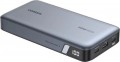 | 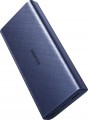 |
|---|---|---|
| Ugreen PB205 | Ugreen PB165 | |
| Compare prices 9 | Outdated Product | |
| User reviews | ||
| TOP sellers | ||
| Battery capacity | 25000 mAh 90 W*h | 20000 mAh 74 W*h |
| Real capacity | 15700 mAh | 12600 mAh |
| Battery type | Li-Pol | Li-Pol |
Charging gadgets / outputs | ||
| USB-C | 2 pcs | 2 pcs |
| USB-A | 1 pcs | 1 pcs |
| USB-C1 | 140 W | 45 W |
| USB-C2 | 65 W | 20 W |
| USB-A1 | 22.5 W | 18 W |
| Power output (all ports) | 120 W | |
Power bank charging | ||
| Power bank charging inputs | USB-C | USB-C |
| Power bank charge power | 65 W | 30 W |
| Full charge time | 2 h | |
Features | ||
| Low current charging |  |  |
| Pass-through charging | | |
| Fast charge | Quick Charge 3.0 Power Delivery 3.1 | Quick Charge 3.0 Power Delivery 3.0 |
| Bundled cables (adapters) | USB-C | |
| Features | info display | |
General | ||
| Body material | plastic | plastic |
| Dimensions | 160x80x20 mm | 144x67x25 mm |
| Weight | 513 g | 383 g |
| Color | ||
| Added to E-Catalog | november 2023 | june 2023 |





Compare Ugreen PB205 and PB165
Price comparison
You may be interested in
My comparisons
Ugreen PB205 often compared


Ugreen PB165 often compared


Glossary
Battery capacity
The capacity of a powerbank indicates the amount of energy it can store and is usually specified in two formats in the specifications — mAh and Wh. The mAh value is more familiar to most buyers and helps quickly understand the class of the model, while Wh more accurately reflects the total energy reserve and is more convenient for a more accurate comparison of devices.
For example, a powerbank with 10000 mAh usually has about 37 Wh, a model with 20000 mAh — approximately 74 Wh, and a version with 30000 mAh — about 111 Wh. The higher these values, the more charges for a smartphone, headphones, watch, or other devices can be expected, but the larger, heavier, and usually more expensive the device becomes.
At the same time, it is important to remember that the actual output is always lower than the nominal figures due to energy conversion losses. Therefore, capacity is one of the main parameters that immediately shows whether the powerbank is suitable for a day's backup or for more serious autonomous use.
Real capacity
The real capacity of the power bank.
Real capacity is the amount of energy that a power bank is able to transfer to rechargeable gadgets. This amount is inevitably lower than the nominal capacity (see above) — most often by about 1.6 times (due to the fact that part of the energy goes to additional features and transmission losses). However, it is by real capacity that it is easiest to evaluate the actual capabilities of an external battery: for example, if this figure is 6500 mAh, this model is guaranteed to be enough for two full charges of a smartphone with a 3000 mAh battery and smartwatches for 250 mAh.
The capacity in this case is indicated for 5 V — the standard USB charging voltage. At the same time, the features of milliamp-hours as a unit of capacity are such that the actual amount of energy in the battery depends not only on the number of mAh, but also on the operating voltage. In fact, this means that when using fast charging technologies (see below) that involve increased voltage, the actual value of the actual capacity will differ from the claimed one (it will be lower). There are formulas and methods for calculating this value, they can be found in special sources.
Real capacity is the amount of energy that a power bank is able to transfer to rechargeable gadgets. This amount is inevitably lower than the nominal capacity (see above) — most often by about 1.6 times (due to the fact that part of the energy goes to additional features and transmission losses). However, it is by real capacity that it is easiest to evaluate the actual capabilities of an external battery: for example, if this figure is 6500 mAh, this model is guaranteed to be enough for two full charges of a smartphone with a 3000 mAh battery and smartwatches for 250 mAh.
The capacity in this case is indicated for 5 V — the standard USB charging voltage. At the same time, the features of milliamp-hours as a unit of capacity are such that the actual amount of energy in the battery depends not only on the number of mAh, but also on the operating voltage. In fact, this means that when using fast charging technologies (see below) that involve increased voltage, the actual value of the actual capacity will differ from the claimed one (it will be lower). There are formulas and methods for calculating this value, they can be found in special sources.
USB-C1
The power capacity of the main USB-C port, which among USB-C connectors is typically the most powerful. This specification is especially important for smartphones with fast charging, tablets, portable consoles, and laptops that require increased power supply.
Values around 18 – 30 W are usually sufficient for fast charging smartphones, 45 – 65 W are suitable for portable consoles, some ultrabooks, and other more demanding devices, and 100 W and above are even designed for powerful laptops and heavy loads.
Values around 18 – 30 W are usually sufficient for fast charging smartphones, 45 – 65 W are suitable for portable consoles, some ultrabooks, and other more demanding devices, and 100 W and above are even designed for powerful laptops and heavy loads.
USB-C2
Maximum output power of the second USB-C port, which usually lags behind USB-C1, but can still be suitable for fast charging smartphones, portable consoles, and other modern devices.
USB-A1
The power on USB-A1 port shows the maximum output power of the main USB-A port, which among USB-A connectors is usually the most powerful. Values around 10 – 18 W are typically sufficient for regular or fast charging of smartphones, 22.5 – 33 W are already interesting for faster charging of compatible models, while higher values for USB-A are significantly rarer than for USB-C. Compared to USB-A2, USB-A3, or USB-A4, it often makes more sense to connect the most demanding device to USB-A1 if maximum speed from this type of port is needed.
However, the USB-A format itself is already less promising today than USB-C, so such a port is more often used for smartphones, headphones, watches, speakers, and other mobile devices rather than heavy-duty applications like laptops.
However, the USB-A format itself is already less promising today than USB-C, so such a port is more often used for smartphones, headphones, watches, speakers, and other mobile devices rather than heavy-duty applications like laptops.
Power output (all ports)
The total charge power provided by the power bank on all connectors overnight - when devices are connected simultaneously to all charging ports.
This parameter is given due to the fact that the total charge power does not always correspond to the sum of the maximum powers of all available ports. The built-in battery of a power bank often has its own limitation on the output power. Therefore, for example, in a model with two 18 W USB ports, each total charge power can be the same 18 W. Note that the distribution of power among the connectors may be different: in some models it is divided equally, in others it is divided in proportion to the maximum current strength (if it differs on different ports). These nuances should be clarified using the detailed characteristics of the charging connectors.
If you plan to regularly use all power bank connectors at once, you should pay attention to this indicator.
This parameter is given due to the fact that the total charge power does not always correspond to the sum of the maximum powers of all available ports. The built-in battery of a power bank often has its own limitation on the output power. Therefore, for example, in a model with two 18 W USB ports, each total charge power can be the same 18 W. Note that the distribution of power among the connectors may be different: in some models it is divided equally, in others it is divided in proportion to the maximum current strength (if it differs on different ports). These nuances should be clarified using the detailed characteristics of the charging connectors.
If you plan to regularly use all power bank connectors at once, you should pay attention to this indicator.
Power bank charge power
The power in watts at which the power bank is charged under normal conditions.
The higher the charging power, the less time it takes to charge (given the same battery capacity). For example, fast charging of a power bank typically means a charging power of 30W or more. However, this parameter does not directly affect compatibility with charging devices: modern portable batteries can work with chargers of both higher and lower power. In the first case, the battery controller will automatically limit the charging current, while in the second case, charging will simply take more time.
The higher the charging power, the less time it takes to charge (given the same battery capacity). For example, fast charging of a power bank typically means a charging power of 30W or more. However, this parameter does not directly affect compatibility with charging devices: modern portable batteries can work with chargers of both higher and lower power. In the first case, the battery controller will automatically limit the charging current, while in the second case, charging will simply take more time.
Full charge time
The time required to fully charge a battery discharged “to zero”. Features of the charging process in different models may be different, respectively, and the time required for this may differ markedly even with the same capacity.
Fast-charging batteries tend to be more expensive. Therefore, choosing this option makes sense if you do not have much time to replenish your energy supply — for example, for hiking. However, keep in mind that charging at full speed may require a charger that supports certain fast charging technologies (see below).
It must also be said that in most modern batteries, the charging speed is uneven — it is highest at the several first percent from zero, then gradually decreases. Therefore, the time required to replenish the energy supply by a certain percentage will not be strictly proportional to the total claimed charge time; moreover, this time will depend on how much the battery is already charged at the time the procedure starts. For example, charging from 0 to 50% will take less time than from 50 to 100%, although both there and there we are talking about half the capacity.
Fast-charging batteries tend to be more expensive. Therefore, choosing this option makes sense if you do not have much time to replenish your energy supply — for example, for hiking. However, keep in mind that charging at full speed may require a charger that supports certain fast charging technologies (see below).
It must also be said that in most modern batteries, the charging speed is uneven — it is highest at the several first percent from zero, then gradually decreases. Therefore, the time required to replenish the energy supply by a certain percentage will not be strictly proportional to the total claimed charge time; moreover, this time will depend on how much the battery is already charged at the time the procedure starts. For example, charging from 0 to 50% will take less time than from 50 to 100%, although both there and there we are talking about half the capacity.
Low current charging
Low current charging allows you to seamlessly charge devices that do not require high current. This allows you to extend the life cycle of the devices and protect them as much as possible during charging. Such devices include smartwatches, headphones, headsets, etc.