
Comparison Tenda TX2 vs Tenda TX2 Pro
Add to comparison |  | 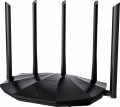 |
|---|---|---|
| Tenda TX2 | Tenda TX2 Pro | |
| Outdated Product | from £51.19 | |
| User reviews | ||
| TOP sellers | ||
| Product type | router | router |
| Data input (WAN-port) | Ethernet (RJ45) Wi-Fi | Ethernet (RJ45) Wi-Fi |
Wireless Wi-Fi connection | ||
| Wi-Fi standards | Wi-Fi 3 (802.11g) Wi-Fi 4 (802.11n) Wi-Fi 5 (802.11ac) Wi-Fi 6 (802.11ax) | Wi-Fi 3 (802.11g) Wi-Fi 4 (802.11n) Wi-Fi 5 (802.11ac) Wi-Fi 6 (802.11ax) |
| Frequency band | 2.4GHz 5 GHz | 2.4GHz 5 GHz |
| Operating ranges | dual-band (2.4 GHz and 5 GHz) | dual-band (2.4 GHz and 5 GHz) |
| Wireless speed 2.4 GHz | 300 Mbps | 300 Mbps |
| Wireless speed 5 GHz | 1201 Mbps | 1201 Mbps |
| Bandwidth | 80 MHz | |
Connection and LAN | ||
| WAN | 1 port 1 Gbps | 1 port 1 Gbps |
| LAN | 3 ports 1 Gbps | 3 ports 1 Gbps |
Antenna and transmitter | ||
| Number of antennas | 4 | 5 |
| Antenna type | external | external |
| MU-MIMO |  | |
| Gain | 6 dBi | 6 dBi |
| Transmitter power | 23 dBm | 23 dBm |
| Signal strength 2.4 GHz | 20 dBm | 20 dBm |
| Signal strength 5 GHz | 23 dBm | 23 dBm |
Functions | ||
| Features | NAT repeater Beamforming firewall | NAT repeater Beamforming firewall |
| More features | DHCP server DDNS DMZ | DHCP server DDNS DMZ |
Security | ||
| Safety standards | WPA WEP WPA2 WPA3 | WPA WEP WPA2 WPA3 |
General | ||
| Operating temperature | 0 °C ~ +40 °C | 0 °C ~ +40 °C |
| Dimensions | 239x144x40 mm | 239x144x40 mm |
| Color | ||
| Added to E-Catalog | april 2024 | january 2023 |


Compare Tenda TX2 and TX2 Pro
You may be interested in
Tenda TX2 often compared


Tenda TX2 Pro often compared


Glossary
Bandwidth
- 160 MHz. The presence of a bandwidth of 160 MHz increases the throughput for data transmission and allows it to approach the maximum theoretical speed.
- 320 MHz. The bandwidth of 320 MHz was introduced in the Wi-Fi 7 standard (see the corresponding paragraph). It provides a significant increase in the speed of data exchange - twice as much compared to the width of the wireless channel of 160 MHz.
- 320 MHz. The bandwidth of 320 MHz was introduced in the Wi-Fi 7 standard (see the corresponding paragraph). It provides a significant increase in the speed of data exchange - twice as much compared to the width of the wireless channel of 160 MHz.
Number of antennas
The total number of antennas (of all types — see below) provided in the design of the device.
In modern Wi-Fi equipment, this indicator can be different: in addition to the simplest devices with 1 antenna, there are models where this number is 2, 3, 4 and even more. The point of using multiple antennas is twofold. Firstly, if there are several external devices per antenna, they have to share the bandwidth among themselves, and the actual communication speed for each subscriber drops accordingly. Secondly, such a design may also be required when communicating with one external device — to work with MU-MIMO technology (see below), which allows you to fully realize the capabilities of modern Wi-Fi standards.
Anyway, more antennas, usually, means a more advanced and functional device. On the other hand, this parameter significantly affects the cost; so specifically looking for equipment with numerous antennas makes sense mainly when the speed and stability of communication are critical.
Note that antennas intended for mobile communications may also be considered in this clause. So when choosing a model with support for mobile networks, it's ok to clarify this point.
In modern Wi-Fi equipment, this indicator can be different: in addition to the simplest devices with 1 antenna, there are models where this number is 2, 3, 4 and even more. The point of using multiple antennas is twofold. Firstly, if there are several external devices per antenna, they have to share the bandwidth among themselves, and the actual communication speed for each subscriber drops accordingly. Secondly, such a design may also be required when communicating with one external device — to work with MU-MIMO technology (see below), which allows you to fully realize the capabilities of modern Wi-Fi standards.
Anyway, more antennas, usually, means a more advanced and functional device. On the other hand, this parameter significantly affects the cost; so specifically looking for equipment with numerous antennas makes sense mainly when the speed and stability of communication are critical.
Note that antennas intended for mobile communications may also be considered in this clause. So when choosing a model with support for mobile networks, it's ok to clarify this point.