
Comparison LG S40T vs LG SQC2
Add to comparison | 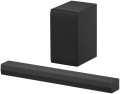 |  |
|---|---|---|
| LG S40T | LG SQC2 | |
| Compare prices 3 | from £277.02 | |
| TOP sellers | ||
| Audio format | 2.1 | 2.1 |
| Mount type | shelf / wall | shelf / wall |
| Virtual surround sound |  |  |
| Ultra HD (4K) | | |
Tech specs | ||
| Rated power | 300 W | 300 W |
| Soundbar speaker power | 100 W | |
| Impedance | 4 Ohm | |
| Sensitivity | 82 dB | |
Subwoofer | ||
| Wireless subwoofer | | |
| Acoustic design | bass-reflex type | bass-reflex type |
| Subwoofer power | 200 W | |
| Subwoofer speaker size | 152 mm | |
| Subwoofer dimensions (WxHxD) | 171x320x252 mm | 171x320x252 mm |
| Subwoofer weight | 4.2 kg | 4.2 kg |
Interfaces | ||
| Interfaces | Bluetooth | Bluetooth |
| Audio decoders | DTS Dolby Digital | DTS Dolby Digital |
Connectors | ||
| Inputs | USB-A optical | mini-Jack (3.5 mm) optical |
| HDMI output | 1 pc | |
Speakers | ||
| Number of speakers | 6 шт | |
| Tweeter size | 20 mm | |
| Midrange speaker size | 51 mm | |
General | ||
| Control | remote control TV remote control from smartphone | remote control TV remote control from smartphone |
| Power consumption | 57 W | 60 W |
| Dimensions (WxHxD) | 720x63x87 mm | 950x71x47 mm |
| Projector weight | 1.65 kg | 2.47 kg |
| Color | ||
| Added to E-Catalog | october 2024 | december 2023 |



Compare LG S40T and SQC2
You may be interested in
LG S40T often compared


LG SQC2 often compared
Glossary
Virtual surround sound
The projector supports the virtual surround function.
The purpose of this feature is that due to special sound settings and the reflection of sound beams from the walls of the room, the listener hears more channels than are actually available in the projector (see "Audio Format"). For example, a 3.1 system with virtual surround sound can produce sound similar to 5.1 surround sound. This allows you to achieve the effect of "immersion" in sound without increasing the number of channels and the cost of the projector. On the other hand, the reliability of such sound is usually noticeably worse than that of real surround sound, and the overall quality is highly dependent on the characteristics of a particular room.
Note that the virtual surround function is specified for 2.0, 2.1, 3.0, 3.1 format systems. In more advanced multi-channel systems, there are a priori additional channels for reproducing surround sound.
The purpose of this feature is that due to special sound settings and the reflection of sound beams from the walls of the room, the listener hears more channels than are actually available in the projector (see "Audio Format"). For example, a 3.1 system with virtual surround sound can produce sound similar to 5.1 surround sound. This allows you to achieve the effect of "immersion" in sound without increasing the number of channels and the cost of the projector. On the other hand, the reliability of such sound is usually noticeably worse than that of real surround sound, and the overall quality is highly dependent on the characteristics of a particular room.
Note that the virtual surround function is specified for 2.0, 2.1, 3.0, 3.1 format systems. In more advanced multi-channel systems, there are a priori additional channels for reproducing surround sound.
Ultra HD (4K)
The ability of the projector to output a video signal in Ultra HD (4K) resolution — 3840x2160. This is the highest resolution used in modern consumer video equipment — 4 times higher than Full HD. However, note that this feature significantly affects the price of the projector, and to view such a video signal, you will need an appropriate screen. Therefore, it makes sense to specifically look for an UltraHD device only if you initially plan to connect it to a screen of the appropriate resolution.
This feature requires the projector to have at least one HDMI output (see below). In this case, the video signal source can be either an external device or the projector itself, operating in the format of a media centre (for example, a model with direct playback from USB media).
This feature requires the projector to have at least one HDMI output (see below). In this case, the video signal source can be either an external device or the projector itself, operating in the format of a media centre (for example, a model with direct playback from USB media).
Soundbar speaker power
The nominal power of the speakers installed directly in the soundbar, excluding the subwoofer (in models with a built-in subwoofer, respectively, only the power of the main speakers is taken into account).
This indicator directly determines the overall volume of the sound projector; It is worth choosing according to this parameter taking into account the specifics of the room in which the projector is planned to be installed: the larger the room and the greater the distance to the viewer, the higher the power should be, otherwise the soundbar will not be able to effectively sound the scene. Detailed recommendations on the optimal power for different situations can be found in special sources.
This indicator directly determines the overall volume of the sound projector; It is worth choosing according to this parameter taking into account the specifics of the room in which the projector is planned to be installed: the larger the room and the greater the distance to the viewer, the higher the power should be, otherwise the soundbar will not be able to effectively sound the scene. Detailed recommendations on the optimal power for different situations can be found in special sources.
Impedance
Impedance is the projector's resistance to alternating current, or more precisely, to the analog audio signal input from an external power amplifier. Actually, this parameter is of practical importance precisely if the device is planned to be used with an external amplifier. Ideally, the projector's impedance should match the impedance for which the amplifier is designed - otherwise, the volume may either decrease (if the impedance is too high), or distortion, overload, and even damage to the acoustics (if the impedance is too low) may occur.
Higher impedance is also thought to reduce the likelihood of interference. However, modern speakers (including sound projectors) have standard impedance values of 4, 6 or 8 ohms - the difference is not so great that the differences in sound quality are noticeable.
Higher impedance is also thought to reduce the likelihood of interference. However, modern speakers (including sound projectors) have standard impedance values of 4, 6 or 8 ohms - the difference is not so great that the differences in sound quality are noticeable.
Sensitivity
The sensitivity value determines the volume of the projector when a signal of a certain power is applied to it. Given the same input power and impedance, a more sensitive system will produce higher volume.
This parameter is important primarily when operating the projector with an external amplifier. At the same time, models with values up to 88 dB are considered low sensitivity, 88 – 92 dB are considered medium, and more than 92 dB are considered high sensitivity.
This parameter is important primarily when operating the projector with an external amplifier. At the same time, models with values up to 88 dB are considered low sensitivity, 88 – 92 dB are considered medium, and more than 92 dB are considered high sensitivity.
Subwoofer power
The rated power of the subwoofer included in the design or delivery of the sound projector.
The higher the power, the louder the sub can sound, the richer the bass it can provide. On the other hand, an increase in power inevitably promises an increase in the size and cost of the speaker. Therefore, an overly powerful subwoofer is just as undesirable as one that is too weak. Detailed recommendations for selecting power for the size and acoustic characteristics of a particular room can be found in special sources.
Note that the external subwoofer in soundbars should be approximately twice as powerful as the soundbar in order to prevent sound sags at maximum volume. So, if the total output power of the speaker system is 300 watts, then 100 of them should come from the soundbar alone, and 200 should go directly to the subwoofer.
The higher the power, the louder the sub can sound, the richer the bass it can provide. On the other hand, an increase in power inevitably promises an increase in the size and cost of the speaker. Therefore, an overly powerful subwoofer is just as undesirable as one that is too weak. Detailed recommendations for selecting power for the size and acoustic characteristics of a particular room can be found in special sources.
Note that the external subwoofer in soundbars should be approximately twice as powerful as the soundbar in order to prevent sound sags at maximum volume. So, if the total output power of the speaker system is 300 watts, then 100 of them should come from the soundbar alone, and 200 should go directly to the subwoofer.
Subwoofer speaker size
The diameter of the speaker in the subwoofer used by the sound projector.
It is believed that the larger the speaker, the louder the sub and the deeper and richer sound it can provide. Models up to 200 mm in size are entry level; This is exactly the size that built-in subwoofers usually have (see above). But free-standing bass speakers can use larger speakers, up to 254 mm (10").
It is believed that the larger the speaker, the louder the sub and the deeper and richer sound it can provide. Models up to 200 mm in size are entry level; This is exactly the size that built-in subwoofers usually have (see above). But free-standing bass speakers can use larger speakers, up to 254 mm (10").
Inputs
— USB-A. This refers to a USB port that allows you to connect external drives (flash drives, hard drives) to the projector and play content directly from them. Models with video outputs (see below) can often function as a media center, outputting video signals to a TV or another external screen.
— USB-C. Used in soundbars for transmitting digital audio with minimal quality loss, replacing traditional AUX and optical ports. Unlike analog connections, USB-C transmits sound without distortion and can support high-resolution audio streams, including Hi-Res formats. It also allows for simultaneous audio and power transmission, simplifying the connection to devices. However, this port is mainly relevant for portable devices, and its primary purpose is to connect a soundbar to a laptop.
— mini-Jack (3.5 mm). The 3.5 mm jack can be used in various interfaces; in this case, it refers to a line audio input with a mini-Jack socket. This input is mainly used to connect portable audio equipment (players, smartphones) to a sound projector.
— RCA. Technically, RCA (commonly called "tulip") is a type of connector that can be used in different interfaces. However, the term "RCA input" usually refers to line inputs for connecting an analog stereo signal. Note that this input consists of two RCA cable sockets, as one cable ca...n only transmit one audio channel.
— Optical. Connector for connecting a digital audio signal via a TOSLINK fiber optic cable. This interface allows for multi-channel sound transmission and is practically immune to electrical interference; its drawback is the fragility of the cable.
— Coaxial S/P-DIF. Connector for connecting a digital audio signal via an electrical cable with an RCA connector (not to be confused with the line RCA described above). Similar to the optical input described above, including the ability to transmit multi-channel sound through a single connector. At the same time, the coaxial cable is less delicate but more sensitive to electrical interference (therefore, a specially shielded cable is preferable for such a connection).
— Composite. This refers to not a full-size composite interface of three connectors, allowing audio and video signal transmission, but only one connector for working with video. Since sound projectors do not reproduce images, the composite input is used to transmit a video signal through the projector to another device, such as a TV. The composite video interface does not support HD and lacks high quality; on the other hand, it is widely used and can work even with outdated video equipment. This input usually uses a yellow RCA ("tulip") connector.
— Component. An input designed to receive an analog video signal for further transmission to another device—TV, video projector, etc. This connection usually uses three RCA connectors, each transmitting its component of the video signal (hence the name). Thanks to this, the component interface offers good bandwidth and picture quality, supports HD, and is considered the most advanced modern standard for analog video.
— IR Control Input. A connector for connecting an external infrared remote control receiver. When correctly positioned, this receiver allows the use of a remote control even from locations where the signal from the remote cannot reach the main (built-in) sensor—such as another room. Note that the receiver can be a specialized device or another component of the audio system—such as an amplifier with an IR control output.
— USB-C. Used in soundbars for transmitting digital audio with minimal quality loss, replacing traditional AUX and optical ports. Unlike analog connections, USB-C transmits sound without distortion and can support high-resolution audio streams, including Hi-Res formats. It also allows for simultaneous audio and power transmission, simplifying the connection to devices. However, this port is mainly relevant for portable devices, and its primary purpose is to connect a soundbar to a laptop.
— mini-Jack (3.5 mm). The 3.5 mm jack can be used in various interfaces; in this case, it refers to a line audio input with a mini-Jack socket. This input is mainly used to connect portable audio equipment (players, smartphones) to a sound projector.
— RCA. Technically, RCA (commonly called "tulip") is a type of connector that can be used in different interfaces. However, the term "RCA input" usually refers to line inputs for connecting an analog stereo signal. Note that this input consists of two RCA cable sockets, as one cable ca...n only transmit one audio channel.
— Optical. Connector for connecting a digital audio signal via a TOSLINK fiber optic cable. This interface allows for multi-channel sound transmission and is practically immune to electrical interference; its drawback is the fragility of the cable.
— Coaxial S/P-DIF. Connector for connecting a digital audio signal via an electrical cable with an RCA connector (not to be confused with the line RCA described above). Similar to the optical input described above, including the ability to transmit multi-channel sound through a single connector. At the same time, the coaxial cable is less delicate but more sensitive to electrical interference (therefore, a specially shielded cable is preferable for such a connection).
— Composite. This refers to not a full-size composite interface of three connectors, allowing audio and video signal transmission, but only one connector for working with video. Since sound projectors do not reproduce images, the composite input is used to transmit a video signal through the projector to another device, such as a TV. The composite video interface does not support HD and lacks high quality; on the other hand, it is widely used and can work even with outdated video equipment. This input usually uses a yellow RCA ("tulip") connector.
— Component. An input designed to receive an analog video signal for further transmission to another device—TV, video projector, etc. This connection usually uses three RCA connectors, each transmitting its component of the video signal (hence the name). Thanks to this, the component interface offers good bandwidth and picture quality, supports HD, and is considered the most advanced modern standard for analog video.
— IR Control Input. A connector for connecting an external infrared remote control receiver. When correctly positioned, this receiver allows the use of a remote control even from locations where the signal from the remote cannot reach the main (built-in) sensor—such as another room. Note that the receiver can be a specialized device or another component of the audio system—such as an amplifier with an IR control output.
HDMI output
The number of HDMI outputs in the design of the sound projector.
HDMI is the most popular modern interface for working with HD content, it allows you to transmit high-definition video simultaneously with multi-channel audio over a single cable. If you have multiple outputs, you can connect multiple signal receivers to the projector at the same time and switch between them from the remote control without touching the wires.
HDMI is the most popular modern interface for working with HD content, it allows you to transmit high-definition video simultaneously with multi-channel audio over a single cable. If you have multiple outputs, you can connect multiple signal receivers to the projector at the same time and switch between them from the remote control without touching the wires.