
Comparison Yamaha PSR-EW320 vs Yamaha PSR-EW310
Add to comparison |  | 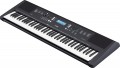 |
|---|---|---|
| Yamaha PSR-EW320 | Yamaha PSR-EW310 | |
| Compare prices 3 | from £496.23 | |
| TOP sellers | ||
| Type | synthesizer (rompler) | synthesizer (rompler) |
Keys | ||
| Number of keys | 76 | 76 |
| Size | full size | full size |
| Mechanics | active | active |
| Rigidity | semi-weighted | semi-weighted |
Specs | ||
| Polyphony | 48 voices | 48 voices |
| Built-in timbres | 650 шт | 622 шт |
| Auto accompaniment |  | |
| Accompaniment styles | 260 шт | 205 шт |
| Learning mode | | |
| Tempo change | 11 – 280 | 11 – 280 |
| Metronome | | |
| Sequencer (recording) | | |
| Built-in compositions | | |
Effects and control | ||
| Timbres layering | | |
| Keyboard split | | |
| Arpeggiator | | |
| Reverberation | | |
| Chorus | | |
| Transposition | | |
| Pitch controller | | |
| Fine tuning | | |
Connectors | ||
| Inputs | mini-Jack (3.5 mm) | mini-Jack (3.5 mm) |
| Connectable pedals | 1 шт | 1 шт |
| Outputs | USB to host (type B) headphones | USB to host (type B) headphones |
| Linear outputs | 1 | 1 |
In box | ||
| In box | music stand | music stand |
General | ||
| Built-in acoustics | 5 W | 5 W |
| Number of bands | 1 | 1 |
| Display | monochrome | monochrome |
| Power consumption | 5 W | 8 W |
| Autonomous power supply | aA batteries | aA batteries |
| Dimensions (WxHxD) | 1148x105x317 mm | 1151x118x369 mm |
| Weight | 5.2 kg | 5.4 kg |
| Color | ||
| Added to E-Catalog | september 2024 | march 2021 |




Compare Yamaha PSR-EW320 and PSR-EW310
Price comparison
You may be interested in
My comparisons
Yamaha PSR-EW320 often compared


Yamaha PSR-EW310 often compared


Glossary
Built-in timbres
The number of built-in sounds provided in the synthesizer.
The number of timbres is often described as the number of instruments that a given model can imitate. However, this is not entirely true — rather, this parameter can be called "the number of instruments and sound effects." For example, the same instrument — an electric guitar — with different "gadgets" (distortion, overdrive) will sound differently, and in the synthesizer each such gadget will be considered a separate timbre. The “drums” timbre usually combines different types of drums and other percussion instruments — in other words, it allows you to portray both the “bass drum” and the cymbals without switching settings, just by pressing the desired keys. And some timbres may not have analogues among real instruments at all.
The more built-in timbres, the more extensive the possibilities of the synthesizer, the more diverse the sounds that can be extracted from it. At the same time, in high-end models like workstations (see "Type"), this number can reach 1000 or even more.
The number of timbres is often described as the number of instruments that a given model can imitate. However, this is not entirely true — rather, this parameter can be called "the number of instruments and sound effects." For example, the same instrument — an electric guitar — with different "gadgets" (distortion, overdrive) will sound differently, and in the synthesizer each such gadget will be considered a separate timbre. The “drums” timbre usually combines different types of drums and other percussion instruments — in other words, it allows you to portray both the “bass drum” and the cymbals without switching settings, just by pressing the desired keys. And some timbres may not have analogues among real instruments at all.
The more built-in timbres, the more extensive the possibilities of the synthesizer, the more diverse the sounds that can be extracted from it. At the same time, in high-end models like workstations (see "Type"), this number can reach 1000 or even more.
Accompaniment styles
The number of auto accompaniment styles (see above) originally provided in the synthesizer, in other words, the number of accompaniment options available to the user.
The more extensive this set, the higher the probability of finding among these melodies suitable options for a particular case. At the same time, the abundance of styles in itself is not yet a 100% guarantee that among them there will be a suitable one, especially since different synthesizer models can differ markedly in a specific set of melodies. So the list does not hurt to clarify before buying. Also note that the situation can be corrected by user styles (see below) — many synthesizers with auto accompaniment support them.
The more extensive this set, the higher the probability of finding among these melodies suitable options for a particular case. At the same time, the abundance of styles in itself is not yet a 100% guarantee that among them there will be a suitable one, especially since different synthesizer models can differ markedly in a specific set of melodies. So the list does not hurt to clarify before buying. Also note that the situation can be corrected by user styles (see below) — many synthesizers with auto accompaniment support them.
Power consumption
Rated power consumed by the tool during operation. Modern synthesizers, even the most powerful and advanced ones like workstations (see "Type"), consume very little energy — up to 100 W, and often noticeably less. Therefore, it is rarely necessary to pay attention to this parameter in fact, mainly in rather specific situations — for example, when working from an autonomous generator, when you need to take into account the entire load connected to such a power supply.