
Comparison Fossibot F800 vs 3E E7
Add to comparison | 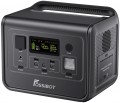 |  |
|---|---|---|
| Fossibot F800 | 3E E7 | |
from £194.65 | Outdated Product | |
| TOP sellers | ||
| In box | charging station | charging station |
| Rated power | 800 W | 700 W |
| Peak power | 1600 W | 1400 W |
| Output waveform | sinusoid (PSW) | modified sine wave |
| UPS function |  |  |
| Switchover time to battery | 10 ms | |
Outputs | ||
| Sockets (230 V) | 1 | 1 |
| USB-A | 2 pcs 5В/3A 13 W | |
| USB-A (quick charge) | 2 5В/3A, 9В/2A, 12В/1.5A 18 W | 1 24 W |
| USB-C | 3 pcs 100 W | 1 pcs 60 W |
| Wireless charging | 1 zone 10 W | |
| Car cigarette lighter | | |
Inputs (station charging) | ||
| From solar panels | | |
| Input port XT60 | | |
Battery and charging time | ||
| Battery type | LiFePO4 | Li-Ion NMC |
| Battery capacity | 512 Wh | 504 Wh |
| Charging cycles | 3500 | 800 |
| Charging time (socket) ≈ | 90 min | 60 min |
| Charging time (socket + solar panel) ≈ | 72 min | |
| Charging time (solar panel) ≈ | 150 min | |
| Charging time (cigarette lighter) ≈ | 180 min | |
| Charging power (socket) | 400 W | 420 W |
| Charging power (solar panel) | 200 W | 200 W |
| Charging power (cigarette lighter) | 120 W | |
General | ||
| PSU | built into the body | built into the body |
| Display | | |
| Backlight | | |
| Carrying handle | | |
| Operating temperature | -10 °C ~ +40 °C | 0 °C ~ +40 °C |
| Dimensions (LxWxH) | 276x209x230 mm | 280x183x207 mm |
| Weight | 6.5 kg | 5.3 kg |
| Warranty | 2 years | |
| Added to E-Catalog | october 2023 | august 2023 |


Compare Fossibot F800 and 3E E7
The charging stations Fossibot F800 and 3E E7 have their own features that may influence the user's choice. The Fossibot F800 offers a rated power of 800 W and a peak power of 1600 W, making it more powerful compared to the 3E E7 with a rated power of 700 W and peak power of 1400 W. However, the 3E E7 has a higher battery capacity (504 Wh) and a greater number of charge cycles (800 versus 3500 for the Fossibot). In terms of outputs, the Fossibot F800 offers 1 socket of 230 V and 2 USB A, while the 3E E7 also has 1 socket of 230 V but additionally offers 2 sockets of 100-120 V and a 10 W wireless charging. Both devices have a built-in power supply, display, and carrying handle, but the Fossibot F800 charges faster (90 min from the network versus 60 min for the 3E E7). Overall, the Fossibot F800 is suitable for more powerful tasks, whereas the 3E E7 may be preferable for users seeking greater capacity and additional outputs.
You may be interested in
Fossibot F800 often compared


Glossary
Rated power
Power that a device can consistently produce for an indefinitely long time without any unpleasant consequences. For normal operation of the charging station, the rated power must be at least 15 - 20% higher than the total power of all devices simultaneously connected to it.
Peak power
Some electrical appliances (in particular, units with electric motors - refrigerators, air conditioners, etc.) consume significantly more energy at startup than after reaching the operating mode. For such a load, the peak power of the charging station must be taken into account - its indicator must be higher than the starting power of the load.
Output waveform
Line shape on a graph of the voltage output from a charging station. The quality of power provided by the device depends on this parameter.
— Sine wave (PSW — Pure Sine Wave). The signal is in the form of a smooth wave without sharp steps, maximally corresponding to the parameters of conventional AC networks. Charging stations with this output signal form can be used for almost any type of load, incl. for powering sensitive electronics that place high demands on the quality of the input voltage.
— Modified sine wave. In a signal similar to a sine wave, the waves on the graph are formed not by smooth lines, but by characteristic “steps” (i.e., jerks). An approximated sine wave is not suitable for powering sensitive electronics, but in general there are not so many such devices in the total number, and circuits with a modified sine wave do not require the creation of expensive and complex technical solutions. As a result, they are cheaper.
— Sine wave (PSW — Pure Sine Wave). The signal is in the form of a smooth wave without sharp steps, maximally corresponding to the parameters of conventional AC networks. Charging stations with this output signal form can be used for almost any type of load, incl. for powering sensitive electronics that place high demands on the quality of the input voltage.
— Modified sine wave. In a signal similar to a sine wave, the waves on the graph are formed not by smooth lines, but by characteristic “steps” (i.e., jerks). An approximated sine wave is not suitable for powering sensitive electronics, but in general there are not so many such devices in the total number, and circuits with a modified sine wave do not require the creation of expensive and complex technical solutions. As a result, they are cheaper.
UPS function
Charging stations with UPS function switch consumers to backup power from their own battery, acting as an uninterruptible power supply. In comparison with full-fledged UPSs, switching does not occur instantly, but with a certain delay (about 10-30 ms). To use this function correctly, you must first study the instructions for the charging station, which often describes the correct procedure for connecting the intended consumer devices.
Switchover time to battery
The delay (usually in milliseconds) between the power going out from the outlet and the moment when the station starts feeding connected devices from its battery, maintaining "pass-through" power. The shorter this time, the higher the chance that devices won't notice the drop at all: for routers, cameras, NAS, and PCs, this is critical because a long pause can cause a reboot, loss of connection, or even filesystem errors. Essentially, this is the same parameter as in a classic UPS, but for charging stations, it greatly depends on implementation: models with a more "UPS-like" switching scheme switch considerably faster, while some stations formally have a UPS mode but actually create a noticeable break or activate the output only after "realizing" the network's loss. In practice, this point helps distinguish a charging station that is truly suitable as a UPS for sensitive electronics from an option "for lights and charging": for example, for home internet and video surveillance, minimal switching time is important, while for lamps, charging phones, or a heater, a brief pause is typically not critical.
USB-A
Full-size USB-A connectors are popular in computer technology, commonly used in charging adapters for 230 V household networks and 12 V car sockets. These outputs have become widespread in charging stations for charging gadgets.
— The total number of such ports can be quite varied (1 USB, 2 connectors, 3 ports, and even 4), as they allow for charging and, in some cases, powering various low-power devices — smartphones, tablets, power banks, lamps, and more.
— Current Strength. The maximum current delivered through the USB-A connector to the charging device. Note that different ports of the charging station may output different currents (for example, 1.5 A and 2.1 A). In such cases, the highest current strength is usually specified.
— Power. The maximum output power in watts (W) that the charging station is capable of delivering through the USB-A connector to a single charging gadget.
— The total number of such ports can be quite varied (1 USB, 2 connectors, 3 ports, and even 4), as they allow for charging and, in some cases, powering various low-power devices — smartphones, tablets, power banks, lamps, and more.
— Current Strength. The maximum current delivered through the USB-A connector to the charging device. Note that different ports of the charging station may output different currents (for example, 1.5 A and 2.1 A). In such cases, the highest current strength is usually specified.
— Power. The maximum output power in watts (W) that the charging station is capable of delivering through the USB-A connector to a single charging gadget.
USB-A (quick charge)
Full-sized USB-A ports with fast charging support. This feature allows you to charge your smartphone, tablet, or other connected devices much more quickly. The charging process occurs at increased power, with current and voltage regulated at each stage to stay within optimal values. However, keep in mind that there are many fast-charging technologies today, and not all of them are compatible with each other.
— Current strength. The current parameters delivered through USB-A fast charging ports. Note that different ports of the charging station may output different voltage and current parameters. This section specifies the current strength values at a certain voltage (for example, 5V / 3A, 9V / 2A, 12V / 1.5A).
— Power. The maximum power in watts (W) that the charging station can deliver through the USB-A fast charging port to a single charging gadget. High output power allows for faster charging. However, the charging device must support the corresponding power; otherwise, the speed will be limited by the gadget's characteristics.
— Current strength. The current parameters delivered through USB-A fast charging ports. Note that different ports of the charging station may output different voltage and current parameters. This section specifies the current strength values at a certain voltage (for example, 5V / 3A, 9V / 2A, 12V / 1.5A).
— Power. The maximum power in watts (W) that the charging station can deliver through the USB-A fast charging port to a single charging gadget. High output power allows for faster charging. However, the charging device must support the corresponding power; otherwise, the speed will be limited by the gadget's characteristics.
USB-C
USB type C ports are smaller compared to classic USB ports and have a convenient reversible design that allows connecting the plug either way. USB type C was initially created to implement various advanced features: increased power, fast charging technologies, etc.
Since the port is relatively new and quite powerful (you can find USB type C with 60W, even 100W and 140W), the total number of such connectors is often limited to one port, or sometimes two).
— Current. The maximum current delivered through the USB type C port to the device being charged. Note that different ports of a charging station may deliver different currents (for example, 1.5A and 2.1A). In such cases, the highest current is usually specified.
— Power. The maximum power in watts (W) that the charging station can deliver to one charging gadget. The high output power of the USB type C port allows for faster charging. However, the device being charged must support the corresponding power; otherwise, the speed of the process will be limited by the gadget's specifications.
Since the port is relatively new and quite powerful (you can find USB type C with 60W, even 100W and 140W), the total number of such connectors is often limited to one port, or sometimes two).
— Current. The maximum current delivered through the USB type C port to the device being charged. Note that different ports of a charging station may deliver different currents (for example, 1.5A and 2.1A). In such cases, the highest current is usually specified.
— Power. The maximum power in watts (W) that the charging station can deliver to one charging gadget. The high output power of the USB type C port allows for faster charging. However, the device being charged must support the corresponding power; otherwise, the speed of the process will be limited by the gadget's specifications.
Wireless charging
In wireless charging mode, energy is transferred to the gadget being charged through an inductive surface, which is usually built into the upper plane of the charging station case. There can be one slot for wireless charging or several of them are provided. The range of this technology does not exceed a few centimeters. However, this method of charging eliminates the fuss with wires and reduces wear on the connectors. One of the key disadvantages of this format is considered to be low power and, accordingly, slow charging speed.