
Comparison Master Tool 79-2003 vs Intertool BX-0004
Add to comparison | 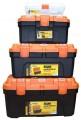 | 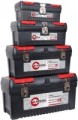 |
|---|---|---|
| Master Tool 79-2003 | Intertool BX-0004 | |
from $51.00 | from $48.16 up to $55.96 | |
| TOP sellers | ||
| Type | set of boxes | set of boxes |
| Kit | 4 | 4 |
| Suitable for | hand tools | tools and small items |
Specs | ||
| Size | 12", 16", 20", 22.5" | 13", 16", 19", 24" |
| Lid organizer |  | |
| Place for bits and sockets | |  |
| Detachable tray | | |
| Recessed handle | | |
General | ||
| Material | plastic | plastic |
| Lock material | plastic | metal |
| Dimensions | 572x300x295 mm 507x254x259 mm 410x230x205 mm 300x140x90 mm | 610x255x251 mm 483x242x240 mm 396x216x164 mm 330x177x135 mm |
| Added to E-Catalog | february 2016 | june 2015 |


Compare Master Tool 79-2003 and Intertool BX-0004
You may be interested in
My comparisons
Glossary
Suitable for
The type of tool for which the container is normally intended.
— For hand tools. Products intended primarily for hand tools - hammers, screwdrivers, pliers, etc. Such tools are relatively small in size and, most often, of a standard shape; so for such boxes there is no point in specifying compatibility (see below). Note that such products are not suitable for small items - so if you plan to work with a large amount of “small things”, it is worth finding a container that was originally designed for this (see below).
— For tools and small items. Containers designed for both hand tools (see above) and for storing a large number of small parts. The specific design of such products may vary. Thus, in classic boxes (see “Type”), a cover with an organizer is most often provided for small items (see below); individual organizers for this purpose have compartments of different sizes; Vests and belt bags differ in size, respectively, pockets, etc.
— Only for small elements. Containers intended only for small parts - fasteners (bolts, nuts, screws, nails), some types of working attachments (drills, bits), etc. The vast majority of such containers are classified as organizers (see “Type”), although there are and exceptions.
— For power tools. Containers for this purpose are characterized by a high degree of...specialization; they are usually made for specific models of power tools (see “Compatibility”). This is due to the fact that similar instruments (even of similar purpose and level) differ markedly in the general structure and arrangement of various structural elements. And even if compatibility for such a container is not indicated, most likely it is intended at least for equipment from a certain brand.
— For hand tools. Products intended primarily for hand tools - hammers, screwdrivers, pliers, etc. Such tools are relatively small in size and, most often, of a standard shape; so for such boxes there is no point in specifying compatibility (see below). Note that such products are not suitable for small items - so if you plan to work with a large amount of “small things”, it is worth finding a container that was originally designed for this (see below).
— For tools and small items. Containers designed for both hand tools (see above) and for storing a large number of small parts. The specific design of such products may vary. Thus, in classic boxes (see “Type”), a cover with an organizer is most often provided for small items (see below); individual organizers for this purpose have compartments of different sizes; Vests and belt bags differ in size, respectively, pockets, etc.
— Only for small elements. Containers intended only for small parts - fasteners (bolts, nuts, screws, nails), some types of working attachments (drills, bits), etc. The vast majority of such containers are classified as organizers (see “Type”), although there are and exceptions.
— For power tools. Containers for this purpose are characterized by a high degree of...specialization; they are usually made for specific models of power tools (see “Compatibility”). This is due to the fact that similar instruments (even of similar purpose and level) differ markedly in the general structure and arrangement of various structural elements. And even if compatibility for such a container is not indicated, most likely it is intended at least for equipment from a certain brand.
Size
The main size of the container for tools. Inches are traditionally used for this designation, and the length is usually indicated as the main size. This information allows you to evaluate the "weight category" of the product as a whole, as well as to determine whether it is suitable for a particular instrument of large sizes. At the same time, the characteristics usually indicate the overall dimensions on all three main sides (in millimetres), however, it is more convenient for many craftsmen to use the size designation in inches.
For kits (see below), this paragraph indicates the dimensions of all containers supplied in the kit.
For kits (see below), this paragraph indicates the dimensions of all containers supplied in the kit.
Place for bits and sockets
The presence on the lid of the box (may occur in other versions, but very rarely) of separate niches for bits and end heads. Something similar is implemented in tool kits, where each accessory has its place and clearly lies in it.
Lock material
The material from which the container locks are made. Most often we are talking about fasteners that close a case or drawer, but sometimes this information is indicated for fasteners in bags, backpacks, etc. The main materials for their manufacture are:
- Plastic. Plastic is inexpensive, but in general it is inferior to metal in terms of strength and reliability. However, often these moments do not play a decisive role (or are compensated by design features - for example, the large thickness of individual parts).
- Metal. Metal locks are very durable and reliable, but they are more expensive than plastic ones. Tool boxes and containers made of almost any material can be equipped with such locks.
— Plastic with metal. This combination is not uncommon in the design of tool boxes and containers. As a rule, the locking bracket of the lock is made of metal, which bears the main load in the locking mechanism, and the “tongue” is made of plastic.
- Plastic. Plastic is inexpensive, but in general it is inferior to metal in terms of strength and reliability. However, often these moments do not play a decisive role (or are compensated by design features - for example, the large thickness of individual parts).
- Metal. Metal locks are very durable and reliable, but they are more expensive than plastic ones. Tool boxes and containers made of almost any material can be equipped with such locks.
— Plastic with metal. This combination is not uncommon in the design of tool boxes and containers. As a rule, the locking bracket of the lock is made of metal, which bears the main load in the locking mechanism, and the “tongue” is made of plastic.