
Comparison Procraft ATA20BS vs Procraft ATA40
Add to comparison |  | 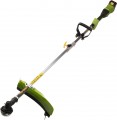 |
|---|---|---|
| Procraft ATA20BS | Procraft ATA40 | |
| Expecting restock | Outdated Product | |
| User reviews | ||
| TOP sellers | ||
| Type | grass trimmer | grass trimmer |
| Motor type | electric (battery) | electric (battery) |
Mowing | ||
| Cutting width | 42 cm | 42 cm |
| Cutting system | rotary | rotary |
Trimmer design | ||
| Motor location | top | top |
| Shaft type | straight | straight |
| Handle type | bike handle | loop-shaped (D-shaped) |
| Line diameter | 2 mm | |
| More features | foldable shaft shoulder strap | foldable shaft shoulder strap |
In box | ||
| Nozzles | spool of line saw blade | spool of line saw blade |
| More features | charger | charger |
Motor | ||
| Brushless motor |  |  |
| Soft start | | |
Battery | ||
| Battery in set | 1 | 2 |
| Battery voltage | 20 В | 20 В |
| Capacity | 4 Ah | 4 Ah |
General | ||
| Deck material | plastic | plastic |
| Waterproof | IPX0 | |
| Noise level | 96 dB | 105 dB |
| Weight | 5.8 kg | 4.2 kg |
| Added to E-Catalog | march 2026 | june 2024 |


Compare Procraft ATA20BS and ATA40
You may be interested in
Procraft ATA20BS often compared


Procraft ATA40 often compared


Glossary
Handle type
Type of handle featured in the design of a trimmer or combi system (see “Type”).
The choice of this parameter depends primarily on the user's personal preferences, although there are also quite objective differences between the various types. The types themselves may be as follows:
— Bike-style. A handle consisting of a pair of characteristic “horns” on either side of the trimmer shaft, resembling, as the name suggests, bicycle handlebars. This design makes it convenient to mow grass and perform other similar tasks; its advantage is that the user's hands are in the most natural position when holding the tool. In addition, the handles are convenient for both right- and left-handed users. The disadvantages of models with bike-style handles include their relatively high weight and large dimensions, as well as their limited suitability for cutting branches and other work “at height.” However, such a need arises extremely rarely with trimmers (especially since specialized types of garden tools—brush cutters and pole saws—exist for this purpose). Therefore, this option has become the most popular in modern trimmers.
— Loop-shaped. A handle in the form of a characteristic loop, usually shaped like the letter D. The rear part of the shaft usually serves as the second handle on such a tool, and the trimmer controls are located there as well. Overall, this design is considered less co...nvenient than the bike-style one: the user has to either hold the tool with the shaft pointing to the side or move one arm far back. On the other hand, a loop-shaped handle provides good vertical maneuverability and allows work both at ground level and significantly higher up, while making it easy to change the height of the attachment. As a result, although this option is less popular than the “bike-style” one, it is still encountered quite often, mainly on relatively light and low-powered trimmers.
The choice of this parameter depends primarily on the user's personal preferences, although there are also quite objective differences between the various types. The types themselves may be as follows:
— Bike-style. A handle consisting of a pair of characteristic “horns” on either side of the trimmer shaft, resembling, as the name suggests, bicycle handlebars. This design makes it convenient to mow grass and perform other similar tasks; its advantage is that the user's hands are in the most natural position when holding the tool. In addition, the handles are convenient for both right- and left-handed users. The disadvantages of models with bike-style handles include their relatively high weight and large dimensions, as well as their limited suitability for cutting branches and other work “at height.” However, such a need arises extremely rarely with trimmers (especially since specialized types of garden tools—brush cutters and pole saws—exist for this purpose). Therefore, this option has become the most popular in modern trimmers.
— Loop-shaped. A handle in the form of a characteristic loop, usually shaped like the letter D. The rear part of the shaft usually serves as the second handle on such a tool, and the trimmer controls are located there as well. Overall, this design is considered less co...nvenient than the bike-style one: the user has to either hold the tool with the shaft pointing to the side or move one arm far back. On the other hand, a loop-shaped handle provides good vertical maneuverability and allows work both at ground level and significantly higher up, while making it easy to change the height of the attachment. As a result, although this option is less popular than the “bike-style” one, it is still encountered quite often, mainly on relatively light and low-powered trimmers.
Line diameter
The diameter of the fishing line supplied with the trimmer (more precisely, with a reel attachment, see "Tips").
In modern models, this parameter can be from 1 to 4 mm. At the same time, a thicker fishing line handles better with dense thickets, but it works rougher, the treated lawn is not particularly even, and for the effective operation of such a nozzle, a fairly powerful engine is needed. On the other hand, a fine line provides a clean and neat cut, but is not suitable for heavy vegetation and large stems. Thus, thick fishing line is usually equipped with powerful units designed for "launched" lawns with an abundance of thick stems. Thin, on the other hand, is found mainly in low-power electric trimmers with a lower engine location, designed for neat lawns with regularly cut grass.
We also recall that many trimmers have the ability to replace the standard reel with another one that differs in line thickness.
In modern models, this parameter can be from 1 to 4 mm. At the same time, a thicker fishing line handles better with dense thickets, but it works rougher, the treated lawn is not particularly even, and for the effective operation of such a nozzle, a fairly powerful engine is needed. On the other hand, a fine line provides a clean and neat cut, but is not suitable for heavy vegetation and large stems. Thus, thick fishing line is usually equipped with powerful units designed for "launched" lawns with an abundance of thick stems. Thin, on the other hand, is found mainly in low-power electric trimmers with a lower engine location, designed for neat lawns with regularly cut grass.
We also recall that many trimmers have the ability to replace the standard reel with another one that differs in line thickness.
Brushless motor
The presence of a brushless (brushless) motor in the device. Such electric motors have a number of advantages over traditional collector motors: in particular, they are more economical in terms of energy consumption, less noisy, and also do not spark. The disadvantages of brushless motors are complexity and high cost.
Battery in set
Features of the battery-powered lawn mower (see "Engine type"). Most modern models of this type are initially equipped with one battery, but there are exceptions. They are indicated in this case, the options can be as follows:
- Without battery. This option is intended primarily for tech who do not want to rely on the choice of the manufacturer and would like to choose a lawn mower battery of their own choice. Theoretically, this may be associated with additional troubles, however, in practice, batteries are often sold literally "next to" the tools - on the nearest rack or in the next section of the online store. In addition, many brands make batteries universal - for example, a battery from a drill can be put in an electric trimmer. So such equipment will also come in handy for tech who already have a cordless tool on the farm - the main thing is to clarify compatibility before buying.
— 2 pieces in a set. Includes two replaceable batteries. The most obvious advantage of this configuration is the increased battery life: when the charge is exhausted, it is enough to change the dead battery for a fresh one. However, in addition to this, this option provides other advantages. So, it allows you to reduce interruptions for charging: one of the batteries can be charged at a time when the second is used for work. In addition, even if one battery fails, the s...econd will remain operational; and the probability of simultaneous failure of both batteries is extremely low (and definitely lower than that of a single battery). On the other hand, you will have to pay extra for a second power source - although often its cost is less than if a spare battery was purchased separately.
- Without battery. This option is intended primarily for tech who do not want to rely on the choice of the manufacturer and would like to choose a lawn mower battery of their own choice. Theoretically, this may be associated with additional troubles, however, in practice, batteries are often sold literally "next to" the tools - on the nearest rack or in the next section of the online store. In addition, many brands make batteries universal - for example, a battery from a drill can be put in an electric trimmer. So such equipment will also come in handy for tech who already have a cordless tool on the farm - the main thing is to clarify compatibility before buying.
— 2 pieces in a set. Includes two replaceable batteries. The most obvious advantage of this configuration is the increased battery life: when the charge is exhausted, it is enough to change the dead battery for a fresh one. However, in addition to this, this option provides other advantages. So, it allows you to reduce interruptions for charging: one of the batteries can be charged at a time when the second is used for work. In addition, even if one battery fails, the s...econd will remain operational; and the probability of simultaneous failure of both batteries is extremely low (and definitely lower than that of a single battery). On the other hand, you will have to pay extra for a second power source - although often its cost is less than if a spare battery was purchased separately.
Waterproof
The presence of moisture protection in the lawn mower and its rank according to the IP (Ingress Protection) standard. The first digit after the IP abbreviation corresponds to protection against dust (maximum 6), the second indicates the degree of protection against water (maximum 8). A higher value is considered more advanced. The maximum degree of protection according to this standard is IP68, that is, complete tightness, but lawn mowers do not provide such serious moisture protection. Often, it is limited to protection against splashes and rain. There are also markings such as IPX4, where the first digit is not written - this means that the lawn mower has not undergone official certification for dust protection, but has protection against moisture.
Noise level
The level of noise produced by the device during operation. Usually, a certain average indicator is indicated in the characteristics — in the standard mode of operation; however, the actual values usually do not differ much from the claimed ones.
The lower the noise level, the more convenient the unit to use and the less tired the operator. In the case of lawn mowers, this is especially true, since such equipment is quite noisy — even the quietest models (some robots) give out about 47 – 48 dB, which is comparable to talking at an average volume. Note that the decibel is a non-linear quantity, and it is easiest to evaluate the actual loudness using comparative tables. Here is the simplest table for the values found in modern lawn mowers:
— 60 – 65 dB — talking in raised tones at a distance of about 1 m;
70 dB — loud conversation of several people at the same distance;
75 dB — loud laughter at a distance of 1 m;
80 dB — motorcycle engine, medium power vacuum cleaner.
90 dB — loud screams, freight car at a distance of 7 – 10 m;
100 dB — a subway train or a loud car signal at a distance of 5 – 7 m, an industrial workshop;
110 dB — tractor engine at a distance of about 1 m.
In addition to subjective sensations, there are specific sanitary standards that limit the impact of strong noise. So, according to European standards, noise of 85 dB is allowed to be heard without protective equipment for 8 hours, 91 dB — 2 hours, 97...dB — half an hour, and 103 dB — only 7 minutes. So when choosing a unit, you should take into account the duration of work with it — with high noise, you may need protective headphones.
The lower the noise level, the more convenient the unit to use and the less tired the operator. In the case of lawn mowers, this is especially true, since such equipment is quite noisy — even the quietest models (some robots) give out about 47 – 48 dB, which is comparable to talking at an average volume. Note that the decibel is a non-linear quantity, and it is easiest to evaluate the actual loudness using comparative tables. Here is the simplest table for the values found in modern lawn mowers:
— 60 – 65 dB — talking in raised tones at a distance of about 1 m;
70 dB — loud conversation of several people at the same distance;
75 dB — loud laughter at a distance of 1 m;
80 dB — motorcycle engine, medium power vacuum cleaner.
90 dB — loud screams, freight car at a distance of 7 – 10 m;
100 dB — a subway train or a loud car signal at a distance of 5 – 7 m, an industrial workshop;
110 dB — tractor engine at a distance of about 1 m.
In addition to subjective sensations, there are specific sanitary standards that limit the impact of strong noise. So, according to European standards, noise of 85 dB is allowed to be heard without protective equipment for 8 hours, 91 dB — 2 hours, 97...dB — half an hour, and 103 dB — only 7 minutes. So when choosing a unit, you should take into account the duration of work with it — with high noise, you may need protective headphones.