
Comparison Asus Xonar U5 vs Asus Xonar U3
Add to comparison | 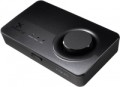 | 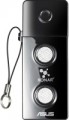 |
|---|---|---|
| Asus Xonar U5 | Asus Xonar U3 | |
from £55.49 | from $33.28 up to $37.80 | |
| TOP sellers | ||
| Type | on camera flashes | on camera flashes |
Specs | ||
| Form factor | external | external |
| Interface | USB-B | USB-A |
| Channels | 5.1 | 5.1 |
| Audiochip | C-Media CM6631A | UA100 |
| Standards | Dolby Digital, DirectSound 3D | |
| ASIO |  |  |
| Mac compatibility | | |
DAC | ||
| DAC resolution | 24 bit | 16 bit |
| Max. sampling rate | 192 kHz | 48 kHz |
| Dynamic Range | 104 dB | |
| Signal-to-noise ratio | 104 dB | 100 dB |
ADC | ||
| ADC resolution | 24 bit | 16 bit |
| Max. sampling rate | 192 kHz | 48 kHz |
| Dynamic range | 104 dB | |
| Signal-to-noise ratio | 104 dB | |
| More features | headphones amplifier | headphones amplifier |
Inputs | ||
| mini-Jack (3.5 mm) | 1 | 1 |
Outputs | ||
| mini-Jack (3.5 mm) | 4 | 1 |
| Optical S/PDIF | 1 | |
| Coaxial S/PDIF | 1 | |
| Added to E-Catalog | december 2014 | january 2014 |


Compare Asus Xonar U5 and Xonar U3
You may be interested in
Asus Xonar U5 often compared


Asus Xonar U3 often compared


Glossary
Interface
The main interface used to connect a sound card to a computer or other device.
Like the sound cards themselves, the interfaces used in them are divided into internal (PCI, PCIe) and external (USB-A, USB-C, FireWire, Thunderbolt, 3.5 mm mini-jack, Bluetooth). Here's a more detailed description of each of these options:
— PCIe. The main modern interface for connecting internal peripherals (including sound cards) to computer motherboards. It is used in most internal type models (see above). The main advantage of PCIe solutions is that connectors for their connection can be found on almost any modern "motherboard". True, these connectors may be needed for other components — graphics cards, TV tuners, or even SSD drives; however, even the simplest motherboards usually have several PCIe slots, so this point cannot be considered a serious disadvantage.
— PCI. An interface for connecting expansion cards to the PC motherboard. It is the predecessor of PCIe, has significantly lower bandwidth and more modest capabilities, so overall it is outdated. Nevertheless, motherboards with such connectors, and sound cards for the PCI interface (including quite advanced ones), continue to be produced. This is because working with sound requires comparatively low bandwidth; and installing a so...und card in a PCI slot leaves PCIe connectors free, which may be required for components more demanding on connection speed. In any case, before purchasing such a sound card, it does not hurt to separately ensure that there is a connector for its connection on the "motherboard".
— USB-A. Connection through a standard USB port. Until recently, it was the most popular interface for external peripherals, found in almost all PCs and laptops. Most external sound cards were made for USB. The disadvantage of this connection method is that USB connectors may be needed for other devices, which creates problems with a small number of ports and an abundance of peripherals. On the other hand, such situations arise not so often, and to solve them, it is enough to have a USB hub on hand.
It should be noted separately that full-size USB ports in modern PCs and laptops have been replaced by more compact USB-C (see below).
— USB-C. A peripheral connector with a symmetrical contact group, which often replaces full-size USB ports on modern PCs and laptops. Many new models of external sound cards are made for this interface. The only exceptions are individual Thunderbolt devices (see below) — for them, Thunderbolt is indicated as the peripheral connection port, not USB-C.
— Thunderbolt. A universal peripheral port mainly used in Apple computers and laptops. It is important to consider that different generations of Thunderbolt differ in the type of physical connector: versions v1 and v2 use the miniDisplayPort socket, version v3 uses the USB-C socket. So when choosing a sound card with such a connection, it is necessary to clarify this point. On the other hand, Thunderbolt versions with different connectors are fully compatible with each other through corresponding adapters.
— FireWire. Also known as IEEE 1394. An interface for external devices that was somewhat popular some time ago but has now almost fallen out of use.
— 3.5 mm (mini-jack). The mini-jack is one of the most common audio connectors. However, it is usually provided as one of the audio inputs (see below) and is very rarely used as the main interface for connecting a sound card to an external device. Such a connection is mainly found in specialized gaming models, intended for use with consoles as well. In these models, the mini-jack may be combined, allowing for the connection of both a line (analog) signal via a regular electrical wire and an optical (digital) signal via a TOSLINK cable. It is worth noting that the optical interface is notable for being completely immune to external interference; it allows for transmitting multi-channel sound, but cables for such connections require careful handling.
— Bluetooth. Wireless connection following the Bluetooth standard. It is mainly found in models intended for use with smartphones and tablets — these gadgets have few wired connectors, but Bluetooth modules are almost guaranteed to be present. However, initial sound transmission is highly compressed, noticeably affecting its quality; to remedy this drawback, modern Bluetooth sound cards usually support aptX. Of course, this technology must be supported by the signal source as well — make sure of this before purchasing.
Like the sound cards themselves, the interfaces used in them are divided into internal (PCI, PCIe) and external (USB-A, USB-C, FireWire, Thunderbolt, 3.5 mm mini-jack, Bluetooth). Here's a more detailed description of each of these options:
— PCIe. The main modern interface for connecting internal peripherals (including sound cards) to computer motherboards. It is used in most internal type models (see above). The main advantage of PCIe solutions is that connectors for their connection can be found on almost any modern "motherboard". True, these connectors may be needed for other components — graphics cards, TV tuners, or even SSD drives; however, even the simplest motherboards usually have several PCIe slots, so this point cannot be considered a serious disadvantage.
— PCI. An interface for connecting expansion cards to the PC motherboard. It is the predecessor of PCIe, has significantly lower bandwidth and more modest capabilities, so overall it is outdated. Nevertheless, motherboards with such connectors, and sound cards for the PCI interface (including quite advanced ones), continue to be produced. This is because working with sound requires comparatively low bandwidth; and installing a so...und card in a PCI slot leaves PCIe connectors free, which may be required for components more demanding on connection speed. In any case, before purchasing such a sound card, it does not hurt to separately ensure that there is a connector for its connection on the "motherboard".
— USB-A. Connection through a standard USB port. Until recently, it was the most popular interface for external peripherals, found in almost all PCs and laptops. Most external sound cards were made for USB. The disadvantage of this connection method is that USB connectors may be needed for other devices, which creates problems with a small number of ports and an abundance of peripherals. On the other hand, such situations arise not so often, and to solve them, it is enough to have a USB hub on hand.
It should be noted separately that full-size USB ports in modern PCs and laptops have been replaced by more compact USB-C (see below).
— USB-C. A peripheral connector with a symmetrical contact group, which often replaces full-size USB ports on modern PCs and laptops. Many new models of external sound cards are made for this interface. The only exceptions are individual Thunderbolt devices (see below) — for them, Thunderbolt is indicated as the peripheral connection port, not USB-C.
— Thunderbolt. A universal peripheral port mainly used in Apple computers and laptops. It is important to consider that different generations of Thunderbolt differ in the type of physical connector: versions v1 and v2 use the miniDisplayPort socket, version v3 uses the USB-C socket. So when choosing a sound card with such a connection, it is necessary to clarify this point. On the other hand, Thunderbolt versions with different connectors are fully compatible with each other through corresponding adapters.
— FireWire. Also known as IEEE 1394. An interface for external devices that was somewhat popular some time ago but has now almost fallen out of use.
— 3.5 mm (mini-jack). The mini-jack is one of the most common audio connectors. However, it is usually provided as one of the audio inputs (see below) and is very rarely used as the main interface for connecting a sound card to an external device. Such a connection is mainly found in specialized gaming models, intended for use with consoles as well. In these models, the mini-jack may be combined, allowing for the connection of both a line (analog) signal via a regular electrical wire and an optical (digital) signal via a TOSLINK cable. It is worth noting that the optical interface is notable for being completely immune to external interference; it allows for transmitting multi-channel sound, but cables for such connections require careful handling.
— Bluetooth. Wireless connection following the Bluetooth standard. It is mainly found in models intended for use with smartphones and tablets — these gadgets have few wired connectors, but Bluetooth modules are almost guaranteed to be present. However, initial sound transmission is highly compressed, noticeably affecting its quality; to remedy this drawback, modern Bluetooth sound cards usually support aptX. Of course, this technology must be supported by the signal source as well — make sure of this before purchasing.
Audiochip
Brand of the audio chip installed in the sound card.
The audio chip is one of the most important parts of a sound card, a kind of "heart" of the whole circuit, and it is on its characteristics that the sound quality and other capabilities of a particular model largely depend. Knowing the brand of the chip, you can easily find various information on it — official specifications, test results, reviews, etc. — and based on this, draw a conclusion to what extent this sound card is able to meet your requirements. Of course, for ordinary video cards (see "View") there is no need to delve into such details, but when choosing a gaming or audiophile model, they can be very useful.
The audio chip is one of the most important parts of a sound card, a kind of "heart" of the whole circuit, and it is on its characteristics that the sound quality and other capabilities of a particular model largely depend. Knowing the brand of the chip, you can easily find various information on it — official specifications, test results, reviews, etc. — and based on this, draw a conclusion to what extent this sound card is able to meet your requirements. Of course, for ordinary video cards (see "View") there is no need to delve into such details, but when choosing a gaming or audiophile model, they can be very useful.
Standards
Various standards and special digital audio technologies that the sound card is officially compatible with. For example, the Dolby and DTS standards in various variations are used primarily for multi-channel audio tracks in films, while DirectSound and EAX provide high-quality “surround” sound in games. In fact, the ability to work with one or another standard is largely determined by the software part of the system, and not by the characteristics of the sound card; however, official compatibility means at least the full compliance of the card with the requirements of the standard and the minimum risk of conflicts at the hardware level.
ASIO
Sound card compatible with ASIO standard.
ASIO (an abbreviation for Audio Stream Input/Output, i.e. “audio stream input-output”) is a technology designed for professional work with sound in the Windows environment; in particular, it reduces latency and improves the accuracy of the audio stream. If you do not plan to seriously engage in recording, mixing tracks, etc., most likely you will not need this function, but for musicians, sound engineers and other similar professionals, it can be very useful. The ASIO standard provides both software and hardware requirements; therefore, to fully use it, you must have a compatible audio card.
ASIO (an abbreviation for Audio Stream Input/Output, i.e. “audio stream input-output”) is a technology designed for professional work with sound in the Windows environment; in particular, it reduces latency and improves the accuracy of the audio stream. If you do not plan to seriously engage in recording, mixing tracks, etc., most likely you will not need this function, but for musicians, sound engineers and other similar professionals, it can be very useful. The ASIO standard provides both software and hardware requirements; therefore, to fully use it, you must have a compatible audio card.
Mac compatibility
Ability to work sound card with Mac computers.
Mac (Macintosh) in this case can be attributed to both the eponymous line of desktop computers manufactured by Apple and MacBook laptops. Both of them have certain hardware differences from "regular" PCs and laptops, in addition, they were originally created for Apple's own MacOS operating system. All this led to specific requirements for peripheral devices, including and sound cards — not all models are able to work normally with a Mac. Therefore, if you purchase a sound card for such a computer or laptop, you should make sure that Mac support is directly claimed for the selected model.
Note that Apple products have very limited possibilities for replacing internal peripherals by the user, and sound cards are not included in the list of replaceable components at all. Therefore, Mac-enabled models are usually referred to as external (see "Type").
Mac (Macintosh) in this case can be attributed to both the eponymous line of desktop computers manufactured by Apple and MacBook laptops. Both of them have certain hardware differences from "regular" PCs and laptops, in addition, they were originally created for Apple's own MacOS operating system. All this led to specific requirements for peripheral devices, including and sound cards — not all models are able to work normally with a Mac. Therefore, if you purchase a sound card for such a computer or laptop, you should make sure that Mac support is directly claimed for the selected model.
Note that Apple products have very limited possibilities for replacing internal peripherals by the user, and sound cards are not included in the list of replaceable components at all. Therefore, Mac-enabled models are usually referred to as external (see "Type").
DAC resolution
The bit depth of the digital-to-analogue converter (DAC) of the sound card. In this case, DAC refers to a part of the circuit that converts digital sound data (machine code) into analogue pulses that are fed directly to an external device — speakers, headphones, etc. The bit depth is one of the main parameters (along with the sampling frequency) that describes the quality of the DAC: the higher it is, the more reliable the sound will be reproduced, the less distortion will be introduced into it during conversion.
16-bit DACs usually have entry-level sound cards — this is enough for good sound quality. In other cases, 24-bit converters are most common, and even for advanced models, in particular gaming ones (see "View"), they are almost mandatory.
16-bit DACs usually have entry-level sound cards — this is enough for good sound quality. In other cases, 24-bit converters are most common, and even for advanced models, in particular gaming ones (see "View"), they are almost mandatory.
Max. sampling rate
The highest sampling rate provided by the digital-to-analogue converter (DAC) of the audio card. For more details on the role of the DAC, see paragraph "Bit depth" above. Here we note that the quality of its work directly depends on the sampling frequency: the higher it is, the less distortion occurs when converting sound.
Usually in sound cards there are standard values for the maximum sampling rate:
44.1 kHz — corresponds to the sound quality of Audio CD;
48 kHz — DVD;
96 kHz — DVD-Audio 5.1;
192 kHz — DVD-Audio 2.0 (two-channel audio has a higher sampling rate than multi-channel audio for a number of reasons), the highest value in modern consumer-grade sound cards.
Another specific point is that the quality of sound played on a computer cannot be higher than the capabilities of a sound card. In other words, if an audio file is recorded at a higher sampling rate than the audio card can provide, its sound quality will be reduced: for example, on a 44.1 kHz card, even DVD-Audio sound will sound like an Audio CD. Therefore, if you want to fully enjoy high-quality sound, you should choose a model with a high sampling rate.
Usually in sound cards there are standard values for the maximum sampling rate:
44.1 kHz — corresponds to the sound quality of Audio CD;
48 kHz — DVD;
96 kHz — DVD-Audio 5.1;
192 kHz — DVD-Audio 2.0 (two-channel audio has a higher sampling rate than multi-channel audio for a number of reasons), the highest value in modern consumer-grade sound cards.
Another specific point is that the quality of sound played on a computer cannot be higher than the capabilities of a sound card. In other words, if an audio file is recorded at a higher sampling rate than the audio card can provide, its sound quality will be reduced: for example, on a 44.1 kHz card, even DVD-Audio sound will sound like an Audio CD. Therefore, if you want to fully enjoy high-quality sound, you should choose a model with a high sampling rate.
Dynamic Range
The dynamic range of a DAC is the ratio between the loudest sound that the converter can produce and the quietest. The wider the dynamic range — the richer the sound will be, the lower the likelihood that quiet sounds that complement the overall picture will be muffled during conversion. At the same time, it is worth noting that almost all modern sound cards provide a dynamic range that is quite sufficient for comfortable everyday use, and in many models this parameter may not be indicated at all. It is worth paying attention to it when choosing an advanced specialized audio card — for example, a gaming one (see "View"). The minimum for professional models is 90 dB, but in fact, among similar solutions, this figure is usually 120 dB or more.
Signal-to-noise ratio
This parameter determines the ratio of the "clean" sound produced by the DAC at the output to all extraneous noise. As such, it is a pretty strong indicator of sound purity. According to the signal-to-noise ratio, DACs in modern sound cards can be divided as follows:
up to 90 dB — initial level;
90-100 dB — average level, advanced "home" models;
more than 100 dB — professional level.
up to 90 dB — initial level;
90-100 dB — average level, advanced "home" models;
more than 100 dB — professional level.