
Comparison Makita KP0800 vs DeWALT DW680
Add to comparison | 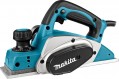 | 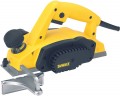 |
|---|---|---|
| Makita KP0800 | DeWALT DW680 | |
| Compare prices 6 | from £265.20 | |
| TOP sellers | ||
Start button lock. Quick change of carbon brushes. Rubberized handles. Little vibration. Metal gearbox housing. Flap shoe. Model KP0800 is supplied without case and accessories. set of knives, KP0800K includes a case, without additional set of knives, and in the kit KP0800X1 there is an extra. set of knives, but without case | Model DW680 comes without a case, model DW680K comes with a case | |
Specs | ||
| Power consumption | 620 W | 600 W |
| Rotation speed | 17000 rpm | 15000 rpm |
| Planing width | 82 mm | 82 mm |
| Planing depth | 2.5 mm | 2.5 mm |
| Grooving depth | 9 mm | 12 mm |
| V-grooves | 1 | 3 |
| Knives | double sided | double sided |
| Dust removal | unidirectional | unidirectional |
| Features | edge guide parking rest | edge guide parking rest |
General | ||
| Power source | mains (230 V) | mains (230 V) |
| Noise level | 96 dB | 96 dB |
| Power cord length | 2 m | |
| Dimensions | 285x158x158 mm | |
| Weight | 2.6 kg | 2.5 kg |
| Added to E-Catalog | november 2013 | november 2013 |




Compare Makita KP0800 and DeWALT DW680
Price comparison
You may be interested in
My comparisons
Makita KP0800 often compared


DeWALT DW680 often compared

Glossary
Power consumption
The total power consumed by the electric planer during operation. The more powerful the tool, the generally higher its productivity and the better it is suitable for large volumes of work and/or hardwoods. Here, however, it must be taken into account that the effective power (the power supplied by the unit directly to the working tool) is anyway lower than the consumed one, but it is far from always indicated. Therefore, it is quite possible to compare different models with each other precisely in terms of power consumption.
Note that more power means higher electricity consumption, and also, most often, more weight and cost of the tool. Therefore, it does not always make sense to chase the most powerful units. So, for occasional use and small volumes of work, a power of 500-600 W is considered quite sufficient; for regular work on relatively soft wood, 700-800 W is enough, and professional models have a power of more than 1000 W.
Note that more power means higher electricity consumption, and also, most often, more weight and cost of the tool. Therefore, it does not always make sense to chase the most powerful units. So, for occasional use and small volumes of work, a power of 500-600 W is considered quite sufficient; for regular work on relatively soft wood, 700-800 W is enough, and professional models have a power of more than 1000 W.
Rotation speed
The maximum speed of rotation of the working tool of the electric planer — a drum with knives attached to it. In modern models, this figure is practically never lower than 10,000 rpm (otherwise it is impossible to ensure normal quality of work), and in most cases it is in the range of 11,000 – 17,000 rpm. It is believed that the higher the number of revolutions, the more evenly the workpiece is processed and the smoother the surface is obtained; and the overall speed of work will be higher. On the other hand, a high speed also requires high engine power, especially when working with hardwoods; for such materials, it makes sense to use a low-speed tool — it will provide more efficient power distribution.
Grooving depth
The greatest depth of the groove that can be cut into the workpiece with a planer.
Grooves are narrow and long slots used, in particular, for tenoning wooden parts. Some models of electric planers are equipped with special tools that make it easier to cut grooves.
Grooves are narrow and long slots used, in particular, for tenoning wooden parts. Some models of electric planers are equipped with special tools that make it easier to cut grooves.
V-grooves
The number of V-grooves provided in the design of the tool.
V-shaped grooves are located on the sole of the tool in the longitudinal direction. They are used to chamfer the corners of the workpiece, serving as a kind of guide: the tool is “put on” by the groove on the corner being machined and moves along the workpiece so that the corner constantly maintains contact with the groove. It is much easier to keep the planer level with this way of working than with a solid flat sole; this is especially true in cases where the workpiece cannot be turned "angle up" and the planer has to be kept in an inclined position.
Also note that this function is intended only for the first pass along the corner, then you have to work in the classical way, with a flat sole — however, with a sufficient depth of the V-shaped groove, the chamfer can be removed immediately, in the first pass. Actually, this is the point of having several grooves in the design — in such cases they have different depths and can be useful for different chamfer sizes. The maximum number of grooves found in modern electric planers is three ; using more in a hand tool just doesn't make sense.
V-shaped grooves are located on the sole of the tool in the longitudinal direction. They are used to chamfer the corners of the workpiece, serving as a kind of guide: the tool is “put on” by the groove on the corner being machined and moves along the workpiece so that the corner constantly maintains contact with the groove. It is much easier to keep the planer level with this way of working than with a solid flat sole; this is especially true in cases where the workpiece cannot be turned "angle up" and the planer has to be kept in an inclined position.
Also note that this function is intended only for the first pass along the corner, then you have to work in the classical way, with a flat sole — however, with a sufficient depth of the V-shaped groove, the chamfer can be removed immediately, in the first pass. Actually, this is the point of having several grooves in the design — in such cases they have different depths and can be useful for different chamfer sizes. The maximum number of grooves found in modern electric planers is three ; using more in a hand tool just doesn't make sense.
Power cord length
The length of the network cable can tell you how far from the outlet you can operate the device. Therefore, for domestic use, it is more relevant to choose models with a short cord, for construction work or use in production, in the garage a longer cable is better.