
Comparison Lukey 852D Plus vs Lukey 702
Add to comparison | 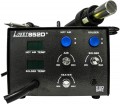 | 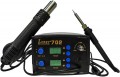 |
|---|---|---|
| Lukey 852D Plus | Lukey 702 | |
from $99.00 | from $95.00 | |
| User reviews | ||
| TOP sellers | ||
| Product type | soldering station with soldering iron and hot air gun | soldering station with soldering iron and hot air gun |
| Power source | mains (230 V) | mains (230 V) |
| Heater | ceramic | ceramic |
Specs | ||
| Power | 350 W | 750 W |
| Minimum temperature | 100 °C | 100 °C |
| Max. temperature | 480 °C | 480 °C |
Features | ||
| Functions | temperature adjustment screen | temperature adjustment screen |
| In box | detachable stand sponge | detachable stand sponge |
General | ||
| Dimensions | 187x135x245 mm | 160x190x116 mm |
| Weight | 4000 g | 1500 g |
| Added to E-Catalog | november 2016 | august 2016 |


Compare Lukey 852D Plus and 702
You may be interested in
My comparisons
Lukey 852D Plus often compared


Lukey 702 often compared


Glossary
Power
Rated power of the soldering iron; in models with adjustments (see below) — the maximum rated power. The more powerful the tool, the more intense the heat it provides, the better it is for working with large objects, such as soldering thick wires, repairing radiators, etc. However, excess power is just as undesirable as insufficient: a tool that is too “weak” will not achieve normal soldering quality, and a tool that is too “strong” will overheat the parts to be joined and may damage them (not to mention excessive power consumption). Therefore, you need to choose a soldering iron in terms of power, taking into account the work for which it is planned to be used.
So, low-power models up to 10 W are intended mainly for miniature parts and delicate work — like soldering microcircuits. The best option for domestic use is 25 – 35 W; for large elements, you can use more powerful models, up to 50 W ; these same indicators will suit most radio amateurs. Soldering irons for 50 – 100 W are designed mainly for thick wires, found, for example, in the on-board networks of cars; and high power is typical for a tool designed for large structures: metal containers (pots, buckets, etc.), radiators of the same cars, etc.
A separate case are models for soldering plastic pipes (see "Type"): they give out at least 700 W, and in the most powerful models, the figures can exceed 2 kW. Here, the more powerful the...tool is, the larger the pipes with which it can work: for example, 700 – 800 W is enough for parts with a diameter of 20 – 25 mm, and for 63 mm pipes it will take no less than the mentioned 2 kW.
Some soldering irons have power controls (see below) that allow you to adjust them to a particular situation and expand the possibilities of application.
Note that high power in itself does not mean a high operating temperature — it only facilitates and accelerates heating.
So, low-power models up to 10 W are intended mainly for miniature parts and delicate work — like soldering microcircuits. The best option for domestic use is 25 – 35 W; for large elements, you can use more powerful models, up to 50 W ; these same indicators will suit most radio amateurs. Soldering irons for 50 – 100 W are designed mainly for thick wires, found, for example, in the on-board networks of cars; and high power is typical for a tool designed for large structures: metal containers (pots, buckets, etc.), radiators of the same cars, etc.
A separate case are models for soldering plastic pipes (see "Type"): they give out at least 700 W, and in the most powerful models, the figures can exceed 2 kW. Here, the more powerful the...tool is, the larger the pipes with which it can work: for example, 700 – 800 W is enough for parts with a diameter of 20 – 25 mm, and for 63 mm pipes it will take no less than the mentioned 2 kW.
Some soldering irons have power controls (see below) that allow you to adjust them to a particular situation and expand the possibilities of application.
Note that high power in itself does not mean a high operating temperature — it only facilitates and accelerates heating.