
Comparison Orient FEVAF003W vs Orient EVAF002W
Add to comparison | 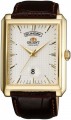 | 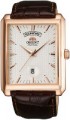 |
|---|---|---|
| Orient FEVAF003W | Orient EVAF002W | |
from $143.44 up to $221.60 | from $147.60 up to $221.44 | |
| TOP sellers | ||
| Gender | men's | men's |
| Country of origin | Japan | Japan |
Mechanism | ||
| Movement type | mechanical | mechanical |
| Self-winding |  | |
| Caliber | 46E40 | |
| Second hand | + | + |
Dial | ||
| Dial type | analog | analog |
| Type of index | marks | marks |
| Colour | white | white |
| Features | day of the week date | day of the week date |
Case and strap | ||
| Case shape | rectangular | rectangular |
| Case material | stainless steel | stainless steel |
| Colour | golden | golden |
| Glass material | mineral | mineral |
| Strap | leather strap | leather strap |
| Strap colour | brown | brown |
| Clasp | classic (with buckle) | classic (with buckle) |
General specs | ||
| Waterproof | 50 WR / 5 ATM | 100 WR / 10 ATM |
| Diameter (width) | 36 mm | 36 mm |
| Thickness | 12 mm | 12 mm |
| Weight | 71 g | |
| Added to E-Catalog | october 2015 | july 2015 |


Compare Orient FEVAF003W and EVAF002W
You may be interested in
My comparisons
Glossary
Caliber
A caliber can be described as the type of movement used in a watch. It is expensive and impractical to design a unique movement for each watch model, so most manufacturers often use the same movement in different watch models, sometimes with significantly different designs. The term "caliber" is due to the fact that initially the type of movement was designated by a number (in inch lines) corresponding to its largest size; however, today unique names or alphanumeric indices that are not directly related to sizes are widely used.
Knowing the name of the caliber on which the watch you are interested in is built, you can, if desired, find more detailed information about the mechanism and determine how its characteristics meet your requirements.
Knowing the name of the caliber on which the watch you are interested in is built, you can, if desired, find more detailed information about the mechanism and determine how its characteristics meet your requirements.
Waterproof
As the name suggests, this parameter determines the degree of resistance of the watch to moisture. It is traditionally stated as the maximum depth under water at which the watch is able to remain watertight; however, it must be borne in mind that this number is very arbitrary. The fact is that when calculating the maximum immersion depth, only the static pressure of water is taken into account, that is, the pressure at complete immobility; at the same time, any movement creates dynamic pressure, which significantly increases the load on the body. In practice, this means that a mark of, for example, 50 m does not mean that you can dive to a depth of 50 m with a watch.
Modern water protection markings correspond to the following practical possibilities:
— 30 m(same as “Water Resistant” without any numbers). Entry level, drops of water are allowed, but not strong splashes. For example, such a watch can be left on in the rain or when washing, but when showering or washing a car, it should be left in a safe place. Of course, there is no talk of immersion in water.
- 50 m. Minimum water resistance, allowing the watch to be immersed in water. These watches can usually be used for swimming, and in some cases even jumping into the water (but not from towers), but they are not suitable for more serious tasks like surfing, snorkeling or scuba diving. As a rule, buttons are not allowed to be...used underwater.
- 100 m. This degree of water protection allows not only swimming, but also diving to shallow depths, however, it is still considered insufficient for surfing, jumping from towers and scuba diving.
- 200 m. Watches with such water protection are classified as “divers”; models and can withstand scuba diving to depths of up to 20 m.
- 300 m or more. Professional diving models suitable for diving to significant depths.
Please note that the characteristics described are approximate. Specific indicators of water resistance and the possibility of using the watch with water should be clarified according to the official data of the manufacturer.
Modern water protection markings correspond to the following practical possibilities:
— 30 m(same as “Water Resistant” without any numbers). Entry level, drops of water are allowed, but not strong splashes. For example, such a watch can be left on in the rain or when washing, but when showering or washing a car, it should be left in a safe place. Of course, there is no talk of immersion in water.
- 50 m. Minimum water resistance, allowing the watch to be immersed in water. These watches can usually be used for swimming, and in some cases even jumping into the water (but not from towers), but they are not suitable for more serious tasks like surfing, snorkeling or scuba diving. As a rule, buttons are not allowed to be...used underwater.
- 100 m. This degree of water protection allows not only swimming, but also diving to shallow depths, however, it is still considered insufficient for surfing, jumping from towers and scuba diving.
- 200 m. Watches with such water protection are classified as “divers”; models and can withstand scuba diving to depths of up to 20 m.
- 300 m or more. Professional diving models suitable for diving to significant depths.
Please note that the characteristics described are approximate. Specific indicators of water resistance and the possibility of using the watch with water should be clarified according to the official data of the manufacturer.
Weight
Total weight of the watch. As a rule, it is indicated taking into account the complete strap/bracelet.
The lightest modern watch weighs no more than 50 g. The most popular models weigh 50 - 100 g, and weight more than 150 g most often means not only a large, but also a fairly advanced device, usually for sports and tourism purposes.
Both light and heavy weight have their advantages: light watches create minimal inconvenience when worn, while massive watches are subconsciously perceived as a solid and reliable device.
The lightest modern watch weighs no more than 50 g. The most popular models weigh 50 - 100 g, and weight more than 150 g most often means not only a large, but also a fairly advanced device, usually for sports and tourism purposes.
Both light and heavy weight have their advantages: light watches create minimal inconvenience when worn, while massive watches are subconsciously perceived as a solid and reliable device.