
Comparison Tronsmart Element T6 vs JBL Charge 2 Plus
Add to comparison | 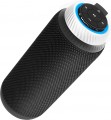 | 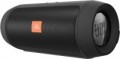 |
|---|---|---|
| Tronsmart Element T6 | JBL Charge 2 Plus | |
from £76.75 | from £438.02 | |
| User reviews | ||
| TOP sellers | ||
Connection | ||
| Sources and media | Bluetooth v4.2 mini-Jack (3.5 mm) | Bluetooth v3.0 mini-Jack (3.5 mm) |
Acoustic characteristics | ||
| Number of channels | 2.0 (stereo) | 2.0 (stereo) |
| Passive emitter |  | |
| Output power | 25 W | 15 W |
| Frequency range | 60 – 20000 Hz | 75 – 20000 Hz |
| Features | speakerphone | speakerphone |
Battery | ||
| Battery capacity | 5200 mAh | |
| Battery life | 15 h | 12 h |
| Charging time | 4 h | |
| USB charging port | microUSB | microUSB |
| Power bank mode |  | |
General | ||
| Waterproof | + | + |
| Material | plastic | plastic |
| Size (HxWxD) | 195x75x75 mm | 79x185x79 mm |
| Weight | 546 g | 600 g |
| Color | ||
| Added to E-Catalog | september 2017 | june 2015 |


Compare Tronsmart Element T6 and JBL Charge 2 Plus
You may be interested in
My comparisons
Tronsmart Element T6 often compared


JBL Charge 2 Plus often compared


Glossary
Sources and media
— Bluetooth. Wireless technology for transmitting sound from mobile phones, tablets, etc. Allows connecting a device wirelessly at a short distance from the signal source. The quality and overall capabilities of Bluetooth depend on the version:
Bluetooth 4. Each version brings improvements over the previous one. For instance, version 4.0 integrated three standards: traditional Bluetooth, high-speed channel, and a power-saving mode for small data volumes. This optimized channel usage and battery consumption. In version 4.1, interference resistance was enhanced near 4G LTE modules. Version 4.2 mainly offered overall improvements in speed and security.
Bluetooth 5.0. One of the most significant innovations of the Bluetooth 5.0 standard was the expansion of the BLE ("Bluetooth Low Energy") mode capabilities: when necessary, the device can increase range by reducing speed, or speed up transmission by reducing range. Additionally, several enhancements were made for simultaneous operation with multiple connected devices.
— Bluetooth 5.1. A substantial upgrade in version 5.1 was the ability for precise positioning of the signal transmitter (receiver). While previous versions could only determine distance, version 5.1 can also determine direction. This improved navigation functionality, enhancing smart home systems, locatin...g connected devices, etc. Additionally, improvements again addressed power-saving and simultaneous operation with multiple connected devices.
— Bluetooth 5.2. The next update after 5.1 in the Bluetooth 5 generation. The main innovations in this version were a range of security enhancements, additional power consumption optimization in LE mode, and a new audio signal format for synchronizing parallel playback on multiple devices.
— Bluetooth 5.3. The Bluetooth v 5.3 wireless communication protocol was introduced at the beginning of 2022. Innovations speeded up the channel agreement process between the controller and the device, implemented fast switching between low duty cycle and high-speed mode, improved bandwidth and connection stability by reducing susceptibility to interference. In case of unexpected interference in Low Energy mode, the channel selection procedure for switching is now faster. The 5.3 protocol does not present fundamental innovations, but several qualitative improvements are evident.
— Bluetooth 5.4. Introduced in early 2023, the version increased the range and data exchange speed. Also, Bluetooth v 5.4 enhanced the BLE power-saving mode. This protocol uses new security features to protect data from unauthorized access, has increased connection reliability by selecting the best channel for communication, and prevents connection losses due to interference.
— Mini-Jack (3.5 mm). Standard Aux audio input for connecting speakers to an audio signal source — for example, a laptop or smartphone.
— USB. Presence of a USB port allows connecting USB flash drives, mobile phones, MP3 players, and other similar peripherals to portable speakers. Therefore, such models have a built-in player and enable using connected gadgets solely as storage devices.
— Card reader. Like the above-described USB, this feature implies the presence of a built-in player in the speaker system. A card reader allows using memory cards as storage where songs can be recorded.
— FM receiver. An integrated tuner, allowing the speaker system to function as a full-fledged FM radio receiver — this range is popular among music radio stations (particularly due to the ability to broadcast sound in stereo format).
Bluetooth 4. Each version brings improvements over the previous one. For instance, version 4.0 integrated three standards: traditional Bluetooth, high-speed channel, and a power-saving mode for small data volumes. This optimized channel usage and battery consumption. In version 4.1, interference resistance was enhanced near 4G LTE modules. Version 4.2 mainly offered overall improvements in speed and security.
Bluetooth 5.0. One of the most significant innovations of the Bluetooth 5.0 standard was the expansion of the BLE ("Bluetooth Low Energy") mode capabilities: when necessary, the device can increase range by reducing speed, or speed up transmission by reducing range. Additionally, several enhancements were made for simultaneous operation with multiple connected devices.
— Bluetooth 5.1. A substantial upgrade in version 5.1 was the ability for precise positioning of the signal transmitter (receiver). While previous versions could only determine distance, version 5.1 can also determine direction. This improved navigation functionality, enhancing smart home systems, locatin...g connected devices, etc. Additionally, improvements again addressed power-saving and simultaneous operation with multiple connected devices.
— Bluetooth 5.2. The next update after 5.1 in the Bluetooth 5 generation. The main innovations in this version were a range of security enhancements, additional power consumption optimization in LE mode, and a new audio signal format for synchronizing parallel playback on multiple devices.
— Bluetooth 5.3. The Bluetooth v 5.3 wireless communication protocol was introduced at the beginning of 2022. Innovations speeded up the channel agreement process between the controller and the device, implemented fast switching between low duty cycle and high-speed mode, improved bandwidth and connection stability by reducing susceptibility to interference. In case of unexpected interference in Low Energy mode, the channel selection procedure for switching is now faster. The 5.3 protocol does not present fundamental innovations, but several qualitative improvements are evident.
— Bluetooth 5.4. Introduced in early 2023, the version increased the range and data exchange speed. Also, Bluetooth v 5.4 enhanced the BLE power-saving mode. This protocol uses new security features to protect data from unauthorized access, has increased connection reliability by selecting the best channel for communication, and prevents connection losses due to interference.
— Mini-Jack (3.5 mm). Standard Aux audio input for connecting speakers to an audio signal source — for example, a laptop or smartphone.
— USB. Presence of a USB port allows connecting USB flash drives, mobile phones, MP3 players, and other similar peripherals to portable speakers. Therefore, such models have a built-in player and enable using connected gadgets solely as storage devices.
— Card reader. Like the above-described USB, this feature implies the presence of a built-in player in the speaker system. A card reader allows using memory cards as storage where songs can be recorded.
— FM receiver. An integrated tuner, allowing the speaker system to function as a full-fledged FM radio receiver — this range is popular among music radio stations (particularly due to the ability to broadcast sound in stereo format).
Output power
The total power of all channels of the speaker system. The higher the power, the larger the size of the room in which the audio system can be used, however, more powerful portable speakers usually have larger dimensions and weight.
Frequency range
The range of audio frequencies reproduced by the audio system. The wider the range, the richer the sound, the more details the speakers can convey, especially in the low and high frequencies. At the same time, we note that the average human ear is able to hear sounds in the range of about 16 – 20,000 Hz, and it makes no sense to provide a wider range in speakers — a person simply will not hear it. Also note that a wide frequency range alone does not guarantee good sound quality.
Battery capacity
Theoretically, a higher capacity allows to achieve greater battery life, but in fact, the operating time also depends on the power consumption of acoustics — and it can be very different, depending on the characteristics and design features. So this parameter is secondary, and when choosing it is worth paying attention not so much to the battery capacity, but to the directly claimed operating time (see below).
Battery life
Operating time of a portable audio system without connecting to an external power source (network or USB port, depending on the capabilities). Note that manufacturers tend to indicate battery life in their specifications under optimal conditions for energy saving: at low volume, without using additional functions, etc. Therefore, in fact, this indicator may be noticeably lower than the claimed one, and speakers with a long operating time will not sound at full volume for the specified hours.
Charging time
The time it takes to charge a fully discharged device to 100% charge.
Power bank mode
Ability to work portable acoustics in power bank mode. This mode is only found in models with their own batteries (see "Power type"): it allows you to use this battery to power a smartphone or other external gadget. Thus, acoustics can play the role of an additional external battery, which is important in situations where it is not possible to charge a portable device in time.
Note that Power Bank speakers may only be compatible with certain phone models; this point should be clarified before buying.
Note that Power Bank speakers may only be compatible with certain phone models; this point should be clarified before buying.