
Comparison Forte FL-2T24 24 L vs Intertool PT-0010 24 L 230 V
Add to comparison | 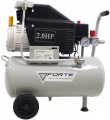 | 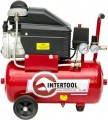 |
|---|---|---|
| Forte FL-2T24 24 L | Intertool PT-0010 24 L 230 V | |
from $74.45 up to $97.09 | from $79.20 up to $110.41 | |
| TOP sellers | ||
| Compressor type | piston | piston |
| Design | oil-lubricated | oil-lubricated |
| Drive | direct | direct |
Specs | ||
| Input performance | 200 L/min | 206 L/min |
| Rated pressure | 8 bar | 8 bar |
| Power | 1.5 kW | 1.5 kW |
| Rotation speed | 2850 rpm | 2850 rpm |
| Number of cylinders | 1 | 1 |
| Number of steps | 1 | 1 |
| Receiver | horizontal | horizontal |
| Receiver volume | 24 L | 24 L |
| Power source | mains (230 V) | mains (230 V) |
General | ||
| Design features | transportation wheels | transportation wheels |
| Noise level (LPA) | 80 dB | |
| Dimensions | 56x58x26 cm | 58x28.5x58 cm |
| Weight | 16 kg | 24 kg |
| Added to E-Catalog | june 2015 | november 2013 |


Compare Forte FL-2T24 and Intertool PT-0010
You may be interested in
My comparisons
Forte FL-2T24 often compared


Intertool PT-0010 often compared


Glossary
Input performance
The amount of air that the compressor is able to process per unit of time; usually stated in liters per minute. Performance, along with pressure (see below), is one of the most important parameters: it is it that primarily determines how compatible the compressor will be with one or another pneumatic tool.
It is worth choosing a model according to this indicator in such a way that it can be guaranteed to “pull out” all the tools that can be connected at the same time. Air consumption is usually directly indicated in the characteristics of each tool, and it is quite simple to calculate the total requirement. However, due to the design features, the compressor must have a certain performance margin; the specific value of this stock depends on a number of nuances.
The main point is that some companies indicate for their units the performance at the outlet (how much air is supplied to the tool), while others indicate at the inlet (how much air the compressor sucks in). Since no compressor is perfect, part of the air is inevitably lost during the compression process, so the amount of air at the outlet will always be less than at the inlet. Accordingly, if the output performance is indicated in the characteristics, a margin of 10-20% is recommended, and if the input is 35-40%.
There are also more complex techniques that allow you to more accurately derive the required performance depending on the characteristics of specific tools; they can be found in...special sources.
It is worth choosing a model according to this indicator in such a way that it can be guaranteed to “pull out” all the tools that can be connected at the same time. Air consumption is usually directly indicated in the characteristics of each tool, and it is quite simple to calculate the total requirement. However, due to the design features, the compressor must have a certain performance margin; the specific value of this stock depends on a number of nuances.
The main point is that some companies indicate for their units the performance at the outlet (how much air is supplied to the tool), while others indicate at the inlet (how much air the compressor sucks in). Since no compressor is perfect, part of the air is inevitably lost during the compression process, so the amount of air at the outlet will always be less than at the inlet. Accordingly, if the output performance is indicated in the characteristics, a margin of 10-20% is recommended, and if the input is 35-40%.
There are also more complex techniques that allow you to more accurately derive the required performance depending on the characteristics of specific tools; they can be found in...special sources.
Noise level (LPA)
The sound pressure level in decibels at a certain distance between the noise source and the ear of the compressor equipment operator. Since people do not work in the immediate vicinity of the compressor, the parameter will be useful for estimating the noise level at a distance. It is most often measured at a distance of 7 m from a working installation, less often at a distance of 1 m.