
Comparison Bestway 56405 vs Bestway 56424
Add to comparison | 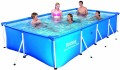 | 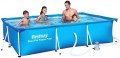 |
|---|---|---|
| Bestway 56405 | Bestway 56424 | |
| Compare prices 1 | from £287.00 | |
| TOP sellers | ||
| Volume | 5.7 m³ | 5.7 m³ |
| Filter | cartridge 1249 L/h | |
| Wall material | vinyl/polyester | PVC |
| Dimensions | 400x211x81 cm | 400x2111x81 cm |
| Weight | 32.1 kg | 34.5 kg |
| Color | ||
| Added to E-Catalog | march 2017 | september 2016 |



Compare Bestway 56405 and 56424
Price comparison
You may be interested in
My comparisons
Bestway 56405 often compared


Glossary
Filter
The filter is one of the most important types of equipment for swimming pools, including frame ones. It is responsible for purifying water from dust, small debris and other contaminants. Considering that modern frame pools are quite spacious, running water through a filter is easier, more convenient and cheaper than changing the entire pool every time it gets dirty. Filters can be like this:
- Sandy. A device with a filter element in the form of a container that holds fine sand of a special composition. When water passes through, sand retains mechanical impurities, including quite small ones. One of the main advantages of sand filters is their high flow Rate; they cope better with large volumes of water than another popular type - cartridge systems (see below). In addition, filters of this type are reusable - if the sand becomes dirty, you do not need to change anything, just organize a backwash. Among the disadvantages of this variety, one can note the relatively low filtration efficiency (including the inability to cope with chemical impurities), as well as the large size. However, in many cases the latter is not a disadvantage - the size of the filter is still small compared to the dimensions of the tank itself, and such a device is located outside the pool, and you can choose the installation location so that the filter does not create any inconvenience.
- Cartridge.... In accordance with the name, such filters use special cartridges with filter elements in the form of membranes made of polymer material. Cartridges are made disposable; when dirty and worn out, such an element must be replaced. This is associated with additional costs, but consumables are inexpensive, and initially cartridge filters are cheaper than sand filters. Another advantage is their relatively compact size. The operating speed of cartridges is lower than that of sand systems, but such a filter can still be made quite productive even for a fairly large volume of water. Thanks to all this, most modern frame pools are equipped with cartridge devices.
The pump is also characterized by flow Rate. It refers to the amount of water that the unit can pump in an hour. Knowing this quantity and the volume of the pool, you can estimate how long it will take to filter it.
Note that manufacturers usually choose the flow Rate of a complete filter based on the optimal compromise between good speed and low cost, as well as the weight of the unit itself. Therefore, in practice, this parameter may be required mainly in the case of searching for a replacement for the standard filter.
- Sandy. A device with a filter element in the form of a container that holds fine sand of a special composition. When water passes through, sand retains mechanical impurities, including quite small ones. One of the main advantages of sand filters is their high flow Rate; they cope better with large volumes of water than another popular type - cartridge systems (see below). In addition, filters of this type are reusable - if the sand becomes dirty, you do not need to change anything, just organize a backwash. Among the disadvantages of this variety, one can note the relatively low filtration efficiency (including the inability to cope with chemical impurities), as well as the large size. However, in many cases the latter is not a disadvantage - the size of the filter is still small compared to the dimensions of the tank itself, and such a device is located outside the pool, and you can choose the installation location so that the filter does not create any inconvenience.
- Cartridge.... In accordance with the name, such filters use special cartridges with filter elements in the form of membranes made of polymer material. Cartridges are made disposable; when dirty and worn out, such an element must be replaced. This is associated with additional costs, but consumables are inexpensive, and initially cartridge filters are cheaper than sand filters. Another advantage is their relatively compact size. The operating speed of cartridges is lower than that of sand systems, but such a filter can still be made quite productive even for a fairly large volume of water. Thanks to all this, most modern frame pools are equipped with cartridge devices.
The pump is also characterized by flow Rate. It refers to the amount of water that the unit can pump in an hour. Knowing this quantity and the volume of the pool, you can estimate how long it will take to filter it.
Note that manufacturers usually choose the flow Rate of a complete filter based on the optimal compromise between good speed and low cost, as well as the weight of the unit itself. Therefore, in practice, this parameter may be required mainly in the case of searching for a replacement for the standard filter.
Wall material
The main material used in the construction of the pool. Usually, the material of the walls is indicated in this paragraph. They are usually made of various polymeric materials — for example, PVC or vinyl.
The quality, reliability and durability of the pool directly depends on the material of the walls. However, it should be borne in mind here that the same material can be presented on the market in several varieties. In addition, various additional tricks can be used in the design — for example, multilayer walls. Therefore, it is worth evaluating the quality of the pool not so much by the claimed material, but by the general price category of the product (compared to models of a similar volume and functionality).
The quality, reliability and durability of the pool directly depends on the material of the walls. However, it should be borne in mind here that the same material can be presented on the market in several varieties. In addition, various additional tricks can be used in the design — for example, multilayer walls. Therefore, it is worth evaluating the quality of the pool not so much by the claimed material, but by the general price category of the product (compared to models of a similar volume and functionality).
Dimensions
Overall dimensions of the swimming pool in expanded position. In general, this parameter is quite obvious, but let's note a couple of important points:
— In the largest models, the length or diameter may exceed 6 m, while in the most miniature ones — it does not even reach 2 m.
— It's worth keeping in mind that a frame pool should not be filled with water more than 80%. Accordingly, the maximum depth of such a construction will not exceed 80% of the total height. For example, products with a height of more than 130 cm are usually classified as deep frame pools — therefore, the actual depth in such models is slightly more than 1 m (130*0.8 = 104 cm). For the younger generation, there are children's frame pools with a rim height of up to 60 cm (and water depth accordingly around 50 cm).
— In the largest models, the length or diameter may exceed 6 m, while in the most miniature ones — it does not even reach 2 m.
— It's worth keeping in mind that a frame pool should not be filled with water more than 80%. Accordingly, the maximum depth of such a construction will not exceed 80% of the total height. For example, products with a height of more than 130 cm are usually classified as deep frame pools — therefore, the actual depth in such models is slightly more than 1 m (130*0.8 = 104 cm). For the younger generation, there are children's frame pools with a rim height of up to 60 cm (and water depth accordingly around 50 cm).