
Comparison Werk BM-2T50N 50 L vs Dnipro-M PVK50-1 50 L
Add to comparison | 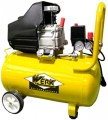 | 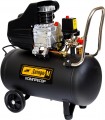 |
|---|---|---|
| Werk BM-2T50N 50 L | Dnipro-M PVK50-1 50 L | |
from $85.84 up to $104.82 | from $112.38 up to $137.28 | |
| User reviews | ||
| TOP sellers | ||
Wheels. | ||
| Compressor type | piston | piston |
| Design | oil-lubricated | oil-lubricated |
| Drive | direct | direct |
Specs | ||
| Input performance | 200 L/min | 206 L/min |
| Rated pressure | 8 bar | 8 bar |
| Power | 1.5 kW | 1.9 kW |
| Rotation speed | 2850 rpm | 3600 rpm |
| Number of cylinders | 1 | 1 |
| Number of steps | 1 | 1 |
| Receiver | horizontal | horizontal |
| Receiver volume | 50 L | 50 L |
| Power source | mains (230 V) | mains (230 V) |
General | ||
| Design features | transportation wheels | transportation wheels |
| Dimensions | 68x32x67.5 cm | |
| Weight | 24 kg | 25 kg |
| Added to E-Catalog | october 2016 | december 2013 |


Compare Werk BM-2T50N and Dnipro-M PVK50-1
You may be interested in
Werk BM-2T50N often compared


Dnipro-M PVK50-1 often compared


Glossary
Input performance
The amount of air that the compressor is able to process per unit of time; usually stated in liters per minute. Performance, along with pressure (see below), is one of the most important parameters: it is it that primarily determines how compatible the compressor will be with one or another pneumatic tool.
It is worth choosing a model according to this indicator in such a way that it can be guaranteed to “pull out” all the tools that can be connected at the same time. Air consumption is usually directly indicated in the characteristics of each tool, and it is quite simple to calculate the total requirement. However, due to the design features, the compressor must have a certain performance margin; the specific value of this stock depends on a number of nuances.
The main point is that some companies indicate for their units the performance at the outlet (how much air is supplied to the tool), while others indicate at the inlet (how much air the compressor sucks in). Since no compressor is perfect, part of the air is inevitably lost during the compression process, so the amount of air at the outlet will always be less than at the inlet. Accordingly, if the output performance is indicated in the characteristics, a margin of 10-20% is recommended, and if the input is 35-40%.
There are also more complex techniques that allow you to more accurately derive the required performance depending on the characteristics of specific tools; they can be found in...special sources.
It is worth choosing a model according to this indicator in such a way that it can be guaranteed to “pull out” all the tools that can be connected at the same time. Air consumption is usually directly indicated in the characteristics of each tool, and it is quite simple to calculate the total requirement. However, due to the design features, the compressor must have a certain performance margin; the specific value of this stock depends on a number of nuances.
The main point is that some companies indicate for their units the performance at the outlet (how much air is supplied to the tool), while others indicate at the inlet (how much air the compressor sucks in). Since no compressor is perfect, part of the air is inevitably lost during the compression process, so the amount of air at the outlet will always be less than at the inlet. Accordingly, if the output performance is indicated in the characteristics, a margin of 10-20% is recommended, and if the input is 35-40%.
There are also more complex techniques that allow you to more accurately derive the required performance depending on the characteristics of specific tools; they can be found in...special sources.
Power
The power of the engine installed in the compressor. It is not the main parameter in evaluating the efficiency of the device — here the performance and nominal pressure play a decisive role (see above), and the engine is selected in such a way that its power is sufficient to ensure the claimed characteristics. However, this indicator still has practical significance: in compressors with an electric motor (and there are now most of them; see “Engine type”), the engine power determines the total energy consumption of the device, as well as the requirements for the network where it is planned to connect it (for more details, see “Voltage networks"). In addition, the power of the engine (regardless of its type) must be known in order to calculate the optimal performance value using some special formulas.
For internal combustion engines, power is traditionally expressed in horsepower (hp); you can convert it to watts in this way: 1 hp. = 735 W.
For internal combustion engines, power is traditionally expressed in horsepower (hp); you can convert it to watts in this way: 1 hp. = 735 W.
Rotation speed
The speed of rotation of the compressor motor shaft in normal operation. This parameter, usually, does not affect the efficiency of the unit — the main indicators are still the performance and nominal pressure (see above). At the same time, it allows you to evaluate the design features of the compressor and its durability. The fact is that a higher rotation speed allows the use of fairly simple and inexpensive working mechanisms, but it increases the wear of moving parts and reduces the motor resource. Therefore, a model with a lower number of revolutions is likely to cost more than the "high-speed" version, but it will also last longer (ceteris paribus characteristics — performance, pressure, drive type, design; see all above).