
Comparison TP-LINK Deco E4 (2-pack) vs TP-LINK Deco M4 (2-pack)
Add to comparison | 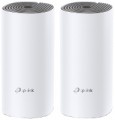 | 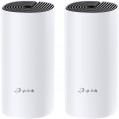 |
|---|---|---|
| TP-LINK Deco E4 (2-pack) | TP-LINK Deco M4 (2-pack) | |
| Compare prices 4 | Compare prices 17 | |
| User reviews | ||
| TOP sellers | ||
The Mesh system consists of two blocks and forms a single network that can be expanded by adding the same blocks. Up to 100 wireless devices can be connected to the system. The system is compatible with Amazon Alexa. | ||
| Product type | MESH system | MESH system |
| In box | 2 devices | 2 devices |
| Data input (WAN-port) | Ethernet (RJ45) | Ethernet (RJ45) |
Wireless Wi-Fi connection | ||
| Wi-Fi standards | Wi-Fi 3 (802.11g) Wi-Fi 4 (802.11n) Wi-Fi 5 (802.11ac) | Wi-Fi 3 (802.11g) Wi-Fi 4 (802.11n) Wi-Fi 5 (802.11ac) |
| Frequency band | 2.4GHz 5 GHz | 2.4GHz 5 GHz |
| Operating ranges | dual-band (2.4 GHz and 5 GHz) | three-channel (2.4 GHz and 5 GHz in 2 channels) |
| Wireless speed 2.4 GHz | 300 Mbps | 300 Mbps |
| Wireless speed 5 GHz | 867 Mbps | 867 Mbps |
Connection and LAN | ||
| LAN | 2 ports 100 Mbps | 1 port 1 Gbps |
Antenna and transmitter | ||
| Number of antennas | 2 | 2 |
| Antenna type | internal | internal |
| MU-MIMO |  | |
| Transmitter power | 23 dBm | 23 dBm |
| Signal strength 2.4 GHz | 20 dBm | 20 dBm |
| Signal strength 5 GHz | 23 dBm | 23 dBm |
Functions | ||
| Features | Amazon Alexa NAT MESH mode firewall | Amazon Alexa NAT MESH mode firewall |
| More features | DHCP server | DHCP server |
Security | ||
| Safety standards | WPA WEP WPA2 | WPA WEP WPA2 |
General | ||
| Dimensions | 91x91x191 mm | 91x91x190 mm |
| Color | ||
| Added to E-Catalog | june 2019 | april 2019 |




Compare TP-LINK Deco E4 (2-pack) and Deco M4 (2-pack)
Comparing TP-LINK Deco E4 and TP-LINK Deco M4, it can be noted that both models are MESH systems and are supplied in a set of 2 devices. Both devices support Wi-Fi 5 and operate in two bands: 2.4 GHz and 5 GHz with a maximum speed of 300 Mbps and 867 Mbps respectively. However, Deco M4 has a three-channel mode, which can provide better performance in busy networks. Both devices have similar features such as NAT, MESH mode, and firewall, as well as the same security standards. Overall, the choice between them may depend on the need for a more stable connection offered by Deco M4.
Price comparison
You may be interested in
Glossary
Operating ranges
The number of wireless bands and channels supported by the router. Specified only for models that work with more than one range.
— Dual-band (2.4 GHz and 5 GHz). Devices that simultaneously support two popular communication bands — 2.4 GHz and 5 GHz — in the "one communication channel per band" format. This ensures compatibility with most Wi-Fi standards (see above), and in some cases also has a positive effect on the quality of communication. For example, a Wi-Fi adapter (see "Device Type") with this feature may provide the ability to evaluate the load on both bands and automatically select the less loaded one.
— Three-channel (2.4 GHz and 5 GHz in 2 channels). An improved version of the dual-band operation format: in the 5 GHz band, communication is carried out on two channels. This allows, for example, to “raise” three wireless connection channels on one router at once (three visible networks in the list of wireless networks) and achieve even higher throughput. The advantages of this format are especially noticeable when the router works simultaneously with several wireless devices.
— Tri-band (2.4 GHz, 5 GHz, 60 GHz). The most "omnivorous" type of modern Wi-Fi equipment, compatible with all popular standards — from the outdated 802.11 b / g to the relatively new 802.11 ad. Also, the abundance of ranges contributes to an increase in spee...d, especially when working with multi-range devices.
— Dual-band (2.4 GHz and 5 GHz). Devices that simultaneously support two popular communication bands — 2.4 GHz and 5 GHz — in the "one communication channel per band" format. This ensures compatibility with most Wi-Fi standards (see above), and in some cases also has a positive effect on the quality of communication. For example, a Wi-Fi adapter (see "Device Type") with this feature may provide the ability to evaluate the load on both bands and automatically select the less loaded one.
— Three-channel (2.4 GHz and 5 GHz in 2 channels). An improved version of the dual-band operation format: in the 5 GHz band, communication is carried out on two channels. This allows, for example, to “raise” three wireless connection channels on one router at once (three visible networks in the list of wireless networks) and achieve even higher throughput. The advantages of this format are especially noticeable when the router works simultaneously with several wireless devices.
— Tri-band (2.4 GHz, 5 GHz, 60 GHz). The most "omnivorous" type of modern Wi-Fi equipment, compatible with all popular standards — from the outdated 802.11 b / g to the relatively new 802.11 ad. Also, the abundance of ranges contributes to an increase in spee...d, especially when working with multi-range devices.
LAN
In this case, LAN means standard network connectors (known as RJ-45) designed for wired connection of LAN devices — PCs, servers, additional access points, etc. The number of ports corresponds to the number of devices that can be directly connected to wired equipment. way.
In terms of speed, 100 Mbps (Fast Ethernet) and 1 Gbps (Gigabit Ethernet) are the most popular options today. At the same time, thanks to the development of technology, more and more gigabit devices are being produced, although in fact this speed is critical only when transferring large amounts of information. At the same time, some models, in addition to the standard speed of the main LAN ports, may have a 2.5 Gbps, 5 Gbps and even 10 Gbps LAN port with increased bandwidth.
In terms of speed, 100 Mbps (Fast Ethernet) and 1 Gbps (Gigabit Ethernet) are the most popular options today. At the same time, thanks to the development of technology, more and more gigabit devices are being produced, although in fact this speed is critical only when transferring large amounts of information. At the same time, some models, in addition to the standard speed of the main LAN ports, may have a 2.5 Gbps, 5 Gbps and even 10 Gbps LAN port with increased bandwidth.