
Comparison Stiga Combi 44 E vs Makita ELM4110
Add to comparison | 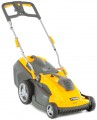 | 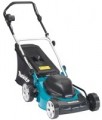 |
|---|---|---|
| Stiga Combi 44 E | Makita ELM4110 | |
from £189.00 | from £200.00 | |
| User reviews | ||
| TOP sellers | ||
| Type | lawn mower | lawn mower |
| Motor type | electric (mains) | electric (mains) |
Mowing | ||
| Cutting width | 42 cm | 41 cm |
| Cutting system | rotary | rotary |
| Min. cutting height | 25 mm | 20 mm |
| Max. cutting height | 75 mm | 75 mm |
| Number of height settings | 6 | 5 |
| Cutting height adjustment | synchronous | synchronous |
| Recommended area | 800 m² | |
Cleaning | ||
| Mulching |  |  |
| Grass ejection | rear ejection in a bag | rear ejection in a bag |
| Bag type | hard | combined |
| Bag volume | 50 L | 50 L |
| Full bag indicator | | |
Design | ||
| Features | handle height adjustment | handle height adjustment |
In box | ||
| Nozzles | 2-tooth blade | 2-tooth blade |
Motor | ||
| Motor power | 1800 W | 1600 W |
General | ||
| Deck material | plastic | |
| Front wheel diameter | 15 cm | |
| Rear wheel diameter | 25 cm | |
| Noise level | 83 dB | |
| Dimensions | 128x47x108 cm | |
| Weight | 14 kg | 23 kg |
| Added to E-Catalog | may 2012 | may 2011 |


Compare Stiga Combi 44 E and Makita ELM4110
Lawn mowers Stiga Combi 44 E and Makita ELM4110 have similar characteristics, but there are several key differences. Stiga Combi 44 E features a cutting width of 42 cm and an engine power of 1800 W, which enables it to handle larger areas more efficiently (recommended area — 800 m²). It also has the capability for mulching and a bag full indicator, which makes it more convenient to use. Meanwhile, Makita ELM4110 has a cutting width of 41 cm and power of 1600 W, which might be less effective for large lawns. However, it has a minimum cutting height of 20 mm, allowing for more precise adjustments to various conditions. Overall, Stiga Combi 44 E is preferable for larger areas, while Makita ELM4110 could be a good choice for smaller gardens.
You may be interested in
Stiga Combi 44 E often compared


Makita ELM4110 often compared

Glossary
Cutting width
The capture width provided by the unit, in other words, the width of the strip of land cultivated in one pass. In fact, this size corresponds to the width of the working nozzle.
The large working width is useful when processing large open spaces, as it allows you to finish the job in a small number of passes. On the other hand, for hard-to-reach places, relatively narrow tools are better suited, able to go where a wider unit will not fit. In addition, the width of the tool directly affects the weight and price.
In general, it makes sense to compare in terms of working width only units of the same type (see above). However, it is worth noting here that trimmers do not differ so much from each other — most models capture from 25 to 45 cm (and a wide processing band is provided by moving the nozzle from side to side). As for the other types, in the most modest models the capture width does not exceed 40 cm, in the heaviest and most powerful it can be 56 – 60 cm or even more(in mini tractors — up to 1.5 m).
The large working width is useful when processing large open spaces, as it allows you to finish the job in a small number of passes. On the other hand, for hard-to-reach places, relatively narrow tools are better suited, able to go where a wider unit will not fit. In addition, the width of the tool directly affects the weight and price.
In general, it makes sense to compare in terms of working width only units of the same type (see above). However, it is worth noting here that trimmers do not differ so much from each other — most models capture from 25 to 45 cm (and a wide processing band is provided by moving the nozzle from side to side). As for the other types, in the most modest models the capture width does not exceed 40 cm, in the heaviest and most powerful it can be 56 – 60 cm or even more(in mini tractors — up to 1.5 m).
Min. cutting height
The minimum cutting height provided by the lawnmower — that is, the smallest height of grass that can remain after the passage of the machine. It makes sense to pay attention to this indicator mainly in cases where the lawn is planned to be cut as short as possible. In addition, the lower the minimum height (with the same maximum), the wider the height adjustment range of this model.
Number of height settings
The number of cutting height settings provided by the lawn mower. The more such settings (with the same adjustment range) — the more accurately you can choose the mowing height. Note that in some robots (see "Type") this number reaches 30 or more with a range of 30 to 60 mm; in other words, you can select the height to the nearest millimetre.
Recommended area
The area of the site for which the lawn mower is designed. It cannot be argued that this parameter is critical when choosing a device, these are only manufacturer's recommendations and are very conditional. However, they are more than justified and generally show the available front of work based on the heating of the motor, the capacity of the tank or battery, and other factors that affect the duration of work.
Mulching
Possibility of work of a lawn-mower in the mode of a mulching.
Mulching is the chopping and automatic spreading of mowed grass over the site. This is one of the most convenient and at the same time practical methods of vegetation disposal. So, it does not need to be collected, and the resulting coating (mulch) performs a number of useful functions: it fertilizes the soil, reduces its heating and evaporation of moisture in hot weather, and also keeps the top layer loose.
Note that some lawn mowers allow you to use a nozzle purchased separately for mulching. However, such models are not included in this category: mulching in our catalog is indicated only for models that support this function out of the box.
Mulching is the chopping and automatic spreading of mowed grass over the site. This is one of the most convenient and at the same time practical methods of vegetation disposal. So, it does not need to be collected, and the resulting coating (mulch) performs a number of useful functions: it fertilizes the soil, reduces its heating and evaporation of moisture in hot weather, and also keeps the top layer loose.
Note that some lawn mowers allow you to use a nozzle purchased separately for mulching. However, such models are not included in this category: mulching in our catalog is indicated only for models that support this function out of the box.
Bag type
Type of bag used in a lawn mower to collect cut grass.
— Hard. Bags (containers) made of rigid material, usually plastic. Such a container is more convenient to empty than a soft one; it is more durable and reliable, but weighs somewhat more.
— Soft. The main advantages of soft fabric bags are their low weight and the ability to fold them when not in use, which can make storage easier. In addition, the fill level of such a bag can be checked at a glance without any special indicators. On the other hand, soft bags are very inconvenient to empty.
— Combination. Bags combining soft and rigid materials in their construction; the upper part is usually rigid. This combination makes the bag easier to empty while also allowing it to be folded quite compactly for storage.
— None. The absence of a bag is characteristic of some types of mowing equipment—in particular, hay mowers and trimmers (see “Type”). In conventional lawn mowers, however, it usually means that the model is not designed to collect grass—all cut vegetation remains on the ground. At the same time, most such models feature a mulching function (see above), although exceptions do occur.
— Hard. Bags (containers) made of rigid material, usually plastic. Such a container is more convenient to empty than a soft one; it is more durable and reliable, but weighs somewhat more.
— Soft. The main advantages of soft fabric bags are their low weight and the ability to fold them when not in use, which can make storage easier. In addition, the fill level of such a bag can be checked at a glance without any special indicators. On the other hand, soft bags are very inconvenient to empty.
— Combination. Bags combining soft and rigid materials in their construction; the upper part is usually rigid. This combination makes the bag easier to empty while also allowing it to be folded quite compactly for storage.
— None. The absence of a bag is characteristic of some types of mowing equipment—in particular, hay mowers and trimmers (see “Type”). In conventional lawn mowers, however, it usually means that the model is not designed to collect grass—all cut vegetation remains on the ground. At the same time, most such models feature a mulching function (see above), although exceptions do occur.
Full bag indicator
Indicator indicating the degree of filling of the bag. The design and capabilities of such an indicator can be different: for example, in some models it only gives an overflow signal, in others it allows you to determine the amount of grass in the bag at any time. However, anyway, this function provides additional convenience: it allows you to evaluate the fullness without removing the bag and without interrupting work.
Motor power
Lawnmower engine power expressed in watts. This designation is used absolutely for all electric models (see "Engine type"), and it is also often found in gasoline and diesel units along with horsepower (these units are clearly related, 1 hp is about 735 watts).
In general, the more powerful the engine, the more performant the mower and the better it will cope with heavy work such as cutting thick grass, bushes, etc. On the other hand, high power has a corresponding effect on fuel / electricity consumption, as well as the weight and price of the engine. In addition, note that the power requirements depend on the type of mower itself and its engine (see above for both). For example, for most robots, the power does not exceed 500 W — more, taking into account specialization, is not required, besides, otherwise the devices would turn out to be too bulky and heavy. Trimmers and lawn mowers of similar power are only electric, and the power limit for power tools is 2500 – 3000 W when powered from the mains and 1500 – 2000 W for battery models. But in gasoline tools, the minimum power is about 500 – 1000 W for trimmers and 1000 – 1500 W for mowers; the maximum value can exceed 4 kW.
Detailed recommendations for choosing a lawn mower d...epending on its type and features of the planned work can be found in special sources.
In general, the more powerful the engine, the more performant the mower and the better it will cope with heavy work such as cutting thick grass, bushes, etc. On the other hand, high power has a corresponding effect on fuel / electricity consumption, as well as the weight and price of the engine. In addition, note that the power requirements depend on the type of mower itself and its engine (see above for both). For example, for most robots, the power does not exceed 500 W — more, taking into account specialization, is not required, besides, otherwise the devices would turn out to be too bulky and heavy. Trimmers and lawn mowers of similar power are only electric, and the power limit for power tools is 2500 – 3000 W when powered from the mains and 1500 – 2000 W for battery models. But in gasoline tools, the minimum power is about 500 – 1000 W for trimmers and 1000 – 1500 W for mowers; the maximum value can exceed 4 kW.
Detailed recommendations for choosing a lawn mower d...epending on its type and features of the planned work can be found in special sources.
Deck material
The material from which the deck is made is a protective casing that covers the cutting tool of a lawn mower or trimmer. In modern mowers there are such options:
— Plastic. The cheapest and at the same time the least durable material.
— Aluminium alloy. The most advanced option: these decks are durable, lightweight and less prone to corrosion, but quite expensive.
— Steel. It has greater strength than aluminium alloy and costs less, but is heavier and more prone to corrosion.
— Plastic. The cheapest and at the same time the least durable material.
— Aluminium alloy. The most advanced option: these decks are durable, lightweight and less prone to corrosion, but quite expensive.
— Steel. It has greater strength than aluminium alloy and costs less, but is heavier and more prone to corrosion.