
Comparison Revyline RL 210 vs Soocas W3
Add to comparison | 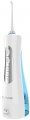 |  |
|---|---|---|
| Revyline RL 210 | Soocas W3 | |
| Outdated Product | from $31.54 up to $69.95 | |
| User reviews | ||
| TOP sellers | ||
The complete set of the irrigator can include both 4 nozzles (global version) and 1. | ||
| Type | irrigator | irrigator |
| Nozzles | 2 no. standard (single jet) | 4 no. standard (single jet) orthodontic (for braces) periodontological (pocket cleaning) for tongue cleaning |
| Model of replaceable nozzle | 4708 | |
Specs | ||
| Intensity modes | 2 | 1 |
| Additional modes | impulse (Pulse) | delicate impulse (Pulse) |
| Pulsation rate | 1.8 thousand/min | 1.3 thousand/min |
| Irrigator pressure | 20 – 140 PSI | |
| Water tank capacity | 150 ml | 230 ml |
Power supply | ||
| Power source | rechargeable battery | rechargeable battery |
| Battery capacity | 2200 mAh | |
| Max. operating time | 75 min | |
| Full charging time | 4 h | 6 h |
| Charging via USB port |  |  |
General | ||
| Waterproof | IPX7 | |
| Case / cover | | |
| Dimensions | 194x78x62 mm | 75x200x80 mm |
| Weight | 265 g | 275 g |
| Color | ||
| Added to E-Catalog | november 2019 | june 2019 |


Compare Revyline RL 210 and Soocas W3
You may be interested in
Soocas W3 often compared


Glossary
Nozzles
No translation necessary.
Model of replaceable nozzle
The model designation helps you find the right replacement tip without the risk of incompatibility with the irrigator handle. Unlike the tip type, which describes its purpose, the model indicates the specific series or item number of the product. This parameter is especially useful when purchasing additional standard, orthodontic, or periodontal tips.
Intensity modes
The number of intensity levels indicates how precisely the water pressure can be adjusted to match gum sensitivity and specific tasks. Low values are suitable for getting used to the irrigator and gentle treatment, while high values are for more intensive cleaning of food residues from between teeth. Intensity should not be confused with cleaning modes, which alter the nature of pulsations or the water delivery algorithm.
Additional modes
Additional operating modes change the way water is delivered and make it possible to adapt the water flosser to gum sensitivity or a specific care task.
— Gentle. Uses lower pressure or a softer pulsation pattern for sensitive gums and gradual acclimatization to the water flosser. It is also suitable for the first procedures after braces or orthodontic appliances have been fitted.
— Deep cleaning. Increases the intensity of the water jet or cyclically changes its intensity for more thorough cleaning of interdental spaces and the gumline. Unlike the standard mode, the program may include pauses for sequentially moving between areas.
— Gum massage. Alternates the strength or frequency of the pulses, creating a gentle pulsating effect along the gumline. The mode is intended primarily for additional gum care rather than as a replacement for basic interdental cleaning.
— Whitening. A special program for removing surface pigmented deposits, usually used together with a suitable nozzle or branded product. It may refresh the appearance of the teeth, but it does not change their natural color and does not replace professional whitening.
— Point. In Point mode, the water flosser alternates brief water delivery with pauses, making it easier to target selected a...reas. Its main difference from the standard mode is not the width of the jet but the intermittent operating cycle. During a pause, the nozzle can be moved from one interdental space to another. This format is convenient for caring for braces, crowns, implants, and hard-to-reach areas.
— Custom. A user-configurable water flosser program that is saved and accessed using a separate button. Simply select a comfortable water-jet intensity once to use it during subsequent cleanings without readjusting it. This is convenient, for example, for regular care of braces, implants, or sensitive gums. Unlike preset programs, this mode uses a individually set water-delivery intensity.
— Pulse. A selectable mode with pronounced alternation in the strength of the water pulses, designed for gum massage or more dynamic cleaning. It should not be confused with the regular pulsating water delivery that many water flossers use continuously and cannot disable.
— Gentle. Uses lower pressure or a softer pulsation pattern for sensitive gums and gradual acclimatization to the water flosser. It is also suitable for the first procedures after braces or orthodontic appliances have been fitted.
— Deep cleaning. Increases the intensity of the water jet or cyclically changes its intensity for more thorough cleaning of interdental spaces and the gumline. Unlike the standard mode, the program may include pauses for sequentially moving between areas.
— Gum massage. Alternates the strength or frequency of the pulses, creating a gentle pulsating effect along the gumline. The mode is intended primarily for additional gum care rather than as a replacement for basic interdental cleaning.
— Whitening. A special program for removing surface pigmented deposits, usually used together with a suitable nozzle or branded product. It may refresh the appearance of the teeth, but it does not change their natural color and does not replace professional whitening.
— Point. In Point mode, the water flosser alternates brief water delivery with pauses, making it easier to target selected a...reas. Its main difference from the standard mode is not the width of the jet but the intermittent operating cycle. During a pause, the nozzle can be moved from one interdental space to another. This format is convenient for caring for braces, crowns, implants, and hard-to-reach areas.
— Custom. A user-configurable water flosser program that is saved and accessed using a separate button. Simply select a comfortable water-jet intensity once to use it during subsequent cleanings without readjusting it. This is convenient, for example, for regular care of braces, implants, or sensitive gums. Unlike preset programs, this mode uses a individually set water-delivery intensity.
— Pulse. A selectable mode with pronounced alternation in the strength of the water pulses, designed for gum massage or more dynamic cleaning. It should not be confused with the regular pulsating water delivery that many water flossers use continuously and cannot disable.
Pulsation rate
The number of pulsations per minute indicates the rhythm of the water jet's impact on teeth and gums. Frequent impulses sequentially loosen and wash away impurities, and the flow feels more continuous and gentle. However, for example, 1800 pulsations per minute are not necessarily more effective than 1200, as the result also depends on the water jet's strength, the nozzle, and the irrigator's design.
Irrigator pressure
The irrigator pressure determines the force of the water jet and directly affects cleaning intensity. Values around 20–40 PSI are suitable for getting used to the device and gentle care, while 70–100 PSI provides more powerful rinsing of hard-to-reach areas. A wide range allows you to select a comfortable flow strength for gums, implants, braces, and different nozzles.
Water tank capacity
The reservoir capacity directly affects the duration of irrigation without refilling. About 200 ml is usually sufficient for a short daily procedure, 300-400 ml for a more thorough cleaning of the entire oral cavity, and a capacity of 500 ml is convenient for braces, extended care, or use by multiple family members. The actual consumption also depends on the pressure, selected nozzle, and jet speed.
Battery capacity
The battery capacity in mAh affects the operating duration of the irrigator between charges. A larger capacity is especially convenient for travel and daily use but may increase the size and weight of the device. In practice, the declared battery life by the manufacturer remains a more indicative parameter, as irrigators with the same battery can consume energy differently.
Max. operating time
The maximum operating time indicates how long a portable oral irrigator can function on a single battery charge. For a better understanding of the values, note that one cleaning session takes about 2 minutes, meaning the irrigator works around 4 minutes per day (per person). However, actual autonomy depends on the water pressure, selected mode, and battery condition.
In our catalog, the parameter is specified in minutes, despite manufacturers' bold claims of 30 days of operation. In such cases, it is recalculated into 2 sessions of 2 minutes per day. Thus, 30 days equal 120 minutes.
In our catalog, the parameter is specified in minutes, despite manufacturers' bold claims of 30 days of operation. In such cases, it is recalculated into 2 sessions of 2 minutes per day. Thus, 30 days equal 120 minutes.