
Comparison terrines
Save List
Add to comparison | 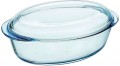 |
|---|---|
| Pyrex Essentials 459A000 3 L | |
from £24.51 | |
| TOP sellers | |
| Shape | oval |
Specs | |
| Total volume | 3 L |
| Volume of the lid | 1 l |
| Dimensions (LxWxH) | 28x19x9 cm |
| Material | glass |
| Lid material | glass |
| Non-stick coating | in absent |
| More features | dishwasher compatible |
| Country of origin | France |
| Color | |
| Added to E-Catalog | may 2016 |


You may be interested in
Glossary
Shape
— Oval. One of the most popular shapes for roasters. It is perfect for cooking a whole bird (given the appropriate capacity), and generally provides fairly even heating (both in the oven and on the stovetop). Additionally, oval roasters are somewhat cheaper than rectangular ones for the same overall dimensions; on the other hand, they have a smaller capacity.
— Rectangular. Another common option among roasters. For the same overall dimensions, this shape offers greater capacity than oval ones, and when cooking a whole bird, it allows for more garnish to be added. The drawbacks of such products include less uniform heating when used on the stovetop; therefore, rectangular roasters are best suited for the oven. Furthermore, they are somewhat more expensive than similarly sized oval models.
— Rectangular. Another common option among roasters. For the same overall dimensions, this shape offers greater capacity than oval ones, and when cooking a whole bird, it allows for more garnish to be added. The drawbacks of such products include less uniform heating when used on the stovetop; therefore, rectangular roasters are best suited for the oven. Furthermore, they are somewhat more expensive than similarly sized oval models.
Total volume
General pot volume. As a rule, it is indicated by the working volume of the roaster and the lid — the actual amount of content that can easily fit inside when used for its primary purpose.
The main criteria when choosing by this indicator are the volumes of planned cooking. For instance, dishes up to 4 liters are mainly intended for small families of 2-3 people. Capacities of 4-7 liters are suitable for a larger family. And a larger capacity can be useful for large family celebrations, mass events, and in cafes/restaurants.
Just in case, we remind you that the downsides of a large volume are bulkiness, corresponding weight, and increased cost. Moreover, such cookware requires appropriate space and equipment for effective use. Therefore, a larger volume is not always the best choice — it's worth considering the actual needs and cooking conditions.
It is also worth noting that similar-sized cookware can have different shapes and proportions. See above for more details on shape; and the proportions are related to many nuances that determine the effectiveness of cookware in various situations.
The main criteria when choosing by this indicator are the volumes of planned cooking. For instance, dishes up to 4 liters are mainly intended for small families of 2-3 people. Capacities of 4-7 liters are suitable for a larger family. And a larger capacity can be useful for large family celebrations, mass events, and in cafes/restaurants.
Just in case, we remind you that the downsides of a large volume are bulkiness, corresponding weight, and increased cost. Moreover, such cookware requires appropriate space and equipment for effective use. Therefore, a larger volume is not always the best choice — it's worth considering the actual needs and cooking conditions.
It is also worth noting that similar-sized cookware can have different shapes and proportions. See above for more details on shape; and the proportions are related to many nuances that determine the effectiveness of cookware in various situations.
Volume of the lid
The volume of the lid in casseroles plays an important role in the cooking process, as it helps retain heat and moisture inside the cookware, creating a steaming effect. A lid with a deeper volume allows more steam to condense, which then drips back into the casserole, ensuring even braising and preventing food from drying out. It is also worth noting that voluminous lids can be used separately (in conditions where handles are absent).
Dimensions (LxWxH)
The dimensions of the roasting pan, including its length, directly affect the amount of food that can be cooked in it and its ease of use. Standard length of roasting pans varies from 30 to 40 cm, which allows for cooking meals for 4–6 people, depending on the depth and width of the dish. The longer the length, the greater the volume, which is important when cooking large pieces of meat, such as goose. The length of the roasting pan determines how comfortably the product can be placed in it and how evenly it will be heated, as length affects heat distribution during the cooking process.
Material
The material from which the product is made.
In addition to traditional cast iron, aluminum is very popular in modern thin-walled cookware, and models made of special glass have become noticeably widespread among casserole dishes. Other materials, such as steel and ceramics, are noticeably less common. Here is a more detailed description of each of these options:
- Cast iron. “Timeless classic” of thick-walled cookware. Cast iron has been used since ancient times and still does not lose popularity: even today, many specialists in oriental cuisine prefer this material. This is due to a number of advantages. Thus, cast iron walls are excellent for “slow” cooking: they heat up evenly and retain heat well (especially since such walls are usually made quite thick, including to ensure the necessary strength). The surface of such cookware is quite easy to clean, and if certain rules are followed, it itself acquires non-stick properties and does not require special coatings (see below). On the other hand, cast iron products are noticeably more expensive than aluminum ones; they have more weight, which is especially critical for large volumes; and the exploitation of cast iron requires compliance with some specific rules. So, when using for the first time, the product must be calcined and washe...d to get rid of dirt and bring the surface into working condition; and it is undesirable to leave food in a cast iron container for a long time (more than a day), since oxidation may begin and the taste of the contents will deteriorate. In light of this, cast iron cookware today, although used quite widely, is inferior to aluminum in terms of prevalence.
- Aluminum. Aluminum alloys have emerged as a modern alternative to the cast iron described above. The main advantage of this material is its low weight, making dishes made from it quite light even with a large volume. True, aluminum is still inferior to cast iron in terms of heat capacity and differs in heating characteristics; therefore, principled adherents of traditional recipes do not accept such utensils, believing that they cannot provide full simmering. However, in an ordinary home kitchen, an aluminum cauldron or a roasting pan can well serve as a replacement for a heavy cast-iron container. But among the obvious disadvantages of this material, it is worth noting the lack of non-stick properties - in the end you either have to put up with difficulties in cleaning, or buy dishes with a special coating (see below). We also note that aluminum cauldrons with relatively thin walls are considered unsuitable for preparing classic pilaf, and storing food in uncoated containers is undesirable - prolonged contact leads to oxidation of the metal and deterioration of taste.
- Glass. Special heat-resistant glass can be found mainly among ducklings. For a number of reasons, such cookware is considered suitable mainly for ovens, although some models can be used on burners without problems (usually dishes with this feature are round in shape and differ from cauldrons only in material). Be that as it may, the glass heats up fairly evenly and retains heat well; it is quite easy to clean and can withstand even “harsh” abrasives without problems (although formally it does not have non-stick properties); and the transparency of the dishes allows you to control the condition of the dish to a certain extent without opening the lid. Among the key disadvantages of such products, one can note, first of all, incompatibility with induction burners. In addition, glass is considered a fragile material; however, this moment is compensated by the large thickness of the walls, and breaking such dishes is not as easy as it might seem. But it is advisable to protect it from sudden changes in temperature - otherwise there is a possibility of cracks and even destruction.
- Ceramics. A material that is in many ways similar to the glass described above - with the exception of transparency. Thus, ceramic cookware has good heat capacity, heats up evenly, is easy to clean and is durable enough for everyday use; on the other hand, such products are not suitable for induction heaters, and also do not tolerate sudden temperature changes. As for appearance, the opacity of this material is to some extent compensated by the fact that it can be given different colors and even designs. The main disadvantage of thick-walled ceramic cookware is its high cost; That is why it is not particularly popular these days.
- Steel. Food-grade stainless steel is highly durable and reliable: even with a relatively small wall thickness, it can withstand falls and strong impacts. On the other hand, in the case of thick-walled cookware, this material is in many ways inferior to cast iron. Thus, steel walls do not heat up as evenly as cast iron walls and cool down faster; this is especially noticeable in light of the fact that the thickness of such walls is usually small - otherwise the dishes would turn out to be unreasonably expensive. In addition, steel does not have non-stick properties - this requires the use of special coatings; and products without such a coating are difficult to clean. So, products made from this material are rare and fall mainly into two categories: inexpensive cookware without a non-stick coating or fairly advanced pans with an additional coating, similar in shape to sauté pans (a type of frying pan with high sides).
In addition to traditional cast iron, aluminum is very popular in modern thin-walled cookware, and models made of special glass have become noticeably widespread among casserole dishes. Other materials, such as steel and ceramics, are noticeably less common. Here is a more detailed description of each of these options:
- Cast iron. “Timeless classic” of thick-walled cookware. Cast iron has been used since ancient times and still does not lose popularity: even today, many specialists in oriental cuisine prefer this material. This is due to a number of advantages. Thus, cast iron walls are excellent for “slow” cooking: they heat up evenly and retain heat well (especially since such walls are usually made quite thick, including to ensure the necessary strength). The surface of such cookware is quite easy to clean, and if certain rules are followed, it itself acquires non-stick properties and does not require special coatings (see below). On the other hand, cast iron products are noticeably more expensive than aluminum ones; they have more weight, which is especially critical for large volumes; and the exploitation of cast iron requires compliance with some specific rules. So, when using for the first time, the product must be calcined and washe...d to get rid of dirt and bring the surface into working condition; and it is undesirable to leave food in a cast iron container for a long time (more than a day), since oxidation may begin and the taste of the contents will deteriorate. In light of this, cast iron cookware today, although used quite widely, is inferior to aluminum in terms of prevalence.
- Aluminum. Aluminum alloys have emerged as a modern alternative to the cast iron described above. The main advantage of this material is its low weight, making dishes made from it quite light even with a large volume. True, aluminum is still inferior to cast iron in terms of heat capacity and differs in heating characteristics; therefore, principled adherents of traditional recipes do not accept such utensils, believing that they cannot provide full simmering. However, in an ordinary home kitchen, an aluminum cauldron or a roasting pan can well serve as a replacement for a heavy cast-iron container. But among the obvious disadvantages of this material, it is worth noting the lack of non-stick properties - in the end you either have to put up with difficulties in cleaning, or buy dishes with a special coating (see below). We also note that aluminum cauldrons with relatively thin walls are considered unsuitable for preparing classic pilaf, and storing food in uncoated containers is undesirable - prolonged contact leads to oxidation of the metal and deterioration of taste.
- Glass. Special heat-resistant glass can be found mainly among ducklings. For a number of reasons, such cookware is considered suitable mainly for ovens, although some models can be used on burners without problems (usually dishes with this feature are round in shape and differ from cauldrons only in material). Be that as it may, the glass heats up fairly evenly and retains heat well; it is quite easy to clean and can withstand even “harsh” abrasives without problems (although formally it does not have non-stick properties); and the transparency of the dishes allows you to control the condition of the dish to a certain extent without opening the lid. Among the key disadvantages of such products, one can note, first of all, incompatibility with induction burners. In addition, glass is considered a fragile material; however, this moment is compensated by the large thickness of the walls, and breaking such dishes is not as easy as it might seem. But it is advisable to protect it from sudden changes in temperature - otherwise there is a possibility of cracks and even destruction.
- Ceramics. A material that is in many ways similar to the glass described above - with the exception of transparency. Thus, ceramic cookware has good heat capacity, heats up evenly, is easy to clean and is durable enough for everyday use; on the other hand, such products are not suitable for induction heaters, and also do not tolerate sudden temperature changes. As for appearance, the opacity of this material is to some extent compensated by the fact that it can be given different colors and even designs. The main disadvantage of thick-walled ceramic cookware is its high cost; That is why it is not particularly popular these days.
- Steel. Food-grade stainless steel is highly durable and reliable: even with a relatively small wall thickness, it can withstand falls and strong impacts. On the other hand, in the case of thick-walled cookware, this material is in many ways inferior to cast iron. Thus, steel walls do not heat up as evenly as cast iron walls and cool down faster; this is especially noticeable in light of the fact that the thickness of such walls is usually small - otherwise the dishes would turn out to be unreasonably expensive. In addition, steel does not have non-stick properties - this requires the use of special coatings; and products without such a coating are difficult to clean. So, products made from this material are rare and fall mainly into two categories: inexpensive cookware without a non-stick coating or fairly advanced pans with an additional coating, similar in shape to sauté pans (a type of frying pan with high sides).
Lid material
The material of the cap supplied with the product.
In this case, the same materials are used as for the dishes themselves (see above). At the same time, metal lids (cast iron, aluminium, steel) are almost guaranteed to be combined with containers made of the same material. But glass ones can also be used with metal utensils — so that you can see the contents without opening the lid and without disturbing the cooking mode. Otherwise, this parameter is usually of secondary importance. However, there is an exception to this rule — the so-called pan lids, which can be used as separate cooking utensils. Here are the main nuances that are relevant for such accessories:
— Cast iron. Like a cast iron cookware, a frying pan lid made of this material heats up slowly and cools slowly. Cast iron tolerates strong heat well, does not require non-stick coatings, but is quite demanding on care (otherwise the non-stick properties are lost).
— Steel. Steel is strong enough, reliable and does not react with food, but it heats up unevenly, does not have non-stick properties (which, however, can be solved by using special coatings) and is quite sensitive to overheating.
— Aluminium. In the case of frying pans, aluminium is considered a low-cost option: it is light, durable, relatively inexpensive, but it does not heat up very evenly and is easily deformed when overheated. In addition, food tends to burn during cooki...ng, and when stored in a dish for a long time, its taste may deteriorate due to metal oxidation (although these shortcomings become irrelevant with a non-stick coating).
In this case, the same materials are used as for the dishes themselves (see above). At the same time, metal lids (cast iron, aluminium, steel) are almost guaranteed to be combined with containers made of the same material. But glass ones can also be used with metal utensils — so that you can see the contents without opening the lid and without disturbing the cooking mode. Otherwise, this parameter is usually of secondary importance. However, there is an exception to this rule — the so-called pan lids, which can be used as separate cooking utensils. Here are the main nuances that are relevant for such accessories:
— Cast iron. Like a cast iron cookware, a frying pan lid made of this material heats up slowly and cools slowly. Cast iron tolerates strong heat well, does not require non-stick coatings, but is quite demanding on care (otherwise the non-stick properties are lost).
— Steel. Steel is strong enough, reliable and does not react with food, but it heats up unevenly, does not have non-stick properties (which, however, can be solved by using special coatings) and is quite sensitive to overheating.
— Aluminium. In the case of frying pans, aluminium is considered a low-cost option: it is light, durable, relatively inexpensive, but it does not heat up very evenly and is easily deformed when overheated. In addition, food tends to burn during cooki...ng, and when stored in a dish for a long time, its taste may deteriorate due to metal oxidation (although these shortcomings become irrelevant with a non-stick coating).
Non-stick coating
Type of non-stick coating provided in the product; for models where these details are not specified, simply the fact of the presence of treatment may be indicated.
The general purpose of all such coatings is to prevent food from burning and sticking to the surface of the cookware. This at least simplifies the washing of the product, and in some cases it also has a positive effect on the quality of the prepared product. However, specifically for cauldrons and cauldrons, such advantages are not so often fundamental. Firstly, in such dishes food does not burn as often as, for example, in frying pans; secondly, cast iron products themselves have certain non-stick properties, and glass and ceramics can be cleaned without any problems even from heavily dried-on contaminants. In light of this, most thick-walled cookware nowadays is produced without any coating at all. In other cases, Teflon, “stone” and ceramics can be used, here are their main features:
- Teflon. Teflon is the commercial name for polytetrafluoroethylene. This material provides excellent non-stick properties at a low cost, but is not durable and requires careful handling. Thus, the service life of even the highest quality Teflon, subject to all operating rules, does not exceed 5 years. Cookware with such a coating should be p...rotected from overheating and should not be used for cooking at high temperatures. It also does not tolerate contact well with metal spatulas, forks, etc. - scratches on Teflon lead to loss of working properties and can even cause the release of harmful substances; To avoid this, you should use kitchen tools made of wood, silicone or other soft materials with such a coating. Teflon also needs to be protected from temperature changes - they can lead to cracks.
— Ceramic. A fairly advanced type of non-stick coating. Unlike Teflon, it is not afraid of contact with metal objects; tolerates strong heat without consequences (in most cases), and even when overheated does not emit harmful substances; and the service life of ceramic surfaces is quite long. Their main disadvantage is their high cost; In addition, ceramics do not withstand strong pinpoint impacts and temperature changes - these impacts can cause chips and cracks.
— Stone (granite, marble). Most often, such a coating has a composite composition: it consists of a special polymer supplemented with stone chips. This gives such a surface a characteristic appearance - with small inclusions, usually light on a dark background. As for practical properties, in this regard, “stone” is a kind of compromise between the Teflon and ceramics described above. Thus, such a coating is not as expensive as ceramics, and at the same time more resistant to scratches and heat than Teflon (although it also requires careful handling). It is also worth considering that the specific properties of cookware with this feature may vary from model to model; they should be clarified according to the manufacturer’s documentation.
The general purpose of all such coatings is to prevent food from burning and sticking to the surface of the cookware. This at least simplifies the washing of the product, and in some cases it also has a positive effect on the quality of the prepared product. However, specifically for cauldrons and cauldrons, such advantages are not so often fundamental. Firstly, in such dishes food does not burn as often as, for example, in frying pans; secondly, cast iron products themselves have certain non-stick properties, and glass and ceramics can be cleaned without any problems even from heavily dried-on contaminants. In light of this, most thick-walled cookware nowadays is produced without any coating at all. In other cases, Teflon, “stone” and ceramics can be used, here are their main features:
- Teflon. Teflon is the commercial name for polytetrafluoroethylene. This material provides excellent non-stick properties at a low cost, but is not durable and requires careful handling. Thus, the service life of even the highest quality Teflon, subject to all operating rules, does not exceed 5 years. Cookware with such a coating should be p...rotected from overheating and should not be used for cooking at high temperatures. It also does not tolerate contact well with metal spatulas, forks, etc. - scratches on Teflon lead to loss of working properties and can even cause the release of harmful substances; To avoid this, you should use kitchen tools made of wood, silicone or other soft materials with such a coating. Teflon also needs to be protected from temperature changes - they can lead to cracks.
— Ceramic. A fairly advanced type of non-stick coating. Unlike Teflon, it is not afraid of contact with metal objects; tolerates strong heat without consequences (in most cases), and even when overheated does not emit harmful substances; and the service life of ceramic surfaces is quite long. Their main disadvantage is their high cost; In addition, ceramics do not withstand strong pinpoint impacts and temperature changes - these impacts can cause chips and cracks.
— Stone (granite, marble). Most often, such a coating has a composite composition: it consists of a special polymer supplemented with stone chips. This gives such a surface a characteristic appearance - with small inclusions, usually light on a dark background. As for practical properties, in this regard, “stone” is a kind of compromise between the Teflon and ceramics described above. Thus, such a coating is not as expensive as ceramics, and at the same time more resistant to scratches and heat than Teflon (although it also requires careful handling). It is also worth considering that the specific properties of cookware with this feature may vary from model to model; they should be clarified according to the manufacturer’s documentation.
More features
— Compatibility with induction. The possibility of using cookware on electric stoves with induction-type heaters. Such heaters, as the name suggests, use the phenomenon of electromagnetic induction. Their advantage is that it is not the surface of the stove that heats up during operation, but the cookware "directly" — this is considered to be very safe and efficient. However, not all cookware can work properly with induction burners — certain materials are required for this. Therefore, if you are buying a roasting pan or cauldron for such a stove, it is worth separately ensuring this capability is present.
— Dishwasher-safe. The ability to safely wash cookware in a dishwasher. The peculiarities of modern "dishwashers" are such that some materials (and even dishware made of suitable materials but with unsuitable shapes) are incompatible with them. Therefore, if the ability to wash in a machine is important to you, it is worth choosing products where this capability is explicitly stated.
— Multilayer bottom. The presence of a multilayer bottom in the design of the cookware. The alternation of layers from different materials allows one product to combine strength, uniform heating, and resistance to temperature fluctuations. The classic drawback of such models is the high price. Note that a multilayer bottom is predominantly found in roasting pans (see "Type..."), cauldrons do not require this feature for a number of reasons.
— Rain effect lid. A special design of the lid that promotes the even distribution of moisture during cooking. It is equipped with indentations or grooves that collect condensing steam and cause it to drip back into the roasting pan, creating a "rain effect." This process helps keep dishes juicy, preventing them from drying out, and improves braising by evenly distributing heat and moisture. This effect is especially useful when cooking large pieces of meat, such as goose, as it contributes to tenderness and a rich flavor.
— Lid-pan. The presence in the cookware set of a special lid that can be used as a full-fledged frying pan. The advantage of such a set is obvious: it can be used both as a roasting pan or cauldron and as a frying pan. However, it is worth considering that in some recipes, a closed lid is critical, and using both elements of the set (the main container and the additional pan) will not work. Still, in any case, an additional piece of cookware may not be superfluous. For features of using lid-pans made from different materials, see "Lid material."
— Spice funnel. The presence of a spice funnel in the standard lid of the roasting pan. Such a funnel is usually located in the center of the lid and combined with the handle. Its purpose is to evenly supply liquid spices (vinegar, wine, oil, etc.) to the dish being prepared: the liquid is poured into the funnel, from which it gradually flows inside through a small hole. Additionally, many such handle-funnels have a dual purpose — their shape allows the lid to be placed with the handle down and used as a stand for hot cookware.
— Dishwasher-safe. The ability to safely wash cookware in a dishwasher. The peculiarities of modern "dishwashers" are such that some materials (and even dishware made of suitable materials but with unsuitable shapes) are incompatible with them. Therefore, if the ability to wash in a machine is important to you, it is worth choosing products where this capability is explicitly stated.
— Multilayer bottom. The presence of a multilayer bottom in the design of the cookware. The alternation of layers from different materials allows one product to combine strength, uniform heating, and resistance to temperature fluctuations. The classic drawback of such models is the high price. Note that a multilayer bottom is predominantly found in roasting pans (see "Type..."), cauldrons do not require this feature for a number of reasons.
— Rain effect lid. A special design of the lid that promotes the even distribution of moisture during cooking. It is equipped with indentations or grooves that collect condensing steam and cause it to drip back into the roasting pan, creating a "rain effect." This process helps keep dishes juicy, preventing them from drying out, and improves braising by evenly distributing heat and moisture. This effect is especially useful when cooking large pieces of meat, such as goose, as it contributes to tenderness and a rich flavor.
— Lid-pan. The presence in the cookware set of a special lid that can be used as a full-fledged frying pan. The advantage of such a set is obvious: it can be used both as a roasting pan or cauldron and as a frying pan. However, it is worth considering that in some recipes, a closed lid is critical, and using both elements of the set (the main container and the additional pan) will not work. Still, in any case, an additional piece of cookware may not be superfluous. For features of using lid-pans made from different materials, see "Lid material."
— Spice funnel. The presence of a spice funnel in the standard lid of the roasting pan. Such a funnel is usually located in the center of the lid and combined with the handle. Its purpose is to evenly supply liquid spices (vinegar, wine, oil, etc.) to the dish being prepared: the liquid is poured into the funnel, from which it gradually flows inside through a small hole. Additionally, many such handle-funnels have a dual purpose — their shape allows the lid to be placed with the handle down and used as a stand for hot cookware.
Country of origin
The country of origin of the brand under which the goose or cauldron is presented on the market. Usually, it is indicated by the "homeland" of the manufacturing company or by the location of its headquarters.
There are many stereotypes associated with the “nationality” of brands and products, but most of them have no basis nowadays. First, the actual place of production is often different from the brand's country of origin. Secondly, the quality of the goods depends not so much on geography, but on the policy of a particular company and how carefully this very quality is controlled in it. Therefore, you should pay attention to the country of origin of the brand only if you fundamentally want or (do not want) to support a manufacturer from a certain state. Quality is best judged by the reputation of a particular brand and the general price category.
There are many stereotypes associated with the “nationality” of brands and products, but most of them have no basis nowadays. First, the actual place of production is often different from the brand's country of origin. Secondly, the quality of the goods depends not so much on geography, but on the policy of a particular company and how carefully this very quality is controlled in it. Therefore, you should pay attention to the country of origin of the brand only if you fundamentally want or (do not want) to support a manufacturer from a certain state. Quality is best judged by the reputation of a particular brand and the general price category.