
Comparison Akai MPK Mini Play vs Novation Launchkey Mini MK2
Add to comparison | 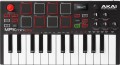 | 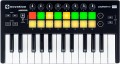 |
|---|---|---|
| Akai MPK Mini Play | Novation Launchkey Mini MK2 | |
from £132.22 | Outdated Product | |
| User reviews | ||
| TOP sellers | ||
Operates on 3 AA batteries. Headphone output. 128 built-in sounds. | ||
| Keys | 25 шт | 25 шт |
| Key size | small-sized | small-sized |
| Mechanics | active (dynamic) | active (dynamic) |
| Rigidity | unweighted | unweighted |
Control | ||
| Pitch controller |  |  |
| Modulation controller | | |
| Octave shift | | |
| Arpeggiator | | |
| Transport control | | |
| Pads | 8 | 16 |
| Regulators (encoders) | 8 | 8 |
Connections | ||
| USB to host (type B) | | |
| Connectable pedals | 1 шт | |
General | ||
| Programming function | | |
| Display | monochrome | |
| Dimensions (WxHxD) | 318x44x181 mm | 325x43x175 mm |
| Weight | 0.75 kg | 0.68 kg |
| Color | ||
| Added to E-Catalog | june 2019 | february 2018 |


Compare Akai MPK Mini Play and Novation Launchkey Mini MK2
You may be interested in
Akai MPK Mini Play often compared


Novation Launchkey Mini MK2 often compared


Glossary
Pitch controller
The presence of a pitch controller in the keyboard (Pitch Bend).
This controller is usually in the form of a small wheel or lever that slightly changes the pitch of the sounding note. This allows you to use some specific playing techniques — for example, to imitate string tightening on a guitar.
This controller is usually in the form of a small wheel or lever that slightly changes the pitch of the sounding note. This allows you to use some specific playing techniques — for example, to imitate string tightening on a guitar.
Modulation controller
The presence of a modulation controller in the keyboard.
This controller allows you to slightly change the volume of the sounding note. It is used mainly to achieve a characteristic "trembling" sound, which can be used both as an artistic technique and to imitate live performance on a particular instrument.
This controller allows you to slightly change the volume of the sounding note. It is used mainly to achieve a characteristic "trembling" sound, which can be used both as an artistic technique and to imitate live performance on a particular instrument.
Arpeggiator
The presence of an arpeggiator in the keyboard.
The name of this function comes from "arpeggio" — a technique for playing chords, in which notes are not played all at once, but in turn. Accordingly, the arpeggiator is a function that allows you to play a taken chord in the arpeggio technique: the musician presses all the keys at once, and the keyboard plays them in turn. This effect can also be achieved manually, but in some cases the arpeggiator turns out to be more convenient: it plays notes at a clearly defined speed and interval, can accompany them with various effects, and provides other additional features. These features vary depending on the model, but some instruments allow you to create entire songs with the arpeggiator by simply pressing a sequence of chords.
The name of this function comes from "arpeggio" — a technique for playing chords, in which notes are not played all at once, but in turn. Accordingly, the arpeggiator is a function that allows you to play a taken chord in the arpeggio technique: the musician presses all the keys at once, and the keyboard plays them in turn. This effect can also be achieved manually, but in some cases the arpeggiator turns out to be more convenient: it plays notes at a clearly defined speed and interval, can accompany them with various effects, and provides other additional features. These features vary depending on the model, but some instruments allow you to create entire songs with the arpeggiator by simply pressing a sequence of chords.
Pads
The number of pads provided in the design of the keyboard.
Pads are auxiliary controls in the form of characteristic pads, usually square. The pads respond to touch, each of them can be tied to a specific sound or even a sequence of sounds. One of the most popular ways to use pads is to play drums or other rhythmic instruments.
Pads are auxiliary controls in the form of characteristic pads, usually square. The pads respond to touch, each of them can be tied to a specific sound or even a sequence of sounds. One of the most popular ways to use pads is to play drums or other rhythmic instruments.
Connectable pedals
The maximum number of pedals that can be connected to the keyboard at the same time.
Pedals are used as additional controls to change various keyboard settings. The “classic of the genre” in this sense is the sustain pedal (see “Sustain”) — if the device has one connector for pedals, then this will almost certainly be the input for just such a pedal. Keyboards are produced, where there are 2 or more such inputs — in addition to sustain, you can connect pedals to them for other adjustments and effects (in particular, changing the volume).
Pedals are used as additional controls to change various keyboard settings. The “classic of the genre” in this sense is the sustain pedal (see “Sustain”) — if the device has one connector for pedals, then this will almost certainly be the input for just such a pedal. Keyboards are produced, where there are 2 or more such inputs — in addition to sustain, you can connect pedals to them for other adjustments and effects (in particular, changing the volume).
Display
The type of display that the keyboard is equipped with.
Most modern MIDI keyboards have relatively simple monochrome (single colour) displays. Such screens are inexpensive, and their capabilities are sufficient for most cases. However, there are also models with colour screens — usually, such equipment is a sign of an advanced keyboard with an abundance of additional functions; for simpler devices, a colour display is overkill.
Most modern MIDI keyboards have relatively simple monochrome (single colour) displays. Such screens are inexpensive, and their capabilities are sufficient for most cases. However, there are also models with colour screens — usually, such equipment is a sign of an advanced keyboard with an abundance of additional functions; for simpler devices, a colour display is overkill.