
Comparison TP-LINK M7650 vs TP-LINK M7450
Add to comparison | 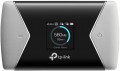 | 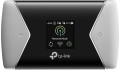 |
|---|---|---|
| TP-LINK M7650 | TP-LINK M7450 | |
| Compare prices 4 | Compare prices 12 | |
| TOP sellers | ||
Connect up to 32 devices. Info display. Slot for a memory card. Control via mobile application tpMiFi. | ||
| Device type | portable router | portable router |
| Wi-Fi | ||
| Connected devices, up to | 32 | 32 |
Connection | ||
| Communication generation | 2G 3G 4G (LTE) | 2G 3G 4G (LTE) |
| 4G (LTE) | Cat.12 (600/100 Mbps) | Cat.6 (300/50 Mbps) |
| Transmission technology | GPRS EDGE HSDPA LTE | GPRS EDGE HSDPA LTE |
| Ports | microUSB | microUSB |
Features | ||
| Memory card slot |  | |
| SIM card slot | | |
| Display | | |
General | ||
| Built-in battery | | |
| Battery capacity | 3000 mAh | 3000 mAh |
| Operating time (internet browsing) | 15 h | 15 h |
| Dimensions | 113x67x16 mm | 113x67x16 mm |
| Added to E-Catalog | december 2021 | december 2021 |




Compare TP-LINK M7650 and M7450
Modems TP-LINK M7650 and TP-LINK M7450 are portable routers with similar characteristics, such as support for 32 connected devices and a memory card slot up to 32 GB. However, the key difference lies in 4G speed: the M7650 supports Cat.12 (600/100 Mbps), while the M7450 is limited to Cat.6 (300/50 Mbps). Both devices have a built-in battery of 3000 mAh and operation time up to 15 hours, making them convenient for use during trips.
Price comparison
You may be interested in
My comparisons
TP-LINK M7650 often compared


TP-LINK M7450 often compared


Glossary
4G (LTE)
The 4G (LTE) mobile connection speed supported by the modem.
All modern LTE equipment is assigned one or another category (Cat.3, Cat.4, Cat.6, Cat.7, Cat.9, Cat.12, Cat.13, Cat.16, Cat.18, Cat.19, Cat.20, Cat.22), on which the transmission speed directly depends. This paragraph specifies both this category and specific speed indicators, moreover, in two parameters — for reception and for transmission. The transmission speed is always much lower, but given the specifics of mobile Internet access, this is usually not critical.
Note that equipment with different speed categories will be quite compatible with each other, however, the throughput will be limited by the capabilities of the slower device. It is also worth saying that this paragraph indicates the theoretical maximum; practical amounts can be noticeably lower (depending on the quality of the network coverage and the features of specific electronics). However, a modem with a higher speed category will perform faster in fact.
All modern LTE equipment is assigned one or another category (Cat.3, Cat.4, Cat.6, Cat.7, Cat.9, Cat.12, Cat.13, Cat.16, Cat.18, Cat.19, Cat.20, Cat.22), on which the transmission speed directly depends. This paragraph specifies both this category and specific speed indicators, moreover, in two parameters — for reception and for transmission. The transmission speed is always much lower, but given the specifics of mobile Internet access, this is usually not critical.
Note that equipment with different speed categories will be quite compatible with each other, however, the throughput will be limited by the capabilities of the slower device. It is also worth saying that this paragraph indicates the theoretical maximum; practical amounts can be noticeably lower (depending on the quality of the network coverage and the features of specific electronics). However, a modem with a higher speed category will perform faster in fact.