
Comparison Quant 9.0 11.7 kVA / 9000 W vs Quant 11 14.3 kVA / 11000 W
Add to comparison | 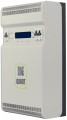 | 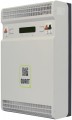 |
|---|---|---|
| Quant 9.0 11.7 kVA / 9000 W | Quant 11 14.3 kVA / 11000 W | |
| Outdated Product | Outdated Product | |
| User reviews | ||
| TOP sellers | ||
the stabilizer is compatible with solar panels. Bypass function. Manual parameter setting. | ||
| AVR type | double conversion | double conversion |
| Input voltage | 230V (1 phase) | 230V (1 phase) |
| Power | 9000 W | 11000 W |
| Power | 11.7 kVA | 14.3 kVA |
Specs | ||
| Input voltage range | 90 – 350 В | 90 – 350 В |
| Output voltage accuracy (±) | 0.5 % | 0.5 % |
| Voltmeter | digital | digital |
Sockets | ||
| Grounded sockets | 1 | 1 |
| Terminal connection |  | |
Protection levels | ||
| Protection | overheating high frequency interference short circuit overload over / under voltage | overheating high frequency interference short circuit overload over / under voltage |
General | ||
| Installation | wall floor | wall floor |
| Cooling | active | active |
| IP protection rating | 20 | 20 |
| Dimensions (HxWxD) | 250x400x120 mm | 330x450x125 mm |
| Weight | 11 kg | 12 kg |
| Added to E-Catalog | july 2020 | july 2020 |


Compare Quant 9.0 and 11
You may be interested in
Quant 9.0 often compared


Quant 11 often compared


Glossary
Power
The maximum active power load permissible for this model.
Active power is the power consumed by AC devices for useful work or heat generation. Additionally, such devices consume reactive power — used for the function of specific components, primarily capacitors and inductive coils. The apparent power, measured in volt-amperes (kilovolt-amperes), is the sum of active and reactive power; see below for more on that. Here, we note that in simple household situations, active power data in watts is usually sufficient for calculations. This parameter is considered key when choosing voltage stabilizers for washing machines and for dishwashers: for the former, an optimal power range is from 2 to 5 kW, and for the latter, from 1.8 to 2.5 kW.
Regardless, the total active power of the connected load should not exceed the figures specified in the stabilizer's specifications. For full assurance, it's wise to have some reserve, though it shouldn't be too large — increasing permissible power significantly affects the size, weight, and price of the device. It's also worth mentioning that there are formulas to convert active power consumption to apparent power, considering the type of connected electrical appliance; these formulas can be found in specialized sources.
It should be noted that manufacturers don't always specify power in watts, sometimes only providing values in kVA. In such case...s, we apply an approximate conversion. Overall, while the value is approximate, it adequately describes the stabilizer's capabilities and helps match specific needs.
Active power is the power consumed by AC devices for useful work or heat generation. Additionally, such devices consume reactive power — used for the function of specific components, primarily capacitors and inductive coils. The apparent power, measured in volt-amperes (kilovolt-amperes), is the sum of active and reactive power; see below for more on that. Here, we note that in simple household situations, active power data in watts is usually sufficient for calculations. This parameter is considered key when choosing voltage stabilizers for washing machines and for dishwashers: for the former, an optimal power range is from 2 to 5 kW, and for the latter, from 1.8 to 2.5 kW.
Regardless, the total active power of the connected load should not exceed the figures specified in the stabilizer's specifications. For full assurance, it's wise to have some reserve, though it shouldn't be too large — increasing permissible power significantly affects the size, weight, and price of the device. It's also worth mentioning that there are formulas to convert active power consumption to apparent power, considering the type of connected electrical appliance; these formulas can be found in specialized sources.
It should be noted that manufacturers don't always specify power in watts, sometimes only providing values in kVA. In such case...s, we apply an approximate conversion. Overall, while the value is approximate, it adequately describes the stabilizer's capabilities and helps match specific needs.
Power
Maximum total load power allowed for this model
In electrical engineering, total power is referred to as the power that accounts for both active and reactive power; the former is discussed above, and the latter can be described as the influence of windings, inductors, and capacitors on the operation of AC networks. Total power is the main parameter for calculating equipment loads in professional electrical engineering and is denoted in volt-amperes (VA), and for stabilizers, in kilovolt-amperes (kVA). Note that for convenience, different types of powers in electrical engineering are designated with units of different names. That's why the power indicated for a stabilizer in watts usually does not equal its power in VA.
When choosing a stabilizer for some household appliances, data on active power is often sufficient, but if possible, it is better to use total power. In particular, this parameter is key when searching for a stabilizer for a refrigerator or a stabilizer for a boiler: in the first case, the optimal value is considered to be 0.4 – 1 kVA, and in the second — from 0.1 to 0.7 kVA. However, in any case, you should choose a specific model so that its total power is not lower than the total power of the entire connected load — and it's better to have a reserve (in case of unforeseen circumstances or connecting additional equipment). At the same time, it should be noted that powerf...ul models are characterized by large dimensions and weight, and above all — high cost; therefore, it is not always wise to chase maximum figures.
It should be noted that manufacturers do not always specify power in kVA, and there is only a value in watts. In such cases, we apply an approximate recalculation. While approximate, the value sufficiently describes the capabilities of the stabilizer and helps select according to specific needs.
We also note that there are formulas that allow deriving the optimal total power of the stabilizer based on data on active power and load type; these can be found in specialized sources.
In electrical engineering, total power is referred to as the power that accounts for both active and reactive power; the former is discussed above, and the latter can be described as the influence of windings, inductors, and capacitors on the operation of AC networks. Total power is the main parameter for calculating equipment loads in professional electrical engineering and is denoted in volt-amperes (VA), and for stabilizers, in kilovolt-amperes (kVA). Note that for convenience, different types of powers in electrical engineering are designated with units of different names. That's why the power indicated for a stabilizer in watts usually does not equal its power in VA.
When choosing a stabilizer for some household appliances, data on active power is often sufficient, but if possible, it is better to use total power. In particular, this parameter is key when searching for a stabilizer for a refrigerator or a stabilizer for a boiler: in the first case, the optimal value is considered to be 0.4 – 1 kVA, and in the second — from 0.1 to 0.7 kVA. However, in any case, you should choose a specific model so that its total power is not lower than the total power of the entire connected load — and it's better to have a reserve (in case of unforeseen circumstances or connecting additional equipment). At the same time, it should be noted that powerf...ul models are characterized by large dimensions and weight, and above all — high cost; therefore, it is not always wise to chase maximum figures.
It should be noted that manufacturers do not always specify power in kVA, and there is only a value in watts. In such cases, we apply an approximate recalculation. While approximate, the value sufficiently describes the capabilities of the stabilizer and helps select according to specific needs.
We also note that there are formulas that allow deriving the optimal total power of the stabilizer based on data on active power and load type; these can be found in specialized sources.