
Comparison PXN V10 V2 vs PXN V10
Add to comparison |  | 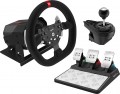 |
|---|---|---|
| PXN V10 V2 | PXN V10 | |
from £305.99 | from £184.99 | |
| TOP sellers | ||
| Device type (configuration) | steering wheel and pedals | steering wheel and pedals |
| Steering wheel size | 27 cm | |
| Detachable steering wheel |  |  |
| Compatibility | PC (Windows) Xbox PlayStation 4 | PC (Windows) Xbox PlayStation 4 |
| Connection | wired | wired |
| Cable | USB-A | USB-A |
Technical specifications | ||
| Total number of buttons | 14 | 14 |
| Feedback | power | power |
| Drive type | hybrid | belt |
| Max. torque | 3.2 Nm | 3.2 Nm |
| Steering wheel turn | 270° – 900° | 270° – 900° |
| Paddle shifters | 4 pcs | 4 pcs |
| Pedals | accelerator brake clutch | accelerator brake clutch |
General information | ||
| Mounting | clamps | clamps |
| Steering wheel cover | alcantara | eco-leather |
| Power source | network | network |
| Color | ||
| Added to E-Catalog | november 2023 | march 2023 |


Compare PXN V10 V2 and V10
You may be interested in
My comparisons
PXN V10 V2 often compared


PXN V10 often compared


Glossary
Steering wheel size
The size of a gaming steering wheel usually refers to the diameter of the wheel in round and D-shaped forms and affects the realism of control, rotation speed, and grip comfort. Compact wheels, around 20 – 24 cm, are more common in simple models and are suitable for arcade racing but feel less realistic. A size of 27 – 30 cm is considered more versatile and closer to an actual car steering wheel, making it convenient for simulators, GT, rally, and everyday play. Larger wheels, 31 – 35 cm, are more often used in advanced setups, especially for trucking simulators, drifts, or the most realistic seating.
For formula wheels or steering wheels with a cut-off shape, the size is more often indicated by the maximum width between the outermost grip points.
For formula wheels or steering wheels with a cut-off shape, the size is more often indicated by the maximum width between the outermost grip points.
Detachable steering wheel
Ability to detach the steering wheel from the base. A removable steering wheel is convenient for storage, transportation, and switching the wheel for different types of racing—for example, installing a round wheel for drifting or a steering wheel for formula racing simulators.
Drive type
The drive type indicates how force from the motor is transmitted to the steering wheel and how realistic the feedback feels in the game.
— Gear-driven. A gear mechanism transmits force from the motor to the steering wheel through gears, so these models are usually simpler and more affordable. It provides basic feedback and is well suited for getting acquainted with racing, but may feel noisier, more stepped, and less smooth than a belt-driven or direct-drive system. Accordingly, a gear-driven steering wheel is suitable for Forza, Need for Speed, or first runs in simulators without serious precision requirements.
— Belt-driven. Transmitting force through a belt makes steering smoother and quieter compared with a gear mechanism. This type of drive usually smooths out jolts better, provides pleasant feedback, and is suitable for those who want a noticeable step up from basic models. A belt-driven steering wheel performs particularly well in circuit racing, where smooth trajectory control and precise vehicle corrections are important.
— Hybrid. A combined drive uses several types of force transmission, most often a belt and gears, to combine an affordable price with smoother feedback. It usually operates more smoothly than a purely gear-driven mechanism, but does not offer the same precision and speed as direct drive. A hybrid steering wheel i...s suitable for players who have outgrown a basic model but are not yet ready to buy an expensive Direct Drive wheelbase.
— Direct-drive. A direct-drive system transmits force from the motor straight to the steering shaft, without belts or gears, so the wheel responds as quickly and precisely as possible. This option is valued for its powerful feedback, detailed transmission of subtle effects, and lack of play, but it is usually more expensive and requires secure mounting. For example, direct drive is well suited to serious sim racing, where it is important to feel tire slip, the vehicle's weight, and the moment it breaks into a skid.
— Gear-driven. A gear mechanism transmits force from the motor to the steering wheel through gears, so these models are usually simpler and more affordable. It provides basic feedback and is well suited for getting acquainted with racing, but may feel noisier, more stepped, and less smooth than a belt-driven or direct-drive system. Accordingly, a gear-driven steering wheel is suitable for Forza, Need for Speed, or first runs in simulators without serious precision requirements.
— Belt-driven. Transmitting force through a belt makes steering smoother and quieter compared with a gear mechanism. This type of drive usually smooths out jolts better, provides pleasant feedback, and is suitable for those who want a noticeable step up from basic models. A belt-driven steering wheel performs particularly well in circuit racing, where smooth trajectory control and precise vehicle corrections are important.
— Hybrid. A combined drive uses several types of force transmission, most often a belt and gears, to combine an affordable price with smoother feedback. It usually operates more smoothly than a purely gear-driven mechanism, but does not offer the same precision and speed as direct drive. A hybrid steering wheel i...s suitable for players who have outgrown a basic model but are not yet ready to buy an expensive Direct Drive wheelbase.
— Direct-drive. A direct-drive system transmits force from the motor straight to the steering shaft, without belts or gears, so the wheel responds as quickly and precisely as possible. This option is valued for its powerful feedback, detailed transmission of subtle effects, and lack of play, but it is usually more expensive and requires secure mounting. For example, direct drive is well suited to serious sim racing, where it is important to feel tire slip, the vehicle's weight, and the moment it breaks into a skid.
Steering wheel cover
The steering wheel covering affects grip, tactile sensations, wear resistance, and comfort during long gameplay. The material determines whether the wheel is pleasant to the touch, won't slip in your hands, and how quickly the surface will lose its appearance with active use.
— Rubber. Practical, affordable, and well-suited for basic gaming wheels. This covering withstands frequent use, is easy to clean, and requires less maintenance, but usually feels simpler compared to leather or Alcantara.
— Alcantara. A pleasant-to-touch material that provides a firm grip, often found in more expensive and sporty steering wheels. It is great for simulators and active driving but gets dirty faster and requires gentle care, especially if playing without gloves.
— Leather. Usually represented by faux leather, making the wheel more akin to a car's and pleasant for everyday gaming. This covering is ideal for general use, GT, rally, and road simulators but may wear out over time in areas of active grip.
— Rubber. Practical, affordable, and well-suited for basic gaming wheels. This covering withstands frequent use, is easy to clean, and requires less maintenance, but usually feels simpler compared to leather or Alcantara.
— Alcantara. A pleasant-to-touch material that provides a firm grip, often found in more expensive and sporty steering wheels. It is great for simulators and active driving but gets dirty faster and requires gentle care, especially if playing without gloves.
— Leather. Usually represented by faux leather, making the wheel more akin to a car's and pleasant for everyday gaming. This covering is ideal for general use, GT, rally, and road simulators but may wear out over time in areas of active grip.