
Comparison Mora Basic 511 LE vs Mora 511
Add to comparison |  | 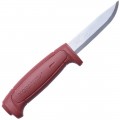 |
|---|---|---|
| Mora Basic 511 LE | Mora 511 | |
| Outdated Product | from $5.08 up to $6.56 | |
| TOP sellers | ||
| Type | knife | knife |
| Suitable for | outdoor (hunting / fishing) | EDC (everyday) |
Specs | ||
| Design | fixed blade | fixed blade |
| Blade profile | clip-point | clip-point |
| Main blade type | smooth | smooth |
| Blade material | steel | steel |
| Hardness | 59 HRC | |
| Blade length | 91 mm | 91 mm |
| Blade thickness | 2 mm | 2 mm |
| Length | 206 mm | 206 mm |
| Weight | 109 g | 110 g |
| Handle material | plastic | plastic |
| More features | subdigital notch / guard plastic scabbard | plastic scabbard |
Tool | ||
| Country of origin | Sweden | Sweden |
| Color | ||
| Added to E-Catalog | july 2024 | january 2016 |


Compare Mora Basic 511 LE and 511
You may be interested in
Mora Basic 511 LE often compared

Mora 511 often compared


Glossary
Suitable for
Characterizes the primary area of use for which the model was designed by the manufacturer. This positioning takes into account the construction, dimensions, materials, equipment, and intended operating conditions: everyday carry, hiking, tactical tasks, training, or use underwater. At the same time, the boundaries between categories are conditional—one knife may be successfully used in different scenarios, so the intended use should be viewed as a manufacturer’s recommendation rather than a strict limitation.
— EDC (everyday carry). Compact knives for regular carry and everyday tasks: opening packages, cutting cord, preparing food, or making minor repairs. These models usually feature a folding design, a clip, a low weight, or a keychain format, so they do not get in the way in a pocket or bag. A compact EDC tool may lack the size and strength needed for demanding outdoor work, so convenience for constant carry is more important here than maximum load.
— Outdoor (hunting / fishing). Models for outdoor trips, setting up camp, working with gear, preparing food, processing branches, field-dressing game, or cleaning fish. In these conditions, a sturdy blade, a secure-grip handle, moisture-resistant materials, and a sheath or reliable locking mechanism in the folded position are especially useful. A compact folding knife is sufficient for easy walks, while extended trips and heavy-duty work...may require a full-size model with a fixed blade.
— Tactical. Knives adapted to demanding field, service, and emergency-rescue conditions. They are characterized by a reliable grip, robust construction, quick opening or deployment, and may include a serrated edge, strap cutter, and glass breaker. Such solutions are useful when working in gloves, with dense materials, and with gear components, but their larger size and aggressive shape are not always convenient for ordinary everyday carry. The designation “tactical” characterizes the model’s construction and equipment; it does not confirm that the model is a weapon.
— Training. Designed for learning knife-handling techniques, flipping, or training sparring with a lower risk of injury. Instead of a fully sharpened edge, it usually has a blunt or imitation blade, and the tip may be rounded. Such a model allows users to practice movements more safely and become accustomed to the design of a real knife, but it is not intended for ordinary cutting tasks.
— For diving. Designed for use underwater, it helps cut tangled fishing line, rope, netting, or other material that could restrict a diver’s movement. These knives are made from corrosion-resistant materials, supplied with reliable sheaths, and designed to attach to the leg, arm, or gear components. A serrated edge and strap cutter make it easier to work with fibrous materials, while a blunt tip on some models reduces the risk of accidentally damaging equipment. After a dive, even a corrosion-resistant knife should preferably be rinsed with fresh water and dried.
— EDC (everyday carry). Compact knives for regular carry and everyday tasks: opening packages, cutting cord, preparing food, or making minor repairs. These models usually feature a folding design, a clip, a low weight, or a keychain format, so they do not get in the way in a pocket or bag. A compact EDC tool may lack the size and strength needed for demanding outdoor work, so convenience for constant carry is more important here than maximum load.
— Outdoor (hunting / fishing). Models for outdoor trips, setting up camp, working with gear, preparing food, processing branches, field-dressing game, or cleaning fish. In these conditions, a sturdy blade, a secure-grip handle, moisture-resistant materials, and a sheath or reliable locking mechanism in the folded position are especially useful. A compact folding knife is sufficient for easy walks, while extended trips and heavy-duty work...may require a full-size model with a fixed blade.
— Tactical. Knives adapted to demanding field, service, and emergency-rescue conditions. They are characterized by a reliable grip, robust construction, quick opening or deployment, and may include a serrated edge, strap cutter, and glass breaker. Such solutions are useful when working in gloves, with dense materials, and with gear components, but their larger size and aggressive shape are not always convenient for ordinary everyday carry. The designation “tactical” characterizes the model’s construction and equipment; it does not confirm that the model is a weapon.
— Training. Designed for learning knife-handling techniques, flipping, or training sparring with a lower risk of injury. Instead of a fully sharpened edge, it usually has a blunt or imitation blade, and the tip may be rounded. Such a model allows users to practice movements more safely and become accustomed to the design of a real knife, but it is not intended for ordinary cutting tasks.
— For diving. Designed for use underwater, it helps cut tangled fishing line, rope, netting, or other material that could restrict a diver’s movement. These knives are made from corrosion-resistant materials, supplied with reliable sheaths, and designed to attach to the leg, arm, or gear components. A serrated edge and strap cutter make it easier to work with fibrous materials, while a blunt tip on some models reduces the risk of accidentally damaging equipment. After a dive, even a corrosion-resistant knife should preferably be rinsed with fresh water and dried.
Hardness
The hardness of the material used for the knife blade. This parameter is one of the key characteristics of the blade. On the one hand, high hardness means that the cutting edge will not deform, wrinkle and dull prematurely, and the blade itself will bend under transverse loads; on the other hand, hard material is difficult to sharpen and is often rather brittle.
For knife blades, Rockwell hardness measurement and designation according to the appropriate scale (HRC) are used. Most good quality steel knives have a hardness of around 52 - 58 HRC - this range is considered to correspond to the optimal ratio of characteristics. For other materials, the numbers can be noticeably lower without any noticeable loss of reliability; see "Blade material" for details. And hardness above 60 HRC is extremely rare - mainly in premium grade steels and higher. In such steels, the brittleness characteristic of hard materials is eliminated through the use of various high-grade additives, and the difficulty in sharpening is compensated by the blade's long service life.
It is worth remembering that hardness is not the only characteristic that determines the quality of the blade: a lot depends on the composition of the alloy, manufacturing technology, etc. However, this is a fairly clear indicator that characterizes the features of a particular material; this is especially true for steel.
For knife blades, Rockwell hardness measurement and designation according to the appropriate scale (HRC) are used. Most good quality steel knives have a hardness of around 52 - 58 HRC - this range is considered to correspond to the optimal ratio of characteristics. For other materials, the numbers can be noticeably lower without any noticeable loss of reliability; see "Blade material" for details. And hardness above 60 HRC is extremely rare - mainly in premium grade steels and higher. In such steels, the brittleness characteristic of hard materials is eliminated through the use of various high-grade additives, and the difficulty in sharpening is compensated by the blade's long service life.
It is worth remembering that hardness is not the only characteristic that determines the quality of the blade: a lot depends on the composition of the alloy, manufacturing technology, etc. However, this is a fairly clear indicator that characterizes the features of a particular material; this is especially true for steel.
Weight
The total weight of the knife. It is worth evaluating this indicator depending on the type (see above) and purpose: for example, for a compact hiking model, light weight is usually a virtue, among hunting and fishing it all depends on specialization, and a machete, by definition, must be weighty — otherwise, cut with such a blade it will just be uncomfortable.
More features
— No point. Models that do not have a pronounced point in the main blade. This design does not allow the blade to make punctures, which in some situations can be an advantage. For example, such models are great for the role of “the first knife for a young tourist”: the absence of a point reduces the likelihood of injury, which is important for children who do not have a clear skill for safe handling of a knife. In "adult" situations, the absence of a point can come in handy, for example, when skinning a hunted animal (so as not to pierce the insides) or cutting a net that fits snugly against the side of a rubber boat. In addition, the presence of a point may be one of the criteria for belonging to a melee weapon; in many countries, a knife without a point is not automatically such a weapon, regardless of other design features.
— Blade lock. The presence of a special lock in the folding knife, which prevents accidental folding of the blade. Such folding is both inconvenient and very traumatic, since the owner's fingers usually get in the way of the blade; blocking prevents such troubles. Note that the lock may not be installed in compact Swiss knives, the blade of which is not dangerous due to its small size, and this function is not found among butterflies in principle — the handle design itself does not allow the knife to fold while held in hand.
— Opening with one hand. The ability t...o open a folding knife (see "Design") with one hand. Among the knives with this feature, two varieties can be distinguished — with manual and automatic opening. In "manual" models, for opening with one hand, a protrusion (peg) or cutout is provided on the blade, which plays the role of a stop for the thumb; in "automatic machines" the blade unfolds (and in many frontal knives — and folds) under the action of a spring controlled by a button or a slider. Anyway, this function provides additional convenience; however, note that in some countries, opening with one hand is considered one of the signs of edged weapons.
Separately, we note that butterfly knives in our catalog are also considered “one-handed”, and by definition: any such knife can be “unwound” from a closed position to an open one using a relatively simple technique.
— Emerson Hook. A device designed to open a folding knife directly when pulled out of a pocket. A knife with such a device, unlike more traditional models, is worn on a clip with the tip up, not down; and the hook itself is located on the butt at the base of the blade and is designed in such a way that when removing the knife, you can catch the hook on the edge of the pocket and open the blade completely or almost completely. This function can be very useful in critical situations, where, as they say, everything is decided in a split second. On the other hand, it is worth bearing in mind that a certain skill is needed to use it effectively; and the Emerson hook is “not friendly” with fabrics, it can damage the material of the pocket, so it is best to use this method of opening with jeans or other clothes made of dense, durable matter.
— Finger notch. The presence in the design of the knife of a special recess located on the handle, where the index finger is placed with a direct grip. This feature provides additional convenience when holding the knife, but makes it less versatile — when using grip options other than straight, the notch can create difficulties (therefore, for example, it is quite rare in hunting models). It should be noted that the presence of a subfinger notch and its depth can serve as one of the criteria for determining whether a weapon belongs to a bladed weapon.
— Strap attachment. The presence in the design of the knife handle of a special fastening for a lanyard — a special strap. The lanyard provides additional convenience when removing the knife from the sheath, can be used to additionally fix the handle in the hand, to install a counterweight that facilitates chopping blows (for machetes and similar models, see "Type"), etc. The traditional strap mount is just a hole in the handle. However, in some types of knives (in particular, Swiss ones), this role can be played by a ring, which is also used to attach the knife itself to a carabiner, a bunch of keys, etc.
— Case. The classic case is an accessory that provides convenience and sometimes additional safety when storing and transporting the tool. At the same time, the difference between such an accessory and a scabbard (which perform a similar function) is that, usually, the knife is placed entirely in the case, while the sheath covers only the blade, leaving the handle outside. Accordingly, folding knives and multi-tools are usually equipped with covers, and such accessories are quite popular among awkward models. And here are the main options for materials:
— Blade lock. The presence of a special lock in the folding knife, which prevents accidental folding of the blade. Such folding is both inconvenient and very traumatic, since the owner's fingers usually get in the way of the blade; blocking prevents such troubles. Note that the lock may not be installed in compact Swiss knives, the blade of which is not dangerous due to its small size, and this function is not found among butterflies in principle — the handle design itself does not allow the knife to fold while held in hand.
— Opening with one hand. The ability t...o open a folding knife (see "Design") with one hand. Among the knives with this feature, two varieties can be distinguished — with manual and automatic opening. In "manual" models, for opening with one hand, a protrusion (peg) or cutout is provided on the blade, which plays the role of a stop for the thumb; in "automatic machines" the blade unfolds (and in many frontal knives — and folds) under the action of a spring controlled by a button or a slider. Anyway, this function provides additional convenience; however, note that in some countries, opening with one hand is considered one of the signs of edged weapons.
Separately, we note that butterfly knives in our catalog are also considered “one-handed”, and by definition: any such knife can be “unwound” from a closed position to an open one using a relatively simple technique.
— Emerson Hook. A device designed to open a folding knife directly when pulled out of a pocket. A knife with such a device, unlike more traditional models, is worn on a clip with the tip up, not down; and the hook itself is located on the butt at the base of the blade and is designed in such a way that when removing the knife, you can catch the hook on the edge of the pocket and open the blade completely or almost completely. This function can be very useful in critical situations, where, as they say, everything is decided in a split second. On the other hand, it is worth bearing in mind that a certain skill is needed to use it effectively; and the Emerson hook is “not friendly” with fabrics, it can damage the material of the pocket, so it is best to use this method of opening with jeans or other clothes made of dense, durable matter.
— Finger notch. The presence in the design of the knife of a special recess located on the handle, where the index finger is placed with a direct grip. This feature provides additional convenience when holding the knife, but makes it less versatile — when using grip options other than straight, the notch can create difficulties (therefore, for example, it is quite rare in hunting models). It should be noted that the presence of a subfinger notch and its depth can serve as one of the criteria for determining whether a weapon belongs to a bladed weapon.
— Strap attachment. The presence in the design of the knife handle of a special fastening for a lanyard — a special strap. The lanyard provides additional convenience when removing the knife from the sheath, can be used to additionally fix the handle in the hand, to install a counterweight that facilitates chopping blows (for machetes and similar models, see "Type"), etc. The traditional strap mount is just a hole in the handle. However, in some types of knives (in particular, Swiss ones), this role can be played by a ring, which is also used to attach the knife itself to a carabiner, a bunch of keys, etc.
— Case. The classic case is an accessory that provides convenience and sometimes additional safety when storing and transporting the tool. At the same time, the difference between such an accessory and a scabbard (which perform a similar function) is that, usually, the knife is placed entirely in the case, while the sheath covers only the blade, leaving the handle outside. Accordingly, folding knives and multi-tools are usually equipped with covers, and such accessories are quite popular among awkward models. And here are the main options for materials:
- Fabric cover. The most popular variety nowadays. As a “fabric”, a durable and reliable material is usually used, resistant to abrasion, temperature extremes, ultraviolet radiation, etc.; a typical example is dense nylon ("cordura") or polyurethane fiber. Anyway, fabric covers are cheaper than leather ones and are not so demanding to care for, while they are reliable, practical, and look good, which is why they are widely used.
- Leather Case. Leather cases differ primarily in their characteristic appearance. Often such a product is not just a utilitarian addition to the knife, but a full-fledged fashion accessory, further emphasizing the style and character of the owner. And in terms of protection, leather covers are somewhat superior to fabric ones. On the other hand, genuine leather is quite expensive, requires special care rules, and in some situations may lose its appearance and performance (for example, when wet and dry quickly, the material may crack). And various leather substitutes (which can also be implied in this case) may have different characteristics — usually, they directly depend on the price.
- Carrying case. This option is indicated in our catalog in two cases: either if the manufacturer did not directly specify the specific material, or if the knife can be supplied with different types of sheaths (at the user's choice or depending on the batch / region of delivery — this point should be specified separately). However, anyway, the material can often be clarified from photographs — after all, covers are most often made of leather or fabric, and it is not difficult to distinguish between these options.
- Plastic scabbard. Plastic is an inexpensive and at the same time quite practical material. Nowadays, there is a wide variety of plastic grades on the market that differ in characteristics; this allows you to choose an option for almost any purpose and price category of a knife. Thanks to this, plastic scabbards are very popular. We only note that products made from kydex (which is also formally plastic) are listed separately in our catalog.
- Kydex scabbard. Kydex was originally a trademark of Sekisui SPI, but nowadays similar materials from other manufacturers are also combined under this name. Kydex is actually a special advanced type of plastic, which is characterized by high strength, scratch resistance (it is difficult to scratch such a surface even on purpose) and general reliability. For illustration, it can be noted that even aviation fairings and marine deep-sea robots are made of such material nowadays. Thus, the scabbard is made of kydex and placed in a separate category. Of course, such products cost more than plastic ones — however, the difference in price is not as serious as one might imagine. So such scabbards can be found even in relatively simple models of knives.
- Leather scabbard. Leather scabbards have the same characteristics as sheaths made of this material. Such products look great; often they, in addition to practical functions, also play the role of fashion accessories. This material is especially well combined with hunting and tourist knives in a traditional design; in fact, such models are most often supplemented with leather scabbards. And on the practical side, the skin is distinguished by excellent strength. At the same time, this material requires certain special rules for use and care. For example, a wet leather product should dry slowly, at a low temperature — otherwise it may lose its luster and become deformed. And for a full guarantee, it is advisable to periodically treat the surface of such scabbards with special means. Also note that genuine leather is quite expensive, and various leather substitutes (which can also be used in this case) may have different characteristics — usually, they directly depend on the price.
- Fabric scabbard. The scabbard is made of dense and durable fabric — usually based on synthetic fibers (for example, nylon cordura). To protect against contact of the fabric with the blade, such products often provide an additional insert made of plastic or other dense material. However, in general, this option, for a number of reasons, is used quite rarely — mainly in relatively inexpensive knives.