
Comparison Mora 546 vs Mora 511
Add to comparison | 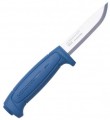 | 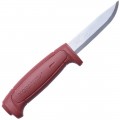 |
|---|---|---|
| Mora 546 | Mora 511 | |
from $6.12 up to $8.48 | from $5.08 up to $6.56 | |
| TOP sellers | ||
| Type | knife | knife |
| Suitable for | outdoor (hunting / fishing) | EDC (everyday) |
Specs | ||
| Design | fixed blade | fixed blade |
| Blade profile | clip-point | clip-point |
| Main blade type | smooth | smooth |
| Blade material | steel | steel |
| Blade length | 91 mm | 91 mm |
| Blade thickness | 2 mm | 2 mm |
| Length | 206 mm | 206 mm |
| Weight | 117 g | 110 g |
| Handle material | plastic | plastic |
| More features | plastic scabbard | plastic scabbard |
Tool | ||
| Country of origin | Sweden | Sweden |
| Color | ||
| Added to E-Catalog | january 2016 | january 2016 |


Compare Mora 546 and 511
Knives Mora 546 and Mora 511 have similar designs: both are fixed-blade with a clip-point blade type and a smooth blade with a length of 91 mm and thickness of 2 mm. The main difference lies in the blade material: Mora 546 is made from regular steel, while Mora 511 uses carbon steel, which can affect durability and sharpening. In terms of weight, Mora 546 is slightly heavier (117 g compared to 110 g for Mora 511), but both knives have a plastic handle and the same length of 206 mm. Both knives are made in Sweden and are available in various colors.
You may be interested in
Mora 546 often compared


Mora 511 often compared

Glossary
Suitable for
Characterizes the primary area of use for which the model was designed by the manufacturer. This positioning takes into account the construction, dimensions, materials, equipment, and intended operating conditions: everyday carry, hiking, tactical tasks, training, or use underwater. At the same time, the boundaries between categories are conditional—one knife may be successfully used in different scenarios, so the intended use should be viewed as a manufacturer’s recommendation rather than a strict limitation.
— EDC (everyday carry). Compact knives for regular carry and everyday tasks: opening packages, cutting cord, preparing food, or making minor repairs. These models usually feature a folding design, a clip, a low weight, or a keychain format, so they do not get in the way in a pocket or bag. A compact EDC tool may lack the size and strength needed for demanding outdoor work, so convenience for constant carry is more important here than maximum load.
— Outdoor (hunting / fishing). Models for outdoor trips, setting up camp, working with gear, preparing food, processing branches, field-dressing game, or cleaning fish. In these conditions, a sturdy blade, a secure-grip handle, moisture-resistant materials, and a sheath or reliable locking mechanism in the folded position are especially useful. A compact folding knife is sufficient for easy walks, while extended trips and heavy-duty work...may require a full-size model with a fixed blade.
— Tactical. Knives adapted to demanding field, service, and emergency-rescue conditions. They are characterized by a reliable grip, robust construction, quick opening or deployment, and may include a serrated edge, strap cutter, and glass breaker. Such solutions are useful when working in gloves, with dense materials, and with gear components, but their larger size and aggressive shape are not always convenient for ordinary everyday carry. The designation “tactical” characterizes the model’s construction and equipment; it does not confirm that the model is a weapon.
— Training. Designed for learning knife-handling techniques, flipping, or training sparring with a lower risk of injury. Instead of a fully sharpened edge, it usually has a blunt or imitation blade, and the tip may be rounded. Such a model allows users to practice movements more safely and become accustomed to the design of a real knife, but it is not intended for ordinary cutting tasks.
— For diving. Designed for use underwater, it helps cut tangled fishing line, rope, netting, or other material that could restrict a diver’s movement. These knives are made from corrosion-resistant materials, supplied with reliable sheaths, and designed to attach to the leg, arm, or gear components. A serrated edge and strap cutter make it easier to work with fibrous materials, while a blunt tip on some models reduces the risk of accidentally damaging equipment. After a dive, even a corrosion-resistant knife should preferably be rinsed with fresh water and dried.
— EDC (everyday carry). Compact knives for regular carry and everyday tasks: opening packages, cutting cord, preparing food, or making minor repairs. These models usually feature a folding design, a clip, a low weight, or a keychain format, so they do not get in the way in a pocket or bag. A compact EDC tool may lack the size and strength needed for demanding outdoor work, so convenience for constant carry is more important here than maximum load.
— Outdoor (hunting / fishing). Models for outdoor trips, setting up camp, working with gear, preparing food, processing branches, field-dressing game, or cleaning fish. In these conditions, a sturdy blade, a secure-grip handle, moisture-resistant materials, and a sheath or reliable locking mechanism in the folded position are especially useful. A compact folding knife is sufficient for easy walks, while extended trips and heavy-duty work...may require a full-size model with a fixed blade.
— Tactical. Knives adapted to demanding field, service, and emergency-rescue conditions. They are characterized by a reliable grip, robust construction, quick opening or deployment, and may include a serrated edge, strap cutter, and glass breaker. Such solutions are useful when working in gloves, with dense materials, and with gear components, but their larger size and aggressive shape are not always convenient for ordinary everyday carry. The designation “tactical” characterizes the model’s construction and equipment; it does not confirm that the model is a weapon.
— Training. Designed for learning knife-handling techniques, flipping, or training sparring with a lower risk of injury. Instead of a fully sharpened edge, it usually has a blunt or imitation blade, and the tip may be rounded. Such a model allows users to practice movements more safely and become accustomed to the design of a real knife, but it is not intended for ordinary cutting tasks.
— For diving. Designed for use underwater, it helps cut tangled fishing line, rope, netting, or other material that could restrict a diver’s movement. These knives are made from corrosion-resistant materials, supplied with reliable sheaths, and designed to attach to the leg, arm, or gear components. A serrated edge and strap cutter make it easier to work with fibrous materials, while a blunt tip on some models reduces the risk of accidentally damaging equipment. After a dive, even a corrosion-resistant knife should preferably be rinsed with fresh water and dried.
Weight
The total weight of the knife. It is worth evaluating this indicator depending on the type (see above) and purpose: for example, for a compact hiking model, light weight is usually a virtue, among hunting and fishing it all depends on specialization, and a machete, by definition, must be weighty — otherwise, cut with such a blade it will just be uncomfortable.