
Comparison Stanley SCH201D2K vs Stanley SCD20C2K
Add to comparison | 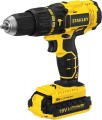 | 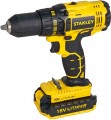 |
|---|---|---|
| Stanley SCH201D2K | Stanley SCD20C2K | |
from $120.84 up to $153.52 | from £235.00 | |
| User reviews | ||
| TOP sellers | ||
| Product type | drill driver | drill driver |
| Design | gun | gun |
Specs | ||
| Real power | 283 W | |
| Rotation speed | 350/1500 rpm | 350/1500 rpm |
| Max. beats | 26000 bpm | |
| Torque | 45 Nm with adjustment 22 steps | 29 Nm with adjustment 22 steps |
| Reducer | 2-speed | 2-speed |
| Number of speeds | 2 | 2 |
| Reverse | slider | slider |
| Weight | 1.4 kg | 1.5 kg |
Chuck | ||
| Chuck type | keyless | keyless |
| Chuck diameter | 13 mm | 13 mm |
| Wood drilling max. ⌀ | 35 mm | 38 mm |
| Metal drilling max. ⌀ | 13 mm | 13 mm |
| Concrete drilling max. ⌀ | 13 mm | |
Protective functions | ||
| Motor brake |  | |
Features | ||
| Features | impact mode backlight | backlight |
| In box | case (bag) charger | case (bag) charger |
Power supply | ||
| Power source | battery | battery |
| Battery in set | 2 | 2 |
| Battery voltage | 18 В | 18 В |
| Battery capacity | 2 Ah | 1.3 Ah |
| Compatible batteries | SB20C, SB20S, SB20D, SB20M | SB20C, SB20S, SB20D, SB20M |
| Charging time | 60 min | |
| Added to E-Catalog | september 2016 | march 2016 |


Compare Stanley SCH201D2K and SCD20C2K
You may be interested in
Stanley SCH201D2K often compared


Stanley SCD20C2K often compared


Glossary
Real power
The useful power of the tool is the maximum power that it can deliver to the working nozzle. This power is always less than the power consumed (see below), since part of the electricity inevitably goes to heat and friction in the tool mechanisms. In addition, this parameter is not given for every model, often information in the characteristics is limited to power consumption. Nevertheless, the actual capabilities of the tool directly depend on the net power: the higher it is, the greater the speed and/or torque this model is able to develop, the easier it is for it to cope with tasks that require high efforts. So, to compare different devices with each other, it is best to use this parameter (of course, you can only compare models of the same type or similar in type).
Also note that high working power is not always an advantage: it accordingly affects the dimensions, weight and price of the tool, while in fact high speeds and efforts are not always necessary. Detailed recommendations on the optimal values for different tools and different types of work can be found in special sources.
Also note that high working power is not always an advantage: it accordingly affects the dimensions, weight and price of the tool, while in fact high speeds and efforts are not always necessary. Detailed recommendations on the optimal values for different tools and different types of work can be found in special sources.
Max. beats
The number of beats per minute provided by a tool that supports the corresponding mode.
For more information about this mode, see "Functions", here we note that it can be provided both in drills and in screwdrivers and wrenches (see "Device"), and the meaning of the impact mode in these varieties is somewhat different. Therefore, the speeds differ: many drills are capable of delivering about 48,000 beats / min, or even 64,000 beats / min, while in screwdrivers and wrenches, 3200 beats / min are considered “classics of the genre”, and values above 3500 beats / min are practically do not meet.
The general meaning of this indicator is also directly related to the type. So, among drills, the difference in chiseling speed can be quite large. With these tools, more strokes improve overall productivity and efficiency, while fewer strokes improve accuracy and reduce the risk of damaging delicate materials. In screwdrivers and nutrunners, high speed also contributes to overall efficiency, but for most of these tools, the differences in this indicator are not significant enough to be noticeable in practice.
For more information about this mode, see "Functions", here we note that it can be provided both in drills and in screwdrivers and wrenches (see "Device"), and the meaning of the impact mode in these varieties is somewhat different. Therefore, the speeds differ: many drills are capable of delivering about 48,000 beats / min, or even 64,000 beats / min, while in screwdrivers and wrenches, 3200 beats / min are considered “classics of the genre”, and values above 3500 beats / min are practically do not meet.
The general meaning of this indicator is also directly related to the type. So, among drills, the difference in chiseling speed can be quite large. With these tools, more strokes improve overall productivity and efficiency, while fewer strokes improve accuracy and reduce the risk of damaging delicate materials. In screwdrivers and nutrunners, high speed also contributes to overall efficiency, but for most of these tools, the differences in this indicator are not significant enough to be noticeable in practice.
Torque
Torque is the maximum force with which this model is capable of turning the working nozzle.
Higher torque gives more options, it allows you to cope with complex tasks such as drilling in hard materials, unscrewing stuck screws and nuts, etc. On the other hand, a lot of force requires corresponding power — and this, in turn, affects the dimensions , weight and cost of the tool itself, and also puts forward increased power requirements (mains power, battery capacity or pressure / compressor performance). And for some tasks, excessive torque is basically unacceptable, so for maximum versatility, it is desirable to have torque control — and this affects the cost even more. And the more steps, the more optimally you can configure the tool to perform a particular type of work. So the general rule is this: when choosing, it is worth considering the specifics of the planned work, and not chasing the greatest working effort.
Detailed recommendations on choosing the optimal torque for different types of tools (see "Device") can be found in special sources. Here we note that it is of key importance primarily for screwdrivers, although it is also given for other types of tools. At the same time, in the “weakest” models, the maximum working force does not exceed 15 Nm, in the most powerful ones it is more than 150 Nm.
Higher torque gives more options, it allows you to cope with complex tasks such as drilling in hard materials, unscrewing stuck screws and nuts, etc. On the other hand, a lot of force requires corresponding power — and this, in turn, affects the dimensions , weight and cost of the tool itself, and also puts forward increased power requirements (mains power, battery capacity or pressure / compressor performance). And for some tasks, excessive torque is basically unacceptable, so for maximum versatility, it is desirable to have torque control — and this affects the cost even more. And the more steps, the more optimally you can configure the tool to perform a particular type of work. So the general rule is this: when choosing, it is worth considering the specifics of the planned work, and not chasing the greatest working effort.
Detailed recommendations on choosing the optimal torque for different types of tools (see "Device") can be found in special sources. Here we note that it is of key importance primarily for screwdrivers, although it is also given for other types of tools. At the same time, in the “weakest” models, the maximum working force does not exceed 15 Nm, in the most powerful ones it is more than 150 Nm.
Weight
The total weight of the tool is usually the device itself, without attachments. For battery models (see "Power Source"), usually, the weight is indicated with a standard battery installed; for battery-powered models, the weight can be given both with and without batteries, but in this case this point is not particularly important.
Other things being equal, less weight simplifies work, increases accuracy of movement and allows you to use the tool for longer without tiring. However, note that high power and productivity inevitably increase the mass of the tool; and various tricks to reduce weight increase the price and can reduce reliability. In addition, in some cases, a massive design is more preferable. First of all, this applies to work with a large load — for example, drilling holes of large diameter, or making recesses with impact: a heavy tool is more stable, it is less prone to jerks and shifts due to uneven material, vibration of mechanisms, etc.
It is also worth noting that specific weight values are directly related to the type of tool (see "Device"). Screwdrivers are the lightest — in most of them this figure does not exceed 500 g. Screwdrivers and drill drivers are more "heavy": their average weight is 1.1 – 1.5 kg, although there are many lighter ( 0.6 – 1 kg) and heavier ( 1.6 – 2 kg or more ) models. And clas...sic drills and wrenches have the greatest weight: such a tool must be quite powerful, so for them 1.6 – 2 kg is an average, 2.1 – 2.5 kg is above average, and many units weigh more than 2, 5 kg.
Other things being equal, less weight simplifies work, increases accuracy of movement and allows you to use the tool for longer without tiring. However, note that high power and productivity inevitably increase the mass of the tool; and various tricks to reduce weight increase the price and can reduce reliability. In addition, in some cases, a massive design is more preferable. First of all, this applies to work with a large load — for example, drilling holes of large diameter, or making recesses with impact: a heavy tool is more stable, it is less prone to jerks and shifts due to uneven material, vibration of mechanisms, etc.
It is also worth noting that specific weight values are directly related to the type of tool (see "Device"). Screwdrivers are the lightest — in most of them this figure does not exceed 500 g. Screwdrivers and drill drivers are more "heavy": their average weight is 1.1 – 1.5 kg, although there are many lighter ( 0.6 – 1 kg) and heavier ( 1.6 – 2 kg or more ) models. And clas...sic drills and wrenches have the greatest weight: such a tool must be quite powerful, so for them 1.6 – 2 kg is an average, 2.1 – 2.5 kg is above average, and many units weigh more than 2, 5 kg.
Wood drilling max. ⌀
The largest diameter of holes that the tool can make when drilling with a conventional drill in wood.
The larger the hole diameter, the higher the resistance of the material, the more power the tool must provide and the higher the load on it. Therefore, the maximum allowable drilling diameter must not be exceeded, even if the chuck allows you to install a thicker drill bit — this can lead to tool breakage and even injury to others.
It is worth noting that some types of wood can have a fairly high density, and for them the actual allowable drill diameter will be, accordingly, less than the claimed one. However, this is true mainly for exotic breeds, which are extremely rare in our area.
The larger the hole diameter, the higher the resistance of the material, the more power the tool must provide and the higher the load on it. Therefore, the maximum allowable drilling diameter must not be exceeded, even if the chuck allows you to install a thicker drill bit — this can lead to tool breakage and even injury to others.
It is worth noting that some types of wood can have a fairly high density, and for them the actual allowable drill diameter will be, accordingly, less than the claimed one. However, this is true mainly for exotic breeds, which are extremely rare in our area.
Concrete drilling max. ⌀
The largest diameter of the holes that the tool is capable of making when drilling with a conventional drill in concrete. It is worth considering that in this case we are not talking about reinforced concrete — this material requires special methods of influence (ideally, the use of diamond crowns).
The larger the hole diameter, the higher the resistance of the material, the more power the tool must provide and the higher the load on it. Therefore, the maximum allowable drilling diameter must not be exceeded, even if the chuck allows you to install a thicker drill bit — this can lead to tool breakage and even injury to others.
The larger the hole diameter, the higher the resistance of the material, the more power the tool must provide and the higher the load on it. Therefore, the maximum allowable drilling diameter must not be exceeded, even if the chuck allows you to install a thicker drill bit — this can lead to tool breakage and even injury to others.
Features
— Impact Mode. The ability to work in the so-called impact mode. Usually, this mode is switched on and off at the user's discretion, and its meaning and features can vary depending on the type of tool (see "Device"). For example, in drills, impacts are made along the drill axis, typically at a rate of several thousand per minute, positively affecting performance and allowing more efficient handling of hard, dense materials (although such a drill still cannot fully replace a rotary hammer). Conversely, in screwdrivers and impact wrenches, the impact mode would more accurately be called impulse: in this work format, the tool's attachment rotates in separate jerks, usually at a frequency of about 3,000 per minute. This also enhances work efficiency, which is especially useful when screwing screws into dense material and loosening old, "stuck" fasteners.
— Power Button Lock. A function that allows the power button to be fixed in the pressed position. Usually, it has the form of an additional button installed either on the main trigger or nearby. This function is very convenient in situations where the tool has to be used for a long time without breaks — for instance, when drilling several dozen holes: it is easier to fix the start button in the on position than to hold it down constantly, further straining the finger on the working hand. And the lock is usually turned off in the simplest way — for exampl...e, by briefly pressing the same start button.
— Speed Control. The ability to additionally limit the tool's speed. Smooth adjustment is present in almost all modern models: the harder the start button is pressed, the higher the speed. This allows you to adjust the tool's operation mode on the fly to suit the situation's characteristics. And this regulator allows setting the maximum rotation speed, so even when the button is pressed "to the limit," the working nozzles' speed does not exceed the set value. This function is indispensable for some tasks requiring precision — notably when handling delicate materials where too high a speed is fraught with damage.
It is important to note that having a speed controller is not related to the number of speed settings (see above). For example, a tool may very well have several speed modes, each of which can have its speed further limited by the controller.
— Speed Maintenance. A function that allows maintaining a constant rotation speed of the nozzle, regardless of the load on it. Without special regulation, at the engine's constant power, the rotation speed inevitably decreases with increased load and increases with decreased load. And the speed maintenance system monitors resistance on the nozzle and, if necessary, changes power so that the rotation speed remains constant. This positively affects both the quality of work and the longevity of the nozzles and the entire tool.
— Brushless Motor. The presence of a brushless (commutatorless) motor in the power tool. Such motors significantly surpass traditional commutator motors in efficiency, which allows for a noticeable reduction in energy consumption without sacrificing power; this is especially important for battery-powered tools (see "Power Source"), where this feature is predominantly found. Besides, brushless motors are less noisy and practically do not produce sparks during operation, making them ideal for work in increased fire hazard conditions. Their main drawbacks are traditional — complex design and high cost.
— Lighting. Built-in light for illuminating the work area. This function can be useful both in evening/night time and in hard-to-reach places where outside lighting poorly penetrates, and also in situations where this lighting is too dim. In most cases, it is implemented with a single LED that lights the working area in front of the tool.
— Ring Lighting. An advanced lighting system where LEDs are arranged around the chuck, allowing for even illumination of the drilling or screwing area. Thus, light falls not from the side but precisely around the working part, reducing interference from shadows cast by the body, hand, or bit. This helps start drilling more accurately, hit the slot with the bit more neatly, and work more confidently with small fasteners. In practice, ring lighting is especially convenient when assembling furniture, installing shelves, working under a sink, or repairing places where little general light penetrates.
— Display. Own display on which various information about the work and state of the device can be displayed — for example, the torque set in the settings or the rotation speed, and in battery models — also a battery charge indicator. Such a screen provides additional convenience and visibility; however, overall, it is quite a specific function that is extremely rare in modern power tools — for instance, speed or torque indicators can be provided directly on the regulator, while a simple LED that signals by blinking or changing color can be used as a charge indicator.
— Smartphone Synchronization. The ability to connect the tool to a smartphone or other gadget (for example, a tablet) via Wi-Fi or Bluetooth. Such a connection is usually used to adjust work parameters like speed or torque; doing this through a mobile app is often more convenient than through the controls on the tool itself. And some models with this feature allow you to set access via a password: the tool simply will not respond to the start button until the correct password is entered on the controlling gadget.
— Built-in Bubble Level. An integrated device for controlling the angle of the tool relative to the horizon. As with regular levels, the scale's role in such devices is played by a sealed vial with marked lines containing brightly colored liquid and an air bubble. By the position of this bubble relative to the marks, the entire tool's position is determined — namely, its alignment with vertical, horizontal, or a predetermined tilt angle (the latter option is virtually never found in built-in levels). In manual tools, usually a single-axis level is provided, reacting only to deviations from horizontal forward or backward, while models with the ability to be mounted on a stand (see below) may also have a circular level, checking vertical alignment and detecting deviations from it in any direction.
— Bit Compartment. A storage place for interchangeable attachments directly in the tool's housing, handle, or battery base. Most often, it is a simple slot or holder for one bit, so the most frequently used attachment is always at hand and does not get lost during work. Less commonly, there is a drum compartment or built-in magazine for several bits.
— Water Cooling (SOL). The presence of SOL in the tool — a liquid cooling system (most often plain water) supplied to the working nozzle using a built-in pump. Such a system performs several functions simultaneously. Firstly, it actually cools the nozzle, preventing damage due to overheating. Secondly, the liquid slightly reduces friction at the contact point, further reducing load on the nozzle and increasing its durability. Thirdly, water absorbs the dust formed during drilling, preventing it from dispersing into the air and entering the lungs of surrounding people; and cleaning after work is significantly simplified. On the other hand, water cooling systems are quite expensive and bulky, and for relatively simple tasks and low loads, it is quite possible to do without SOL.
— Power Button Lock. A function that allows the power button to be fixed in the pressed position. Usually, it has the form of an additional button installed either on the main trigger or nearby. This function is very convenient in situations where the tool has to be used for a long time without breaks — for instance, when drilling several dozen holes: it is easier to fix the start button in the on position than to hold it down constantly, further straining the finger on the working hand. And the lock is usually turned off in the simplest way — for exampl...e, by briefly pressing the same start button.
— Speed Control. The ability to additionally limit the tool's speed. Smooth adjustment is present in almost all modern models: the harder the start button is pressed, the higher the speed. This allows you to adjust the tool's operation mode on the fly to suit the situation's characteristics. And this regulator allows setting the maximum rotation speed, so even when the button is pressed "to the limit," the working nozzles' speed does not exceed the set value. This function is indispensable for some tasks requiring precision — notably when handling delicate materials where too high a speed is fraught with damage.
It is important to note that having a speed controller is not related to the number of speed settings (see above). For example, a tool may very well have several speed modes, each of which can have its speed further limited by the controller.
— Speed Maintenance. A function that allows maintaining a constant rotation speed of the nozzle, regardless of the load on it. Without special regulation, at the engine's constant power, the rotation speed inevitably decreases with increased load and increases with decreased load. And the speed maintenance system monitors resistance on the nozzle and, if necessary, changes power so that the rotation speed remains constant. This positively affects both the quality of work and the longevity of the nozzles and the entire tool.
— Brushless Motor. The presence of a brushless (commutatorless) motor in the power tool. Such motors significantly surpass traditional commutator motors in efficiency, which allows for a noticeable reduction in energy consumption without sacrificing power; this is especially important for battery-powered tools (see "Power Source"), where this feature is predominantly found. Besides, brushless motors are less noisy and practically do not produce sparks during operation, making them ideal for work in increased fire hazard conditions. Their main drawbacks are traditional — complex design and high cost.
— Lighting. Built-in light for illuminating the work area. This function can be useful both in evening/night time and in hard-to-reach places where outside lighting poorly penetrates, and also in situations where this lighting is too dim. In most cases, it is implemented with a single LED that lights the working area in front of the tool.
— Ring Lighting. An advanced lighting system where LEDs are arranged around the chuck, allowing for even illumination of the drilling or screwing area. Thus, light falls not from the side but precisely around the working part, reducing interference from shadows cast by the body, hand, or bit. This helps start drilling more accurately, hit the slot with the bit more neatly, and work more confidently with small fasteners. In practice, ring lighting is especially convenient when assembling furniture, installing shelves, working under a sink, or repairing places where little general light penetrates.
— Display. Own display on which various information about the work and state of the device can be displayed — for example, the torque set in the settings or the rotation speed, and in battery models — also a battery charge indicator. Such a screen provides additional convenience and visibility; however, overall, it is quite a specific function that is extremely rare in modern power tools — for instance, speed or torque indicators can be provided directly on the regulator, while a simple LED that signals by blinking or changing color can be used as a charge indicator.
— Smartphone Synchronization. The ability to connect the tool to a smartphone or other gadget (for example, a tablet) via Wi-Fi or Bluetooth. Such a connection is usually used to adjust work parameters like speed or torque; doing this through a mobile app is often more convenient than through the controls on the tool itself. And some models with this feature allow you to set access via a password: the tool simply will not respond to the start button until the correct password is entered on the controlling gadget.
— Built-in Bubble Level. An integrated device for controlling the angle of the tool relative to the horizon. As with regular levels, the scale's role in such devices is played by a sealed vial with marked lines containing brightly colored liquid and an air bubble. By the position of this bubble relative to the marks, the entire tool's position is determined — namely, its alignment with vertical, horizontal, or a predetermined tilt angle (the latter option is virtually never found in built-in levels). In manual tools, usually a single-axis level is provided, reacting only to deviations from horizontal forward or backward, while models with the ability to be mounted on a stand (see below) may also have a circular level, checking vertical alignment and detecting deviations from it in any direction.
— Bit Compartment. A storage place for interchangeable attachments directly in the tool's housing, handle, or battery base. Most often, it is a simple slot or holder for one bit, so the most frequently used attachment is always at hand and does not get lost during work. Less commonly, there is a drum compartment or built-in magazine for several bits.
— Water Cooling (SOL). The presence of SOL in the tool — a liquid cooling system (most often plain water) supplied to the working nozzle using a built-in pump. Such a system performs several functions simultaneously. Firstly, it actually cools the nozzle, preventing damage due to overheating. Secondly, the liquid slightly reduces friction at the contact point, further reducing load on the nozzle and increasing its durability. Thirdly, water absorbs the dust formed during drilling, preventing it from dispersing into the air and entering the lungs of surrounding people; and cleaning after work is significantly simplified. On the other hand, water cooling systems are quite expensive and bulky, and for relatively simple tasks and low loads, it is quite possible to do without SOL.
Battery capacity
The capacity of the battery that comes with the corresponding tool (see “Power source”). The most limited capacity values in modern power tools do not even reach 1 Ah ; such batteries are found mainly among electric screwdrivers(see “Device”). And in powerful professional models there are batteries with 3 - 4 Ah or even more.
In theory, the higher the capacity, the longer the tool can work on a single battery charge. However, in practice, everything is far from so simple. Firstly, ampere-hours are a fairly specific unit; its features are such that only batteries with the same voltage can be directly compared by the number of ampere-hours. If there is a difference in voltage, you need to convert the capacity into watt hours and use them for comparison. Secondly, the actual autonomy of the tool depends not only on the properties of the battery, but also on power consumption and other performance characteristics. Thus, it is possible to compare different models in terms of battery capacity only with the same supply voltage and similar capabilities.
In theory, the higher the capacity, the longer the tool can work on a single battery charge. However, in practice, everything is far from so simple. Firstly, ampere-hours are a fairly specific unit; its features are such that only batteries with the same voltage can be directly compared by the number of ampere-hours. If there is a difference in voltage, you need to convert the capacity into watt hours and use them for comparison. Secondly, the actual autonomy of the tool depends not only on the properties of the battery, but also on power consumption and other performance characteristics. Thus, it is possible to compare different models in terms of battery capacity only with the same supply voltage and similar capabilities.
Charging time
The time to fully charge the battery that the tool is equipped with from a standard charger (when using other batteries or a “non-native” charger, this time may vary both in one direction and in the other).
For cordless tools in general, see "Power Source". And charging time data gives you an idea of how you'll need to organize your workflow and how long breaks you'll need to charge your batteries. The specific duration of the process will depend both on the capacity of the battery (ceteris paribus, a more capacious model takes longer to charge), and on the technologies used by the manufacturer that increase charging efficiency. However, in general, it is customary to refer to tools with a good charging speed as models where this procedure takes no more than 45 minutes.
We also note that the specific meaning of this parameter also depends on the number of batteries in the kit. Recall that there are often several of them at once (see "Complete battery"), and while one battery is working, the rest can be charged. This allows you to reduce interruptions to a minimum, and even completely do without them. But if there is only one battery, charging breaks will inevitably be required in full. This is especially true for tools with a built-in power source (in models with replaceable batteries, the situation can be corrected by purchasing additional batteries).
For cordless tools in general, see "Power Source". And charging time data gives you an idea of how you'll need to organize your workflow and how long breaks you'll need to charge your batteries. The specific duration of the process will depend both on the capacity of the battery (ceteris paribus, a more capacious model takes longer to charge), and on the technologies used by the manufacturer that increase charging efficiency. However, in general, it is customary to refer to tools with a good charging speed as models where this procedure takes no more than 45 minutes.
We also note that the specific meaning of this parameter also depends on the number of batteries in the kit. Recall that there are often several of them at once (see "Complete battery"), and while one battery is working, the rest can be charged. This allows you to reduce interruptions to a minimum, and even completely do without them. But if there is only one battery, charging breaks will inevitably be required in full. This is especially true for tools with a built-in power source (in models with replaceable batteries, the situation can be corrected by purchasing additional batteries).