
Comparison Edifier S880DB vs Edifier S360DB
Add to comparison | 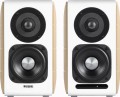 | 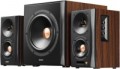 |
|---|---|---|
| Edifier S880DB | Edifier S360DB | |
| Compare prices 3 | Compare prices 3 | |
| User reviews | ||
| TOP sellers | ||
Separate amplifiers for each band. Hi-Res Audio | Wireless subwoofer | |
| Speakers | kit 2.0 | kit 2.1 |
| Lines | 2 | 2 |
Specs | ||
| Signal-to-noise ratio | 85 dB | 85 dB |
| Frequency range | 55 – 20000 Hz | 40 – 20000 Hz |
| Speaker output | 88 W | 150 W |
| Front | 44 W/channel | 40 W/channel |
| Subwoofer | 70 W | |
| Speaker port tube |  | |
Features | ||
| Functions | Bluetooth aptX treble control bass control | Bluetooth aptX treble control bass control |
| Connection | RCA optical input coaxial input | RCA optical input coaxial input |
General | ||
| Detachable cable | power and sound | power and sound |
| Remote control | wireless | wireless |
| Volume control | behind and on the remote | side and remote |
| Speaker material | MDF | MDF |
| Subwoofer material | MDF | |
| Front speaker size (WxHxD) | 138x230x168 mm | 140x253x177 mm |
| Subwoofer size | 322x275x299 mm | |
| Weight | 7.5 kg | 17.4 kg |
| Color | ||
| Added to E-Catalog | february 2018 | january 2018 |






Compare Edifier S880DB and S360DB
Price comparison
You may be interested in
Edifier S880DB often compared


Edifier S360DB often compared


Glossary
Speakers
The number of individual speakers included in the package. In most cases, here, in fact, the sound format supported by the kit is indicated, and the actual number of speakers also corresponds to it. For example, the 2.0 kit includes a regular pair of stereo speakers (no subwoofer); this is most often considered quite sufficient for listening to music. 2.1 is two main speakers plus a subwoofer, 5.1 is five speakers (centre, front pair, rear pair) and a subwoofer. It is worth noting here that 5.1 is the most advanced format found in modern computer acoustics. It already allows you to achieve the effect of surround sound "from all sides" and at the same time is relatively inexpensive. More extensive sets — 7.1, etc. — should be looked for already in general-purpose acoustics.
A specific case is models in the form of a single column. Usually, they are stereo systems (2.0), made in the format of "soundbars" — two speakers (or two sets of speakers) in one common housing. In some situations, such devices are more convenient than separate speakers; on the other hand, soundbars are more bulky and do not allow you to change the relative position of the speakers, adjusting the sound. Therefore, this option is rare nowadays.
A specific case is models in the form of a single column. Usually, they are stereo systems (2.0), made in the format of "soundbars" — two speakers (or two sets of speakers) in one common housing. In some situations, such devices are more convenient than separate speakers; on the other hand, soundbars are more bulky and do not allow you to change the relative position of the speakers, adjusting the sound. Therefore, this option is rare nowadays.
Frequency range
The range of audio frequencies supported by acoustics. The wider this range — the fuller the reproduced sound, the lower the likelihood that some of these details at low or high frequencies will remain “behind the scenes”. At the same time, the human ear is able to hear frequencies of the order of 16 – 22,000 Hz, and with age, this range narrows even more. In modern audio equipment, especially at the top level, there may be more extensive ranges, but from a practical point of view, this does not make much sense. In addition, it is worth noting that a wide frequency range in itself does not guarantee high-quality sound — a lot also depends on the frequency response.
Speaker output
Total speaker power rating — the sum of the power ratings of all components (front, rear, centre, etc.)
Rated usually means the highest average sound power that the speakers can produce without overloading and damage. Individual peaks of sound can significantly exceed this figure, but it is the average value that is key — in particular, it is it that determines the overall loudness of the acoustics. However it should be borne in mind here that in sets with a subwoofer, the latter can account for about half of the total power of the entire system, while the actual volume is determined mainly by the main speakers. In fact, this means that with equal total power, acoustics with a subwoofer can sound noticeably quieter than a model without a subwoofer: for example, a 2.0 system at 20 W will have 10 W per main channel, while in a 2.1 model at 20 W with 10- watt subwoofer on the main speakers will have only 5 watts.
As for specific values, in the quietest modern PC speakers, the power does not exceed 10 watts. An indicator of 10 – 25 W can be called relatively modest, 25 – 50 W — average, and values of 50 – 100 W and above are found mainly in sets with subwoofers, where a significant part of the power falls on the bass speaker (although there are also ordinary stereo speakers with similar features)....
Theoretically, the power of acoustics also affects its compatibility with a specific amplifier: speakers should not be inferior to it in terms of rated power, otherwise sound distortion and even equipment damage are possible. However, computer acoustics in the vast majority of cases are used with their own amplifiers, optimally matched to the speakers installed in the speakers. So this moment becomes relevant only in some very specific cases — for example, when replacing a complete external amplifier (see below) with another one.
Rated usually means the highest average sound power that the speakers can produce without overloading and damage. Individual peaks of sound can significantly exceed this figure, but it is the average value that is key — in particular, it is it that determines the overall loudness of the acoustics. However it should be borne in mind here that in sets with a subwoofer, the latter can account for about half of the total power of the entire system, while the actual volume is determined mainly by the main speakers. In fact, this means that with equal total power, acoustics with a subwoofer can sound noticeably quieter than a model without a subwoofer: for example, a 2.0 system at 20 W will have 10 W per main channel, while in a 2.1 model at 20 W with 10- watt subwoofer on the main speakers will have only 5 watts.
As for specific values, in the quietest modern PC speakers, the power does not exceed 10 watts. An indicator of 10 – 25 W can be called relatively modest, 25 – 50 W — average, and values of 50 – 100 W and above are found mainly in sets with subwoofers, where a significant part of the power falls on the bass speaker (although there are also ordinary stereo speakers with similar features)....
Theoretically, the power of acoustics also affects its compatibility with a specific amplifier: speakers should not be inferior to it in terms of rated power, otherwise sound distortion and even equipment damage are possible. However, computer acoustics in the vast majority of cases are used with their own amplifiers, optimally matched to the speakers installed in the speakers. So this moment becomes relevant only in some very specific cases — for example, when replacing a complete external amplifier (see below) with another one.
Front
The power rating of each individual front speaker provided in the speaker system. This parameter can be specified for a system with any number of speakers (see above) — all sound formats used in computer acoustics provide a pair of front speakers.
In the most general terms, the higher the power, the louder the speaker is capable of sounding. For more information about this parameter, see "Total power" above. Also note here that for stereo systems without a subwoofer, the power of one front channel is half of the total power; in more advanced acoustics, the power ratio between the channels may be different.
In the most general terms, the higher the power, the louder the speaker is capable of sounding. For more information about this parameter, see "Total power" above. Also note here that for stereo systems without a subwoofer, the power of one front channel is half of the total power; in more advanced acoustics, the power ratio between the channels may be different.
Subwoofer
Rated power of the complete subwoofer of the acoustic system.
Recall that a subwoofer is a specialized speaker for low and ultra-low frequencies; such a speaker is especially useful for games and movies, it is for such content that well-defined bass is most important. Accordingly, the saturation and (to a certain extent) the overall sound quality of low frequencies depends on the power of such a speaker. "Subs" are usually matched to the power of the rest of the system components, however, sets with a similar total power of the main channels may still differ in the characteristics of the subwoofers.
It is also worth noting that the power of this component can be a very significant part of the total power of all acoustics: in some models, about half of the “total watts” (or even more) falls on the subwoofer. This should be taken into account when comparing; see "Total power" for more details.
Recall that a subwoofer is a specialized speaker for low and ultra-low frequencies; such a speaker is especially useful for games and movies, it is for such content that well-defined bass is most important. Accordingly, the saturation and (to a certain extent) the overall sound quality of low frequencies depends on the power of such a speaker. "Subs" are usually matched to the power of the rest of the system components, however, sets with a similar total power of the main channels may still differ in the characteristics of the subwoofers.
It is also worth noting that the power of this component can be a very significant part of the total power of all acoustics: in some models, about half of the “total watts” (or even more) falls on the subwoofer. This should be taken into account when comparing; see "Total power" for more details.
Volume control
The location of the own volume control provided in the speakers. In modern computer speakers, there are regulators installed in the front, back, side, top, on the signal cable, on the amplifier and on the remote control (the latter can be either the only regulator or in addition to the regulator with a different location; see below for details). Here are the features of each option:
— Front. The most popular arrangement nowadays: the front panel of the speaker is the easiest to reach, the regulator can be twisted at any time without any problems, and even if the speakers are tightly surrounded by foreign objects from the back and sides, the front panel usually remains free. Of the shortcomings, one can only note the moment that not everyone likes the extra handles on the front panel of the speaker — however, this is a purely aesthetic nuance that does not affect convenience.
— Behind. The knob mounted on the rear panel of the speaker is not very convenient for frequent volume changes — you usually have to find it by touch, and some free space around the speaker is required to access it. So on such speakers it is most convenient to initially select a certain optimal sound level, and then, if necessary, adjust the volume through the computer's software settings and not reach out to the regul...ator once again. Therefore, this option is quite rare. On the other hand, such invisibility has its advantages: acoustics acquires the most accurate appearance, without unnecessary small elements on the outside.
— Sideways. A kind of compromise between the two options described above: the regulator is not as noticeable as the front one, and at the same time it is easier to get to it than the rear one. However there should be enough free space on the corresponding side of the speaker for this, but this drawback is not particularly critical. So the lateral arrangement is found, although less often than the anterior one, but noticeably more often than the posterior one.
— Above. Pretty specific option. In terms of general specifics, it is similar to the side arrangement described above, however, for a number of reasons it is extremely rare — in speakers of non-standard design, as well as in some sets in which the system control is located on the subwoofer (this component is often installed on the floor, and the top position of the regulator is the most convenient).
— On the signal cable. A regulator placed directly on the wire carrying the audio signal. It is used mainly in inexpensive compact speakers: it is easier and cheaper to install a regulator in this way than to build it into a case, and the dimensions of the case itself can be reduced due to the absence of “extra” parts inside.
— On the amplifier. Option for models with external amplifier (see above). It is the parameters of the amplifier that determine the volume of the sound, so it is more logical to place the volume control on it, and not on one of the speakers. Theoretically, the specific location of the regulator can be different; in fact, this knob (like other controls) is usually mounted on the front panel. Note that such equipment is often supplemented by a regulator on the remote control (see below) — the amplifier is not always conveniently located, for frequent adjustments it is more convenient to use the remote control.
— On the remote control. The controller mounted on the remote control — this can be either a wired or wireless accessory (see "Remote control"). Actually, the presence of a remote control is almost guaranteed to mean the presence of a volume control in it, exceptions are extremely rare; and if there are two such consoles (wired and wireless), then the regulators are often installed in both. Also note that volume control from the remote control can be supplemented by a knob located in any of the places described above (except for the signal cable).
— Front. The most popular arrangement nowadays: the front panel of the speaker is the easiest to reach, the regulator can be twisted at any time without any problems, and even if the speakers are tightly surrounded by foreign objects from the back and sides, the front panel usually remains free. Of the shortcomings, one can only note the moment that not everyone likes the extra handles on the front panel of the speaker — however, this is a purely aesthetic nuance that does not affect convenience.
— Behind. The knob mounted on the rear panel of the speaker is not very convenient for frequent volume changes — you usually have to find it by touch, and some free space around the speaker is required to access it. So on such speakers it is most convenient to initially select a certain optimal sound level, and then, if necessary, adjust the volume through the computer's software settings and not reach out to the regul...ator once again. Therefore, this option is quite rare. On the other hand, such invisibility has its advantages: acoustics acquires the most accurate appearance, without unnecessary small elements on the outside.
— Sideways. A kind of compromise between the two options described above: the regulator is not as noticeable as the front one, and at the same time it is easier to get to it than the rear one. However there should be enough free space on the corresponding side of the speaker for this, but this drawback is not particularly critical. So the lateral arrangement is found, although less often than the anterior one, but noticeably more often than the posterior one.
— Above. Pretty specific option. In terms of general specifics, it is similar to the side arrangement described above, however, for a number of reasons it is extremely rare — in speakers of non-standard design, as well as in some sets in which the system control is located on the subwoofer (this component is often installed on the floor, and the top position of the regulator is the most convenient).
— On the signal cable. A regulator placed directly on the wire carrying the audio signal. It is used mainly in inexpensive compact speakers: it is easier and cheaper to install a regulator in this way than to build it into a case, and the dimensions of the case itself can be reduced due to the absence of “extra” parts inside.
— On the amplifier. Option for models with external amplifier (see above). It is the parameters of the amplifier that determine the volume of the sound, so it is more logical to place the volume control on it, and not on one of the speakers. Theoretically, the specific location of the regulator can be different; in fact, this knob (like other controls) is usually mounted on the front panel. Note that such equipment is often supplemented by a regulator on the remote control (see below) — the amplifier is not always conveniently located, for frequent adjustments it is more convenient to use the remote control.
— On the remote control. The controller mounted on the remote control — this can be either a wired or wireless accessory (see "Remote control"). Actually, the presence of a remote control is almost guaranteed to mean the presence of a volume control in it, exceptions are extremely rare; and if there are two such consoles (wired and wireless), then the regulators are often installed in both. Also note that volume control from the remote control can be supplemented by a knob located in any of the places described above (except for the signal cable).
Subwoofer material
The material used for the woofer enclosure — subwoofer (of course, if there is one in the kit).
The most popular material options for such finishes today are plastic and MDF(medium density fibreboard). Plastic is often considered a more budgetary material, MDF is more advanced and acoustically of high quality. However, in fact, this difference is not critical, and the sound quality is more related to the price category of the acoustic set than to the material of the subwoofer. But what the finishing material affects unambiguously is the appearance.
The most popular material options for such finishes today are plastic and MDF(medium density fibreboard). Plastic is often considered a more budgetary material, MDF is more advanced and acoustically of high quality. However, in fact, this difference is not critical, and the sound quality is more related to the price category of the acoustic set than to the material of the subwoofer. But what the finishing material affects unambiguously is the appearance.