
Comparison Ajax StarterKit Plus vs Ajax StarterKit
Add to comparison | 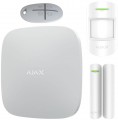 | 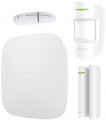 |
|---|---|---|
| Ajax StarterKit Plus | Ajax StarterKit | |
from £301.68 | from £252.00 | |
| User reviews | ||
| TOP sellers | ||
The kit includes a control panel Ajax Hub Plus, a motion sensor Ajax MotionProtect, an Ajax DoorProtect opening sensor and an Ajax Space Control key fob. Possibility to connect up to 150 sensors. 3G support. | The kit includes a control panel Ajax Hub, a motion sensor Ajax MotionProtect, an Ajax DoorProtect opening sensor and an Ajax Space Control key fob. | |
| Form factor | alarm system | alarm system |
| Connecting sensors (protocol) | Jeweller | Jeweller |
| Wireless zones | 150 | 100 |
| Backup power | 16 h | 15 h |
Connection to control panel | ||
| Max. wireless sensors | 150 | 100 |
| Sensor communication range | 2000 m | 2000 m |
| Key fobs communication range | 800 m | 800 m |
| Users (numbers to call) | 99 | 50 |
Complete with central | ||
| Motion sensors | 1 | 1 |
| Opening sensors | 1 | 1 |
| Control fobs | 1 | 1 |
Sensor characteristics | ||
| Motion sensor | Ajax MotionProtect | Ajax MotionProtect |
| Opening sensor | Ajax DoorProtect | Ajax DoorProtect |
| Horizontal angle of coverage | 88.5 ° | 88.5 ° |
| Vertical coverage angle | 80 ° | 80 ° |
| Motion sensor range | 12 m | 12 m |
| Opening sensor threshold | 20 mm | 20 mm |
| animal immunity |  | |
General | ||
| Control | control fob phone (GSM) mobile app (Wi-Fi) | control fob phone (GSM) mobile app (Wi-Fi) |
| Operating temperature | 0 °C ~ +50 °C | 0 °C ~ +50 °C |
| Max. humidity | 80 % | 80 % |
| Control panel dimensions (HxWxD) | 163x163x36 mm | 163x163x36 mm |
| Motion sensor dimensions (HxWxD) | 110x65x50 mm | 110x65x50 mm |
| Opening sensor dimensions (HxWxD) | 90x20x20 mm | 90x20x20 mm |
| Key fob dimensions (HxWxD) | 65x37x10 mm | 65x37x10 mm |
| Added to E-Catalog | january 2019 | february 2018 |


Compare Ajax StarterKit Plus and StarterKit
You may be interested in
Ajax StarterKit Plus often compared


Ajax StarterKit often compared


Glossary
Wireless zones
The number of security zones that can be covered by this kit when using wireless sensors.
In this case, a security zone means a separate protected area for which you can separately set the operating mode — for example, "Protection", "Protection disarmed" or a special tracking format. On many models, the number of zones corresponds to the maximum number of wireless sensors that can be connected to the device (see "Wireless Sensors"). However, there are exceptions: for example, a model for several dozen sensors can have 6-10 protection zones, in the expectation that one zone will be served simultaneously by several sensors.
In this case, a security zone means a separate protected area for which you can separately set the operating mode — for example, "Protection", "Protection disarmed" or a special tracking format. On many models, the number of zones corresponds to the maximum number of wireless sensors that can be connected to the device (see "Wireless Sensors"). However, there are exceptions: for example, a model for several dozen sensors can have 6-10 protection zones, in the expectation that one zone will be served simultaneously by several sensors.
Backup power
The time that the alarm is able to work on its own built-in power supply, in case of failure of an external power source.
Backup power allows the security system to remain operational during power outages (including during deliberate shutdown). The longer the time of operation on backup power, the more reliable the alarm, the lower the likelihood that due to power outages, the security will be completely disabled. At the same time, note that the specifications usually indicate an “perfect” battery life, with minimal power consumption; in fact, this period may be less — depending on the specific mode of operation, the frequency of operations and the quality of the batteries used (if replaceable batteries play the role of an autonomous source). So it is worth choosing according to this indicator with a certain margin — at least 15 – 20%.
Backup power allows the security system to remain operational during power outages (including during deliberate shutdown). The longer the time of operation on backup power, the more reliable the alarm, the lower the likelihood that due to power outages, the security will be completely disabled. At the same time, note that the specifications usually indicate an “perfect” battery life, with minimal power consumption; in fact, this period may be less — depending on the specific mode of operation, the frequency of operations and the quality of the batteries used (if replaceable batteries play the role of an autonomous source). So it is worth choosing according to this indicator with a certain margin — at least 15 – 20%.
Max. wireless sensors
The number of wireless sensors that can be simultaneously connected to the central unit (if this connection format is supported — see "Connecting sensors"). This number, by definition, is not less than the number of wireless zones (see the relevant paragraph).
Note that even the most modest modern systems support 6 – 8 wireless sensors, in the most advanced models this number can exceed 100. So you have to pay attention to this parameter mainly in cases where you need to organize a very extensive alarm system.
Note that even the most modest modern systems support 6 – 8 wireless sensors, in the most advanced models this number can exceed 100. So you have to pay attention to this parameter mainly in cases where you need to organize a very extensive alarm system.
Users (numbers to call)
The number of users or voice call numbers that can be stored in the device's memory.
The very possibility of a call, of course, is found only in models with support for remote control — via GSM or Wi-Fi (see "Control"). Systems with this function, when triggered, send a voice call to specified users via the mobile network to a phone or via the Internet to an application on a smartphone / tablet. Having accepted the call, the user receives voice information about the details of the alarm, and also, in most cases, gets access to additional functions: control via the voice menu, intercom, listening (see "Control panel capabilities"), etc. Many modern alarm systems allow set not one recipient of such calls, but a whole list: if there is no connection with one user, the system will try to call the second, if he does not answer, the third, etc. This will be useful in cases where several people are responsible for signaling.
The very possibility of a call, of course, is found only in models with support for remote control — via GSM or Wi-Fi (see "Control"). Systems with this function, when triggered, send a voice call to specified users via the mobile network to a phone or via the Internet to an application on a smartphone / tablet. Having accepted the call, the user receives voice information about the details of the alarm, and also, in most cases, gets access to additional functions: control via the voice menu, intercom, listening (see "Control panel capabilities"), etc. Many modern alarm systems allow set not one recipient of such calls, but a whole list: if there is no connection with one user, the system will try to call the second, if he does not answer, the third, etc. This will be useful in cases where several people are responsible for signaling.