
Comparison Crucial P3 CT4000P3SSD8 4 TB vs Crucial P3 Plus CT4000P3PSSD8 4 TB
Add to comparison | 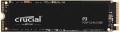 | 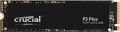 |
|---|---|---|
| Crucial P3 CT4000P3SSD8 4 TB | Crucial P3 Plus CT4000P3PSSD8 4 TB | |
from £329.45 | Compare prices 1 | |
| User reviews | ||
| TOP sellers | ||
| Placement | internal | internal |
| Volume | 4 TB | 4 TB |
| Form factor | M.2 | M.2 |
| M.2 interface | PCIe 3.0 4x | PCIe 4.0 4x |
Technical specs | ||
| Controller | Phison E21T | Phison E21T |
| Memory type | 3D QLC NAND | 3D QLC NAND |
| Number of 3D NAND layers | 176-Layer Micron | 176-Layer Micron |
| NVMe |  | |
| Write speed | 3000 MB/s | 4100 MB/s |
| Read speed | 3500 MB/s | 4800 MB/s |
| TBW | 800 TB | 800 TB |
| DWPD | 0.1 times/day | 0.1 times/day |
| Manufacturer's warranty | 5 years | 5 years |
General | ||
| Size | 22x80 mm | 22x80 mm |
| Added to E-Catalog | september 2022 | september 2022 |


Compare Crucial P3 CT4000P3SSD8 and P3 Plus CT4000P3PSSD8
Price comparison
You may be interested in
Crucial P3 Plus often compared


Glossary
M.2 interface
The interface supported by M.2 format drives (see "Form Factor").
All such drives use a standard hardware connector, but different electrical (logical) interfaces can be implemented through this connector—either SATA (usually SATA 3) or PCIe (most often in variants PCIe 3.0 2x, PCIe 3.0 4x, PCIe 4.0 4x, PCIe 5.0 4x). The M.2 connector on the motherboard must support the corresponding interface—otherwise normal operation of the SSD will not be possible. Let's look at each option in more detail.
Connection via the SATA 3 standard provides data transfer speeds of up to 5.9 Gbps (about 600 MB/s); it is considered a very simple option and is mainly used in budget M.2 modules. This is because this interface was originally created for hard drives, and for faster SSDs, its capabilities might already be insufficient.
On the other hand, the PCIe interface offers higher connection speeds and allows for the implementation of special technologies such as NVMe (see below). The designation of this interface specifies its version and the number of lanes—for example, PCIe 3.0 2x means version 3 with two data transfer lanes. From this designation, you can determine the maximum connection speed: PCIe version 3.0 provides just under 1 GB/s per lane, version 4.0—twice as much (up to 2 GB/s), and 5.0—twice as m...uch as the "four" (almost 4 GB/s). Thus, for example, for PCIe 5.0 4x the maximum data exchange speed will be around 15 GB/s (4 lanes at almost 4 GB/s each). Note that newer and faster drives can be connected to earlier and slower M.2 connectors—although the data transfer speed will be limited by the connector's capabilities.
Connection via the SATA 3 standard provides data transfer speeds of up to 5.9 Gbps (about 600 MB/s); it is considered a very simple option and is mainly used in budget M.2 modules. This is because this interface was originally created for hard drives, and for faster SSDs, its capabilities might already be insufficient.
On the other hand, the PCIe interface offers higher connection speeds and allows for the implementation of special technologies such as NVMe (see below). The designation of this interface specifies its version and the number of lanes—for example, PCIe 3.0 2x means version 3 with two data transfer lanes. From this designation, you can determine the maximum connection speed: PCIe version 3.0 provides just under 1 GB/s per lane, version 4.0—twice as much (up to 2 GB/s), and 5.0—twice as m...uch as the "four" (almost 4 GB/s). Thus, for example, for PCIe 5.0 4x the maximum data exchange speed will be around 15 GB/s (4 lanes at almost 4 GB/s each). Note that newer and faster drives can be connected to earlier and slower M.2 connectors—although the data transfer speed will be limited by the connector's capabilities.
Write speed
The highest speed in write mode characterizes the speed with which the module can receive information from a connected computer (or other external device). This speed is limited both by the connection interface (see "Connector"), and by the characteristics of the device of the SSD itself.
Read speed
The highest data exchange rate with a computer (or other external device) that the drive can provide in read mode; in other words — the highest speed of information output from the drive to an external device. This speed is limited both by the connection interface (see "Connector"), and by the characteristics of the device of the SSD itself. Its values can vary from 100 – 500 MB / s in the slowest models to 3 Gb / s and higher in the most advanced ones.