
Comparison MSI PRO MP271CA 27 " black vs MSI PRO MP273 27 " black
Add to comparison | 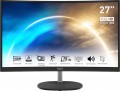 | 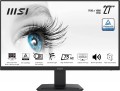 |
|---|---|---|
| MSI PRO MP271CA 27 " black | MSI PRO MP273 27 " black | |
from £209.95 | from £155.63 | |
| TOP sellers | ||
| Product type | monitor | monitor |
| Size | 27 " | 27 " |
Screen | ||
| Curved screen | 1500R | |
| Panel type | *VA | IPS |
| Surface treatment | anti-glare | anti-glare |
| Resolution | 1920x1080 (16:9) | 1920x1080 (16:9) |
| FPS | 75 Hz | 75 Hz |
| Pixel size | 0.31 mm | 0.31 mm |
| Response time (GtG) | 5 ms | 5 ms |
| Response time (MPRT) | 1 ms | |
| Vertical viewing angle | 178 ° | 178 ° |
| Horizontal viewing angle | 178 ° | 178 ° |
| Static contrast | 4 000:1 | 1 000:1 |
| Colour depth | 8-bit (16.7M Colors) | 8-bit (16.7M Colors) |
| Colour space (sRGB) | 98 % | 100 % |
| TÜV Rheinland certificate |  | |
Connection | ||
| Video transmission | DisplayPort v1.2 HDMI v1.4 | DisplayPort v1.2 HDMI v1.4 |
| Connectors (optional) | mini-Jack output (3.5 mm) | mini-Jack output (3.5 mm) |
Features | ||
| Features | Flicker-Free AMD FreeSync | Flicker-Free AMD FreeSync |
| Speakers | | |
| Sound power | 4 W | 4 W |
General | ||
| Wall mount | VESA 100x100mm | VESA 75x75mm |
| External power supply |  | |
| Dimensions (WxHxD) | 610x455x237 mm | 614 x463x181 mm |
| Weight | 5.4 kg | 3.9 kg |
| Color | ||
| Added to E-Catalog | april 2023 | november 2022 |


Compare MSI PRO MP271CA and PRO MP273
You may be interested in
MSI PRO MP271CA often compared

MSI PRO MP273 often compared


Glossary
Curved screen
The presence of a curved screen in the monitor design.
Such a screen has the left and right edges curved forward - it is believed that this shape significantly improves perception compared to a flat surface. At the same time, it makes sense to provide this feature only on fairly large diagonals - at least 30"; therefore, it is typical mainly for high-end models. It is also worth noting that in order to take advantage of all the advantages of a curved screen, you need to look at it from a certain point - at the optimal distance, strictly in the center; however, for computer monitors this is usually not a problem.
The main parameter of a curved screen is the radius of curvature. It is indicated in millimeters along the radius of a circle, the bend of which corresponds to the bend of the monitor: for example, the designation 1800R indicates a radius of 1.8 m.
The smaller the number in this designation, the more curved the screen (all other things being equal). At the same time, some manufacturers claim that the ideal curvature value is 1000R: supposedly, it is with this curvature of the screen that the image on it turns out to be as close as possible to a person’s natural field of vision, and the closer the curvature of the monitor is to 1000R, the better the viewing experience. However, in practice a lot depends on personal preference; and when viewed from a long distance (exceeding the radius of curvature by one a...nd a half times or more), all the advantages of a curved screen are lost.
Such a screen has the left and right edges curved forward - it is believed that this shape significantly improves perception compared to a flat surface. At the same time, it makes sense to provide this feature only on fairly large diagonals - at least 30"; therefore, it is typical mainly for high-end models. It is also worth noting that in order to take advantage of all the advantages of a curved screen, you need to look at it from a certain point - at the optimal distance, strictly in the center; however, for computer monitors this is usually not a problem.
The main parameter of a curved screen is the radius of curvature. It is indicated in millimeters along the radius of a circle, the bend of which corresponds to the bend of the monitor: for example, the designation 1800R indicates a radius of 1.8 m.
The smaller the number in this designation, the more curved the screen (all other things being equal). At the same time, some manufacturers claim that the ideal curvature value is 1000R: supposedly, it is with this curvature of the screen that the image on it turns out to be as close as possible to a person’s natural field of vision, and the closer the curvature of the monitor is to 1000R, the better the viewing experience. However, in practice a lot depends on personal preference; and when viewed from a long distance (exceeding the radius of curvature by one a...nd a half times or more), all the advantages of a curved screen are lost.
Panel type
The panel type determines the technology used to build a monitor’s screen and how it renders color, contrast, viewing angles, black levels, and response time. This parameter has a noticeable impact on how the monitor is used.
— TN+film. A TN+film panel is designed for fast pixel response and is found in inexpensive or older gaming monitors. It is chosen when minimal latency is important, for example in fast-paced online games, but it falls behind IPS, VA, and OLED in color reproduction and viewing angles.
— *VA. A VA panel is characterized by high static contrast, so dark scenes look deeper than on most IPS monitors. This is a good choice for movies, gaming, evening work, and multimedia, especially if rich black levels are important without switching to OLED. The main drawback of VA is possible smearing of dark objects in motion, so for shooters and fast-paced games, it is better to consider not only the stated milliseconds but also real-world reviews of the specific model.
— IPS. An IPS panel maintains color and brightness well when viewed from different angles, making it suitable for workspaces, study, gaming, and amateur image editing. It is one of the most balanced options when you need an everyday monitor without a clear bias toward movies or esports. In terms of black depth, IPS usually loses to VA and OLED, so in a dark room, black may look...more like dark gray.
— OLED .An OLED panel consists of self-emissive pixels that can switch off completely to display black. As a result, the monitor delivers maximum contrast, very fast response, and expressive HDR, which is especially noticeable in games, movies, and dark scenes. The limitation of OLED is the risk of burn-in from static elements such as taskbars, logos, and software interfaces, so these models require more careful use for continuous office work.
In addition, the main panel types can be enhanced, namely by being equipped with miniature LEDs or an additional quantum-dot layer.
— Mini LED. An enhanced backlighting system for LCD monitors in which a large number of small LEDs are used instead of conventional LEDs. This backlighting allows individual areas of the screen to be dimmed more precisely, so HDR scenes look more contrast-rich and blacks appear deeper than on ordinary IPS or VA monitors with basic backlighting. For example, Mini LED is especially useful for gaming, movies, and HDR content, but quality depends heavily on the number of dimming zones and the settings of the specific model.
— Quantum dots (QD). Quantum-dot technology adds a special color layer to the screen, making red, green, and other saturated shades purer. It can be found in different types of monitors: QD-IPS, QD-VA, QD-OLED. In practice, this is useful for HDR, gaming, movies, and image editing where a wide color gamut is important, but the QD label itself does not guarantee accurate factory calibration.
— TN+film. A TN+film panel is designed for fast pixel response and is found in inexpensive or older gaming monitors. It is chosen when minimal latency is important, for example in fast-paced online games, but it falls behind IPS, VA, and OLED in color reproduction and viewing angles.
— *VA. A VA panel is characterized by high static contrast, so dark scenes look deeper than on most IPS monitors. This is a good choice for movies, gaming, evening work, and multimedia, especially if rich black levels are important without switching to OLED. The main drawback of VA is possible smearing of dark objects in motion, so for shooters and fast-paced games, it is better to consider not only the stated milliseconds but also real-world reviews of the specific model.
— IPS. An IPS panel maintains color and brightness well when viewed from different angles, making it suitable for workspaces, study, gaming, and amateur image editing. It is one of the most balanced options when you need an everyday monitor without a clear bias toward movies or esports. In terms of black depth, IPS usually loses to VA and OLED, so in a dark room, black may look...more like dark gray.
— OLED .An OLED panel consists of self-emissive pixels that can switch off completely to display black. As a result, the monitor delivers maximum contrast, very fast response, and expressive HDR, which is especially noticeable in games, movies, and dark scenes. The limitation of OLED is the risk of burn-in from static elements such as taskbars, logos, and software interfaces, so these models require more careful use for continuous office work.
In addition, the main panel types can be enhanced, namely by being equipped with miniature LEDs or an additional quantum-dot layer.
— Mini LED. An enhanced backlighting system for LCD monitors in which a large number of small LEDs are used instead of conventional LEDs. This backlighting allows individual areas of the screen to be dimmed more precisely, so HDR scenes look more contrast-rich and blacks appear deeper than on ordinary IPS or VA monitors with basic backlighting. For example, Mini LED is especially useful for gaming, movies, and HDR content, but quality depends heavily on the number of dimming zones and the settings of the specific model.
— Quantum dots (QD). Quantum-dot technology adds a special color layer to the screen, making red, green, and other saturated shades purer. It can be found in different types of monitors: QD-IPS, QD-VA, QD-OLED. In practice, this is useful for HDR, gaming, movies, and image editing where a wide color gamut is important, but the QD label itself does not guarantee accurate factory calibration.
Response time (MPRT)
The parameter expresses how long an object moving in the frame is displayed on the screen until it completely disappears. The lower this indicator, the more realistic dynamic scenes look on the monitor. The reaction of the matrix to movements clearly shows the time of existence of the trail from the changing picture. The MPRT parameter is more dependent on the refresh rate of the monitor screen than on the pixel response time. To reduce its value, the Motion Blur Reduction (MBR) function is often used, which briefly turns off the backlight at the end of the time of dynamic frames in order to increase the clarity of dynamic scenes.
Static contrast
Static contrast provided by the monitor screen.
This value describes the difference between the brightest whites and darkest blacks that the screen is capable of producing. In this case, unlike dynamic contrast (see below), the difference is indicated on the condition that the brightness of the screen backlight remains unchanged. In other words, this is the contrast that is guaranteed to be achievable within one frame. Static contrast is inevitably lower than dynamic. However, it is she who describes the basic capabilities of the screen.
The minimum static contrast ratio for tolerable image quality is considered to be 250:1, but even the most modest modern monitors give out about 400:1 (and a value of 1000:1 is not the highest class), and in high-end models this figure can reach 2000:1 and even more. .
This value describes the difference between the brightest whites and darkest blacks that the screen is capable of producing. In this case, unlike dynamic contrast (see below), the difference is indicated on the condition that the brightness of the screen backlight remains unchanged. In other words, this is the contrast that is guaranteed to be achievable within one frame. Static contrast is inevitably lower than dynamic. However, it is she who describes the basic capabilities of the screen.
The minimum static contrast ratio for tolerable image quality is considered to be 250:1, but even the most modest modern monitors give out about 400:1 (and a value of 1000:1 is not the highest class), and in high-end models this figure can reach 2000:1 and even more. .
Colour space (sRGB)
Monitor colour gamut Rec. 709 or sRGB.
Any colour gamut is indicated as a percentage, however, not relative to the entire variety of visible colours, but relative to the conditional colour space (colour model). This is due to the fact that no modern screen is able to display all the colours visible to humans. However, the larger the colour gamut, the wider the monitor's capabilities, the better its colour reproduction.
Nowadays, sRGB is actually the standard color model adopted for computer technology; This is what is used in the development and production of most video cards. For television, the Rec. standard, similar in parameters, is used. 709. In terms of the range of colors, these models are identical, and the percentage of coverage for them is the same. In the most advanced monitors it can reach or even exceed 100%; These are the values that are considered necessary for high-end screens, incl. professional.
Any colour gamut is indicated as a percentage, however, not relative to the entire variety of visible colours, but relative to the conditional colour space (colour model). This is due to the fact that no modern screen is able to display all the colours visible to humans. However, the larger the colour gamut, the wider the monitor's capabilities, the better its colour reproduction.
Nowadays, sRGB is actually the standard color model adopted for computer technology; This is what is used in the development and production of most video cards. For television, the Rec. standard, similar in parameters, is used. 709. In terms of the range of colors, these models are identical, and the percentage of coverage for them is the same. In the most advanced monitors it can reach or even exceed 100%; These are the values that are considered necessary for high-end screens, incl. professional.
Wall mount
The size of the VESA mount included with the monitor.
VESA is the standard wall mount format for modern TVs and monitors. The mounting base is a rectangular plate with four screw holes in the corners. The distance between these holes vertically and horizontally in millimetres is the main characteristic of the fastening — for example, one of the most common is the size of 100x100. For small screens, 75x75 mounts are provided, for large and heavy monitors — 200x200 and more (up to 800x400).
VESA is the standard wall mount format for modern TVs and monitors. The mounting base is a rectangular plate with four screw holes in the corners. The distance between these holes vertically and horizontally in millimetres is the main characteristic of the fastening — for example, one of the most common is the size of 100x100. For small screens, 75x75 mounts are provided, for large and heavy monitors — 200x200 and more (up to 800x400).
External power supply
The power supply, made separately, outside the monitor case — usually right on the power cord (similar to how it is implemented, for example, in many laptops).
This arrangement allows you to take out a fairly significant part of the hardware outside the case. Therefore, monitors with an external power supply are themselves thinner and more elegant than similar models with a built-in power supply. On the other hand, the need to look for a place for the PSU itself in some situations can cause inconvenience. Therefore, when choosing, it is worth considering the peculiarities of the situation: in some cases, an integrated power supply may well be the best option.
This arrangement allows you to take out a fairly significant part of the hardware outside the case. Therefore, monitors with an external power supply are themselves thinner and more elegant than similar models with a built-in power supply. On the other hand, the need to look for a place for the PSU itself in some situations can cause inconvenience. Therefore, when choosing, it is worth considering the peculiarities of the situation: in some cases, an integrated power supply may well be the best option.