
Comparison M-AUDIO Code 49 vs M-AUDIO Code 25
Add to comparison | 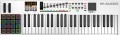 | 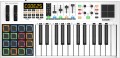 |
|---|---|---|
| M-AUDIO Code 49 | M-AUDIO Code 25 | |
from £159.75 | Outdated Product | |
| TOP sellers | ||
| Keys | 49 шт | 25 шт |
| Key size | full size | full size |
| Mechanics | active (dynamic) | active (dynamic) |
| Rigidity | semi-weighted | semi-weighted |
| Aftertouch |  | |
Control | ||
| Pitch controller | | |
| Modulation controller | | |
| Octave shift | | |
| Keyboard split | | |
| Transport control | | |
| Pads | 16 | 16 |
| Faders | 9 | 5 |
| Regulators (encoders) | 8 | 5 |
Connections | ||
| MIDI in | | |
| MIDI out | | |
| USB to host (type B) | | |
| Connectable pedals | 2 шт | 2 шт |
General | ||
| Programming function | | |
| Display | monochrome | monochrome |
| Dimensions (WxHxD) | 860x71x255 mm | 530x71x255 mm |
| Weight | 4.5 kg | 2.8 kg |
| Color | ||
| Added to E-Catalog | february 2018 | february 2018 |


Compare M-AUDIO Code 49 and Code 25
You may be interested in
M-AUDIO Code 49 often compared


M-AUDIO Code 25 often compared


Glossary
Keys
The total number of keys on the keyboard.
The more keys provided in the design, the wider the instrument's own range, the more notes it can play without resorting to octave shift or transposition. On the other hand, this characteristic directly affects the dimensions and cost, and an extensive range is not required so often. Therefore, 88 -key instruments corresponding to a full-size classical piano keyboard are quite rare. But compact models with only 25 keys(2 octaves), on the contrary, are popular: for the purposes for which MIDI keyboards are used, this is often quite enough. Other common options are the 49 -key (4 octave) and 61 -key (5 octave) models; somewhat less common are 32 and 37 keys.
The more keys provided in the design, the wider the instrument's own range, the more notes it can play without resorting to octave shift or transposition. On the other hand, this characteristic directly affects the dimensions and cost, and an extensive range is not required so often. Therefore, 88 -key instruments corresponding to a full-size classical piano keyboard are quite rare. But compact models with only 25 keys(2 octaves), on the contrary, are popular: for the purposes for which MIDI keyboards are used, this is often quite enough. Other common options are the 49 -key (4 octave) and 61 -key (5 octave) models; somewhat less common are 32 and 37 keys.
Faders
The number of faders provided in the design of the keyboard.
A fader is a slider control. The simplest kind of such controls is the volume setting; if there is one fader in the design, most likely it is responsible for the volume. If there are more controls, other functions can be tied to them, respectively — in particular, changing the settings in the recording programme on the computer to which the keyboard is connected.
A fader is a slider control. The simplest kind of such controls is the volume setting; if there is one fader in the design, most likely it is responsible for the volume. If there are more controls, other functions can be tied to them, respectively — in particular, changing the settings in the recording programme on the computer to which the keyboard is connected.
Regulators (encoders)
The number of encoder controlsprovided in the design of the keyboard.
Such a knob looks like a rotary knob, with which you can control various functions of the device to which the keyboard is connected — for example, turn the virtual knobs in the programme for recording and sound processing. At the same time, we note that a full-fledged encoder is capable of rotating 360 ° and turning to any angle in any direction, however, keyboards can also contain knobs with a limited rotation sector — they can also be called encoders. None of these options has a clear advantage: in some cases, an unlimited turning sector is more convenient, in others, a limited one.
Such a knob looks like a rotary knob, with which you can control various functions of the device to which the keyboard is connected — for example, turn the virtual knobs in the programme for recording and sound processing. At the same time, we note that a full-fledged encoder is capable of rotating 360 ° and turning to any angle in any direction, however, keyboards can also contain knobs with a limited rotation sector — they can also be called encoders. None of these options has a clear advantage: in some cases, an unlimited turning sector is more convenient, in others, a limited one.