
Comparison Tenda AC7 vs Tenda AC6
Add to comparison | 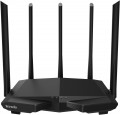 | 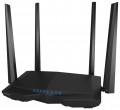 |
|---|---|---|
| Tenda AC7 | Tenda AC6 | |
from £62.20 | from £48.17 | |
| User reviews | ||
| TOP sellers | ||
The router is equipped with five antennas with a gain of 6 dBi, in total with a transmitter with a power of up to 23 dBm, this allows you to count on a wide coverage area. | Dual band Wi-Fi. Four external antennas. Support for MU-MIMO and Beamforming+ technologies. Smart mode. Remote control via mobile app. | |
| Product type | router | router |
| Data input (WAN-port) | Ethernet (RJ45) Wi-Fi | Ethernet (RJ45) Wi-Fi |
Wireless Wi-Fi connection | ||
| Wi-Fi standards | Wi-Fi 3 (802.11g) Wi-Fi 4 (802.11n) Wi-Fi 5 (802.11ac) | Wi-Fi 3 (802.11g) Wi-Fi 4 (802.11n) Wi-Fi 5 (802.11ac) |
| Frequency band | 2.4GHz 5 GHz | 2.4GHz 5 GHz |
| Operating ranges | dual-band (2.4 GHz and 5 GHz) | dual-band (2.4 GHz and 5 GHz) |
| Wireless speed 2.4 GHz | 300 Mbps | 300 Mbps |
| Wireless speed 5 GHz | 867 Mbps | 867 Mbps |
Connection and LAN | ||
| WAN | 1 port 100 Mbps | 1 port 100 Mbps |
| LAN | 3 ports 100 Mbps | 3 ports 100 Mbps |
Antenna and transmitter | ||
| Number of antennas | 5 | 4 |
| Antenna type | external | external |
| MU-MIMO |  | |
| Gain | 6 dBi | 5 dBi |
| 2.4 GHz antennas | 2 | |
| 5 GHz antennas | 2 | |
| Transmitter power | 23 dBm | 23 dBm |
| Signal strength 2.4 GHz | 20 dBm | 20 dBm |
| Signal strength 5 GHz | 23 dBm | 23 dBm |
Functions | ||
| Features | NAT bridge mode repeater Beamforming firewall | NAT bridge mode repeater Beamforming firewall |
| More features | DHCP server VPN DDNS DMZ | DHCP server VPN DDNS DMZ |
Security | ||
| Safety standards | WPA WEP WPA2 | WPA WEP WPA2 |
General | ||
| Dimensions | 220x49x142 mm | 220x142x49 mm |
| Weight | 310 g | |
| Color | ||
| Added to E-Catalog | may 2019 | february 2017 |


Compare Tenda AC7 and AC6
Routers Tenda AC7 and Tenda AC6 have similar characteristics, but there are key differences. AC7 is equipped with five antennas with a gain of 6 dBi, providing a wider coverage area compared to the four 5 dBi antennas on AC6. Both devices support MU-MIMO and Beamforming technologies, however, AC7 offers slightly higher transmitter power (23 dBm) and total power (29 dBm compared to 28 dBm for AC6). User reviews point out that AC7 handles multi-user loads better, while AC6 stands out for its ease of setup and good performance for home use. Both routers have the same maximum Wi-Fi speed: 300 Mbps on 2.4 GHz and 867 Mbps on 5 GHz.
You may be interested in
Tenda AC7 often compared


Tenda AC6 often compared


Glossary
Number of antennas
The total number of antennas (of all types — see below) provided in the design of the device.
In modern Wi-Fi equipment, this indicator can be different: in addition to the simplest devices with 1 antenna, there are models where this number is 2, 3, 4 and even more. The point of using multiple antennas is twofold. Firstly, if there are several external devices per antenna, they have to share the bandwidth among themselves, and the actual communication speed for each subscriber drops accordingly. Secondly, such a design may also be required when communicating with one external device — to work with MU-MIMO technology (see below), which allows you to fully realize the capabilities of modern Wi-Fi standards.
Anyway, more antennas, usually, means a more advanced and functional device. On the other hand, this parameter significantly affects the cost; so specifically looking for equipment with numerous antennas makes sense mainly when the speed and stability of communication are critical.
Note that antennas intended for mobile communications may also be considered in this clause. So when choosing a model with support for mobile networks, it's ok to clarify this point.
In modern Wi-Fi equipment, this indicator can be different: in addition to the simplest devices with 1 antenna, there are models where this number is 2, 3, 4 and even more. The point of using multiple antennas is twofold. Firstly, if there are several external devices per antenna, they have to share the bandwidth among themselves, and the actual communication speed for each subscriber drops accordingly. Secondly, such a design may also be required when communicating with one external device — to work with MU-MIMO technology (see below), which allows you to fully realize the capabilities of modern Wi-Fi standards.
Anyway, more antennas, usually, means a more advanced and functional device. On the other hand, this parameter significantly affects the cost; so specifically looking for equipment with numerous antennas makes sense mainly when the speed and stability of communication are critical.
Note that antennas intended for mobile communications may also be considered in this clause. So when choosing a model with support for mobile networks, it's ok to clarify this point.
Gain
Gain provided by each device antenna; if the design provides for antennas with different characteristics (a typical example is both external and internal antennas), then the information, usually, is indicated by the highest value.
Amplification of the signal in this case is provided by narrowing the radiation pattern — just as in flashlights with adjustable beam width, reducing this width increases the illumination range. The simplest omnidirectional antennas narrow the signal mainly in the vertical plane, "flattening" the coverage area so that it looks like a horizontal disk. In turn, directional antennas (mainly in specialized access points, see "Device type") create a narrow beam that covers a very small area, but provides a very solid gain.
Specifically, the gain describes how powerful the signal is in the main direction of the antenna compared to an perfect antenna that spreads the signal evenly in all directions. Together with the power of the transmitter (see below), this determines the total power of the equipment and, accordingly, the efficiency and range of communication. Actually, to determine the total power, it is enough to add the gain in dBi to the transmitter power in dBm; dBi and dBm in this case can be considered as the same units (decibels).
In general, such data is rarely required by the average user, but it can be useful in some specific situations that specialists have to deal with. Detailed calculation methods for suc...h situations can be found in special sources; here we emphasize that it does not always make sense to pursue a high antenna gain. First, as discussed above, this comes at the cost of narrowing the scope, which can be inconvenient; secondly, too strong a signal is also often undesirable, for more details see "Transmitter power".
Amplification of the signal in this case is provided by narrowing the radiation pattern — just as in flashlights with adjustable beam width, reducing this width increases the illumination range. The simplest omnidirectional antennas narrow the signal mainly in the vertical plane, "flattening" the coverage area so that it looks like a horizontal disk. In turn, directional antennas (mainly in specialized access points, see "Device type") create a narrow beam that covers a very small area, but provides a very solid gain.
Specifically, the gain describes how powerful the signal is in the main direction of the antenna compared to an perfect antenna that spreads the signal evenly in all directions. Together with the power of the transmitter (see below), this determines the total power of the equipment and, accordingly, the efficiency and range of communication. Actually, to determine the total power, it is enough to add the gain in dBi to the transmitter power in dBm; dBi and dBm in this case can be considered as the same units (decibels).
In general, such data is rarely required by the average user, but it can be useful in some specific situations that specialists have to deal with. Detailed calculation methods for suc...h situations can be found in special sources; here we emphasize that it does not always make sense to pursue a high antenna gain. First, as discussed above, this comes at the cost of narrowing the scope, which can be inconvenient; secondly, too strong a signal is also often undesirable, for more details see "Transmitter power".
2.4 GHz antennas
The total number of antennas in the router that are responsible for communication in the 2.4 GHz band. For details about the number of antennas, see "Total antennas", about the range — "Frequency range".
5 GHz antennas
The total number of antennas in the router that are responsible for communication in the 5 GHz band. For details about the number of antennas, see "Total antennas", about the range — "Frequency range".