
Comparison Tenda AC10 vs Tenda AC6
Add to comparison | 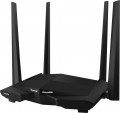 | 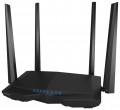 |
|---|---|---|
| Tenda AC10 | Tenda AC6 | |
from £22.99 | from £48.17 | |
| User reviews | ||
| TOP sellers | ||
Beamforming and MU-MIMO support. "Space" design. | Dual band Wi-Fi. Four external antennas. Support for MU-MIMO and Beamforming+ technologies. Smart mode. Remote control via mobile app. | |
| Product type | router | router |
| Data input (WAN-port) | Ethernet (RJ45) Wi-Fi | Ethernet (RJ45) Wi-Fi |
Wireless Wi-Fi connection | ||
| Wi-Fi standards | Wi-Fi 3 (802.11g) Wi-Fi 4 (802.11n) Wi-Fi 5 (802.11ac) | Wi-Fi 3 (802.11g) Wi-Fi 4 (802.11n) Wi-Fi 5 (802.11ac) |
| Frequency band | 2.4GHz 5 GHz | 2.4GHz 5 GHz |
| Operating ranges | dual-band (2.4 GHz and 5 GHz) | dual-band (2.4 GHz and 5 GHz) |
| Wireless speed 2.4 GHz | 300 Mbps | 300 Mbps |
| Wireless speed 5 GHz | 867 Mbps | 867 Mbps |
Connection and LAN | ||
| WAN | 1 port 1 Gbps | 1 port 100 Mbps |
| LAN | 3 ports 1 Gbps | 3 ports 100 Mbps |
Antenna and transmitter | ||
| Number of antennas | 4 | 4 |
| Antenna type | external | external |
| MU-MIMO |  | |
| Gain | 5 dBi | 5 dBi |
| 2.4 GHz antennas | 2 | 2 |
| 5 GHz antennas | 2 | 2 |
| Transmitter power | 23 dBm | 23 dBm |
| Signal strength 2.4 GHz | 20 dBm | 20 dBm |
| Signal strength 5 GHz | 23 dBm | 23 dBm |
Functions | ||
| Features | NAT bridge mode repeater Beamforming firewall | NAT bridge mode repeater Beamforming firewall |
| More features | DHCP server VPN DDNS DMZ | DHCP server VPN DDNS DMZ |
Security | ||
| Safety standards | WPA WEP WPA2 | WPA WEP WPA2 |
General | ||
| Dimensions | 220x142x49 mm | 220x142x49 mm |
| Weight | 810 g | |
| Color | ||
| Added to E-Catalog | july 2019 | february 2017 |


Compare Tenda AC10 and AC6
You may be interested in
Tenda AC10 often compared


Tenda AC6 often compared


Glossary
WAN
The WAN port characterizes the ability of the device to receive a wired signal. There may be models with both one port and two WAN ports, and in rare cases, more connected providers. Such an expanded number of WAN connectors affects the cost and, accordingly, is found in more part among professional-level routers.
In terms of speed, when choosing a device, the priority is the speed of the output LAN port or Wi-Fi. However, faster WAN ports ( 1 Gbps, 2.5 Gbps, 5 Gbps, 10 Gbps) allow you to divide the load on several outputs at once without reducing speed performance, as may be the case with WAN port 100 Mbps.
In terms of speed, when choosing a device, the priority is the speed of the output LAN port or Wi-Fi. However, faster WAN ports ( 1 Gbps, 2.5 Gbps, 5 Gbps, 10 Gbps) allow you to divide the load on several outputs at once without reducing speed performance, as may be the case with WAN port 100 Mbps.
LAN
In this case, LAN means standard network connectors (known as RJ-45) designed for wired connection of LAN devices — PCs, servers, additional access points, etc. The number of ports corresponds to the number of devices that can be directly connected to wired equipment. way.
In terms of speed, 100 Mbps (Fast Ethernet) and 1 Gbps (Gigabit Ethernet) are the most popular options today. At the same time, thanks to the development of technology, more and more gigabit devices are being produced, although in fact this speed is critical only when transferring large amounts of information. At the same time, some models, in addition to the standard speed of the main LAN ports, may have a 2.5 Gbps, 5 Gbps and even 10 Gbps LAN port with increased bandwidth.
In terms of speed, 100 Mbps (Fast Ethernet) and 1 Gbps (Gigabit Ethernet) are the most popular options today. At the same time, thanks to the development of technology, more and more gigabit devices are being produced, although in fact this speed is critical only when transferring large amounts of information. At the same time, some models, in addition to the standard speed of the main LAN ports, may have a 2.5 Gbps, 5 Gbps and even 10 Gbps LAN port with increased bandwidth.