Everything You Need to Know About Headphones: A Complete Technical Guide

We independently test the products and technologies that we recommend.

1. Anatomy Features: Design and Form Factor
Physical architecture is the first search filter. How headphones fit on the head, whether they have isolated ear cups, and what material the ear cushions are made of often affect the final sound more than any digital enhancements.
The design determines everything: from the width of the soundstage and sub-bass power to whether your ears will sweat after an hour of use. Therefore, the path to a successful purchase always starts with mechanics. Let's break it down into three key components.
1.1 Main Headphone Form Factors
The form factor is the basic fit geometry. It determines how the driver is positioned relative to the eardrum: whether it envelops the ear completely, sits on the cartilage, or seals the ear canal tightly. This physical positioning directly affects the speaker's ability to form massive, dense bass.
-
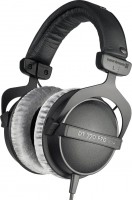
Over-ear: Large ear cups completely cover the ear, resting against the skull. They provide reliable passive isolation and allow for the installation of large drivers for deep bass.
Tip: Take regular breaks during extended listening. The sealed fit will inevitably cause skin to sweat.
-
On-ear: Compact ear cups rest directly on the ear cartilage. They are significantly lighter and more mobile than over-ear counterparts.
Tip: Avoid this format if you wear glasses constantly— double pressure on the cartilage will quickly cause pain.
-
IEM (In-Ear Monitors): Inserted deep into the ear canal, sealing it tightly with tips.
Tip: Choose for noisy streets. This is the only portable format where sub-bass hits directly on the eardrum without energy loss.
-
Earbuds: Sit in the ear, leaving the canal partially open.
Tip: Choose if you can't stand the "vacuum" feeling of plugs. But note: you won't get massive bass due to the loose fit.
-
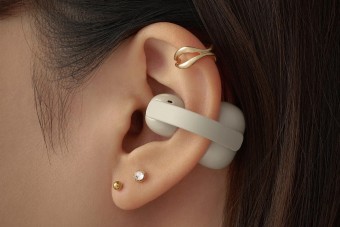
Bone conduction: Rest on the cheekbones and transmit vibrations directly to the inner ear through the bone, leaving the ear canal open.
Tip: Use them exclusively for safe runs. Don't expect booming bass — dense bone doesn't transmit low frequencies. In the subway, the open ear will catch all external noise, turning music into mush.
We've covered the basic fit geometry. But if you choose full-size or on-ear models, you'll have to take one more step—select the acoustic design of the ear cups themselves.

bone conduction when ears need to be free.
1.2 Acoustic Design: Closed, Open, or Semi-open
This parameter determines how sound behaves on the other side of the driver. The body forms the width of the imaginary scene and is responsible for cutting off external noises.
-
Closed-back: The driver is completely isolated by a solid body. Sound waves are reflected inside, slightly narrowing the panorama "in the head," but providing articulated low frequencies.
Tip: Use closed monitors like the Audio-Technica ATH-M50x for recording vocals or working in a noisy office.
-
Open-back: The back side looks like a grill. Sound freely exits outward, creating a wide, expansive scene without internal resonances.
Tip: Buy reference-grade Sennheiser HD 600 for a quiet room. On the street, traffic noise will completely drown out the music, and in an open space, you'll drive your colleagues crazy.
-
Semi-open: A compromise option with partial perforation of the outer cover. The scene here is slightly wider than closed counterparts, but sound still leaks outward.
Tip: Choose if you're looking for expansive sound but want to minimally muffle external noise.
The architecture of the cups lays the spatial framework of the sound. But even premium acoustic engineering loses its meaning if you neglect the element that directly contacts the head.
1.3 Ear Cushion Materials: Mechanical Equalizer for Fine-Tuning
This soft contour directly controls the airflows inside the cup. The amount of bass that reaches the eardrum directly depends on the density of the ear cushions and their fit. Think of them as a mechanical equalizer:
-
Leather and
faux leather: Create a maximally sealed acoustic contour around the ear.
Tip: Leave them for reliable bass retention (so the bass doesn't "leak") and for real passive isolation.
-
Velour and perforated fabric: Allow air to pass through well and don't create a "greenhouse" effect.
Tip: Use them in hot weather or for long sessions. However, keep in mind: due to the porous structure of the fabric, some bass will inevitably dissipate, but high frequencies will become softer.
-
Foam tips (Memory foam for IEM): Foam polymer with memory effect.
Tip: Buy them separately for your plugs. Foam expands inside and perfectly fills the anatomical irregularities of the canal, enhancing noise isolation.
Physical architecture is the unshakable acoustic foundation. No software equalizer will add space to tightly closed cups with leather pads, and no algorithm will save bass in open earbuds. But once ergonomics are settled, it's time for electronics.
2. Why Premium Plays Quietly: Impedance and Sensitivity
Mismatched electrical parameters with the audio output are the main reason for purchasing disappointments. Most myths revolve around impedance (resistance of the coil to alternating current). We've summarized the real behavior of headphones depending on resistance in a table:
| Impedance (Ohm) | Target Sound Source | Practical Behavior |
|---|---|---|
| 16–32 Ohm | Smartphones, laptops, TWS chips | Deliver high volume from weak mobile amplifiers. They pick up hardware background noise (hissing) significantly from cheap motherboards. |
| 32–80 Ohm | Portable Hi-Res players, basic sound cards | The standard for portability. Less background noise, optimal balance between volume and driver control. |
| 80–150 Ohm | DJ mixers, basic studio audio interfaces | From the phone, they'll play sluggishly and quietly. Sound is revealed only with an external portable DAC. |
| 250–600 Ohm | Stationary amplifiers, studio consoles | Require high voltage swing to drive the coil. Sound is clean, powerful, without interference from the circuit. |
But resistance is just half the picture. Without understanding sensitivity, the numbers in Ohms won't give a complete idea of the model's final volume:
-
Sensitivity: Efficiency of converting electrical energy into acoustic pressure. Usually specified in dB/mW. Combined with resistance, it determines how loud the headphones will play.
Tip: For listening with a smartphone or laptop, choose models from 100 dB/mW. Headphones at 32 Ohm with 95 dB and below will play quietly.
- Max Input Power: The limit of energy the voice coil can "digest" before physical destruction or the appearance of harsh distortion. MIP is relevant primarily for sound engineers to avoid burning monitors with a powerful studio mixer.
Form the "source + headphones" combination taking these physical laws into account. A basic laptop easily handles low impedance, but "tight" (demanding power) classics like Beyerdynamic DT 770 PRO 250 Ohm will fully blossom only with an external amplifier with a high voltage reserve.

mismatch results in either hardware noise or sluggish sound.
3. From Blueprint to Engine: Graphs and Drivers
The packaging often promises a lot, but the real class of sound hides in distortion graphs and the physical architecture of drivers. Let's learn to distinguish important numbers from marketing traps:
-
Frequency Range: The boundaries of reproducible sound (usually 20 – 20000 Hz).
Tip: Don't fall for pretty numbers like "5 Hz – 40 kHz." Always look for the error rate (e.g., ±3 dB) in the specifications—without it, the driver may technically produce the same 5 Hz, but with such a drop in volume that you simply won't hear them.
-
Frequency Response Curve (FRC): A graph showing the volume of each reproducible frequency.
Tip: Look for independent FRC measurements. A hump at 100 Hz means massive powerful bass, raised highs add brilliance, and a flat line is good for studio mix analysis.
-
THD (Total Harmonic Distortion, nonlinear distortion coefficient): The percentage of parasitic harmonics that the driver generates and adds to the signal under load. In simple terms—how much the headphones "lie," adding sounds that aren't in the recording.
Tip: Test headphones at high volume before buying. If bass immediately turns into mush, and highs start to hurt your ears, the driver can't handle the load. Look for models with a declared THD below 0.5%—this ensures clean sound at any volume level.
Now about the "engine" of headphones—the driver. Its design dictates the speed, texture, and scale of the sound:
-
Dynamic: A traditional design with a moving coil and diaphragm.
Tip: Choose them for electronic and pop music—nothing gives such a physical punch in the lows as a quality dynamic driver.
- Balanced Armature: A micro-armature clamped in a magnetic field. An excellent choice for monitoring vocals and acoustic instruments due to surgical detail and speed, but sub-bass here will always be restrained and somewhat dry.
- Planar Magnetic: Super-thin film with conductive tracks. They have minimal distortion and a clean panorama. Tight planars like HiFiMan Sundara untangle fast metal or expansive symphonies excellently, but require high current from the source.
-
Electrostatic: The diaphragm vibrates in a high-voltage electrostatic field. This is both strength and weakness: minimal distortion and lightning-fast speed, but the absence of sub-bass.
Tip: Consider this type only with a serious budget—they work exclusively with special amplifiers that supply 200–580 V to the diaphragm.
- Hybrid: A combination of several types of drivers within one case (e.g., dynamic driver for low frequencies + armature for mid/high frequencies). A smart compromise if you want to get massive low frequencies and vocal clarity.

planar provides minimal distortion.
The driver type determines the model's signature by 80%. Don't look for a universal option; choose based on the genres prevalent in your playlist.
4. Wired vs. "Air": Types of Connections
The modern audiophile or gamer chooses not just headphones, but a method of delivering the signal to the driver. Each interface has its own physics, limitations, and clear purpose.
4.1 Wired Tier: Analog and Digital
-
Classic Genre (3.5 mm and 6.3 mm): Common unbalanced connectors. The 3.5 mm jack has become a dictator in the world of portable devices, while its older brother, the 6.3 mm jack, firmly holds positions in studio and home stationary equipment due to its more reliable design and larger contact area.
Tip: To not limit yourself to one scenario, buy an adapter from 3.5 mm to 6.3 mm. Always choose options with gold plating: it protects the metal from oxidation, saving the sound from crackling and static over time with every twist of the plug in the socket.
-
Balanced Connection (2.5 mm, 4.4 mm Pentaconn, 4-pin XLR):
The top league for sound enthusiasts. Unlike the standard cable, which is common to both channels, in a balanced scheme, the left and right lines are completely isolated. This technical solution drastically cuts cross-talk and minimizes interference.
Tip: The balanced output of the amplifier gives twice the voltage. Switching to such a cable is advisable only when your "tight" headphones lack power from the regular output. Balanced cables won't help budget models—physics can't be fooled.
-
USB-C / Lightning Audio: A signal transmission method where the cable itself acts as a digital transport bridge. The sound exits the smartphone or PC in unchanged digital form, and all transformation magic happens inside the headphones (or the block on the wire), where they have their own DAC and amplifier.
Tip: Use USB-C to completely bypass your motherboard or laptop's cheap, noisy sound card. Headphones with their own DAC provide a cleaner sound without background squeaks.
4.2 Wireless Airwaves: Freedom in Radio Waves
- Bluetooth (Universal Soldier): The main interface of the modern era, whose advantage is absolute mobility. But freedom always has a price: sound is compressed by codecs to fit into a narrow radio channel, and in a congested urban environment, the bitrate drops even lower. The second downside is signal latency, which causes the sound to lag behind the picture. For podcasts, streaming, calls—fine. For games and movies—not so much. That's where the old reliable cable or radio channel comes into play.
-
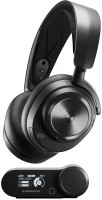
2.4 GHz Radio Channel (Wireless RF): A no-compromise wireless alternative for gamers and moviegoers. The headphones work through their own USB dongle (transmitter). This protocol accelerates data transmission speed to the maximum, ensuring rock-solid stability, zero latency (up to 10–15 ms), and audio transmission without compression.
Tip: If your realm is online shooters where a fraction of a second decides everything, buy exclusively wired or radio-channel headphones.
4.3 Separate Tier: Stationary Digital
Optical Interface (Toslink / S/PDIF): Transmission of audio data using light impulses through a flexible fiber optic cable. This connector is often found in stationary gaming stations, receivers, and discrete sound cards. Its main physical advantage is galvanic isolation. Light does not transmit electrical current, meaning the headphones are completely protected from electromagnetic interference from the graphics card or power supply. Ground loop and low-frequency hum are physically impossible here.
5. Losses Along the Way: Bluetooth Codecs
Codecs are not about enhancing sound quality, but rather the opposite. They are a kind of "archivists" that determine how much the sound stream degrades as it travels from the source to the diaphragm.
- SBC (Subband Coding): The basic codec, guaranteed to be supported by all Bluetooth devices. It aggressively cuts high frequencies and has noticeable latency, so listening to complex instrumental music through it is not advisable.
- AAC (Advanced Audio Coding): An algorithm based on complex mathematical psychoacoustic models. It works extremely efficiently on Apple devices. The Apple AirPods Pro 3 shine on it. However, Android users should treat AAC with caution— its quality heavily depends on the codec implementation by the specific smartphone manufacturer.
- aptX / aptX Adaptive / aptX Lossless: A family of codecs from Qualcomm with an extended dynamic range. The Adaptive version is critically important for mobile gaming and movies—it dynamically reduces latency, saving from desynchronization with the picture. The Lossless version (≈ up to 1.2 Mbps) provides genuinely clean streams, but only in perfect airspace and supported on both sides.
- LDAC and LHDC: Flagship protocols (up to 1000 kbps), allowing for Hi-Res Audio Wireless certification. To honestly transmit such a volume of data, an impeccably clean radio ether is required, without interference.
- LE Audio (LC3, Low Complexity Communication Codec): A new standard whose main feature is colossal data compression optimization. It provides higher sound quality at significantly lower bitrates, almost twice the headphone's autonomy, and minimal audio latency—only 20–30 ms (compared to 150–250 ms with classic Bluetooth codecs).
From Practice: Don’t make high bitrates a fetish for outdoor use. In a congested urban ether, headphones are guaranteed to drop LDAC stream speed to the minimal 330 kbps to avoid stuttering, fully negating the advantages of the Hi-Res format and bringing premium sound down to a basic level.
6. Magic or Marketing: Smart Features
Modern TWS are complex computing systems. But not all hardware and software features can create the magic that advertisers paint. Let's break down the real physics of popular technologies:
-
ANC (Active Noise Cancellation): An external microphone captures noise, and a processor generates a mirror sound wave in the speakers out of phase. Destructive interference occurs—the waves cancel each other out.
Critical nuance: Noise-cancelling only perfectly cuts out stable, monotonous low-frequency hum (engine, ventilation, road). The algorithm is powerless against sudden chaotic high-frequency sounds (baby crying, mechanical keyboard) — the signal processing delay prevents the processor from generating a quick counter-phase.
-
Transparency Mode: The reverse action of ANC. Microphones capture street sounds and mix them into your music.
Tip: Activate this mode during runs or bike rides—it will enhance your safety.
- ENC / cVc (Environmental Noise Cancellation): A microphone array working solely for your interlocutor. The algorithm effectively cuts wind and crowd noise from your voice during a call. An indispensable thing for outdoor conversations.
- Multipoint: The ability to hold an active connection with two Bluetooth sources simultaneously. The sound does not mix: the headphones play only from one device, and when switching to another—automatically pauses the first. A convenient office option, allowing you to watch videos on a laptop and seamlessly answer calls without manually switching settings.

above 2 kHz, passive isolation suppresses it.
When choosing additional options, focus on your real needs. Overpaying for Multipoint is pointless if you only use headphones with one smartphone.
7. FAQ
What is the practical difference between 16 Ohm and 32 Ohm impedance?
Practically, 16-ohm models will play noticeably louder at the same slider position. However, due to low resistance, they mercilessly capture hardware background noise (interference from the board, processor hissing) from low-quality audio outputs. 32-ohm models offer an optimal compromise: they maintain sufficient volume but more effectively filter the electrical noise of the circuit.
Should I buy studio monitor headphones for everyday music listening?
Studio equipment is created as a measuring tool for finding mix defects and controlling levels. It has a deliberately dry, flat frequency response. A regular listener may quickly find such sound boring, too sharp in the highs, and lacking massive bass. If you're looking for enjoyment from your favorite tracks, choose devices with a V-shaped equalizer setting.
Is a separate amplifier or DAC needed for headphones?
It depends on the combination. Low-impedance models (16–32 Ohms) with high sensitivity are sufficient for a smartphone. However, tight classics (150–250 Ohms) or planars sound quiet and lifeless without an amplifier—it's essential here. A separate DAC primarily removes background noise from cheap built-in cards, not "adds detail."
Which Bluetooth codec is better for Android and which for iPhone?
For iPhone, the ceiling is AAC and LE Audio (starting with iOS 17): aptX and LDAC are not supported by Apple and are not planned. For Android, the peak is LDAC or aptX Adaptive/Lossless, but you will only see a real benefit in relatively clean radio ether. In a noisy city, any codec drops in bitrate, and the difference becomes negligible.
Why do audiophiles "burn-in" headphones and does this effect really exist?
Physical burn-in has a technical justification only for large dynamic membranes. The suspension needs time (10–20 hours of movement) to develop mechanical elasticity as calculated. For armature models, where the membrane is metallic, it's physically impossible. In 90% of cases, what is called "burn-in" is a simple psychoacoustic adaptation of your brain to the new frequency balance.

and the rest of the "effect" is the brain getting used to the new frequency response.
8. Final Mix
Specifications in the datasheet are a coordinate grid that allows you to quickly weed out irrelevant options, not a magic guarantee of impeccable sound. When choosing, always rely on the iron physics and the "source + scenario" combination.
Understanding the basic architecture of drivers, impedance characteristics, and a sober perspective on the limitations of smart features will allow you to ignore marketing noise and choose a device that will bring enjoyment and well-justify the investment.
You can always compare characteristics in detail and find your ideal model in our headphone catalog.







Articles, reviews, useful tips
All materials