How to Expand the Functionality of a Classic Drill with Attachments

We independently test the products and technologies that we recommend.

1. Functional drill attachments — advantages for home use and disadvantages for professional use
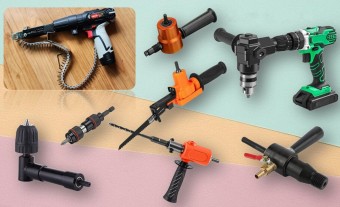
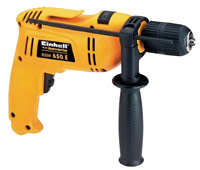
To expand the functionality of a classic drill, resourceful manufacturers offer various attachments. Their range is quite diverse, and the advantages are obvious:
- Huge savings — buying a specific attachment is much cheaper than purchasing a separate tool.
- Free space — all accessories can easily be stored in one case or box together with the drill.
- Mobility — taking five attachments with you is easier than taking five types of equipment.
However, it should be understood that this is not a cure-all, but a convenient and cost-effective solution for home use. Considering such attachments for professional work makes no sense for objective reasons:
- Modest performance — such modules are not designed for constant heavy loads or high-strength materials.
- Limited service life — this logically follows from the above. With periodic, proper home use, an attachment can serve for many years, while in a professional environment it may fall apart very quickly.
- Time costs — professionals use separate tools without any restrictions. Attachments do not offer such convenience, since their replacement takes time and also increases wear on the mounts and mechanisms.
2. What types of work can be performed with a drill and additional attachments
Today, the market offers attachments for almost every type of activity, not limited to repairs. The full range of potential applications is as follows:
| What tool it can replace | What types of work can be performed |
|---|---|
| Jigsaw |
|
| Angle grinder (UShM) |
|
| Screwdriver |
|
| Belt sander |
|
| Riveter |
|
| Circular saw (circular saw machine) |
|
| Router |
|
| Sharpener for knives and other items |
|
| Surface pump |
|
| Construction mixer |
|
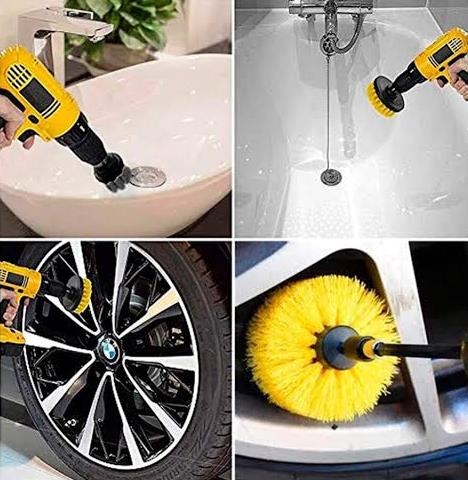
Other useful functions that a drill can perform should not be overlooked either. With bits and socket heads, you can easily carry out repair work at home or in the garage. There is a wide range of attachments for cleaning frying pans, removing paint, removing dirt, simple apartment cleaning (treating tiles and faucets and removing dust), and car cleaning (the interior, wheel rims, and engine) on the market.


3. Main drill requirements for implementing all additional functions
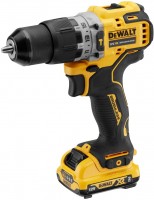
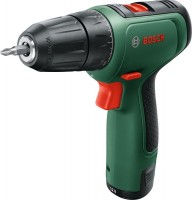
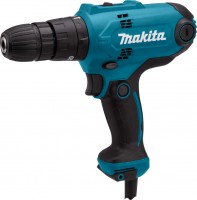
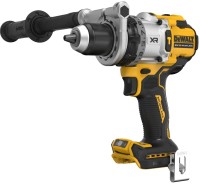
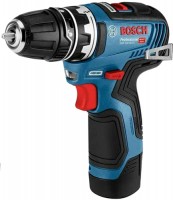
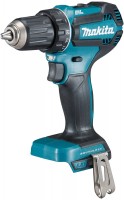
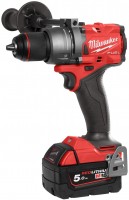
As the saying goes: “A miser pays twice, and an inexperienced person pays three times.” For everything to work efficiently, safely, and without breakdowns, the drill must meet certain requirements.
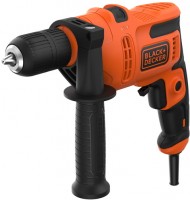
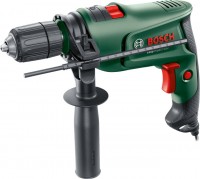
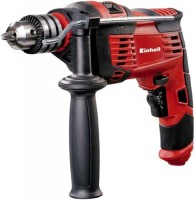
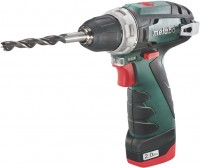
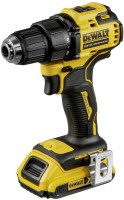
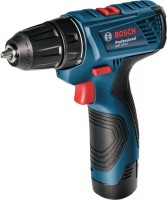
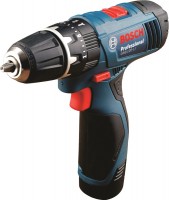
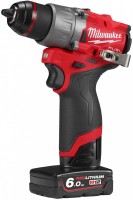
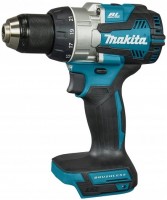
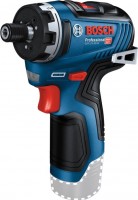
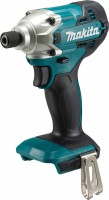
- Power and torque. These two parameters are usually interconnected and determine the equipment’s ability to handle heavy tasks. This is especially important when using attachments, as they create additional load and can cause overheating or overloading, leading to operational problems. Budget drills are not the best solution in this case, but an expensive professional tool is not essential either. For stable, versatile operation, about 800 W of power and 30 Nm of torque are sufficient.
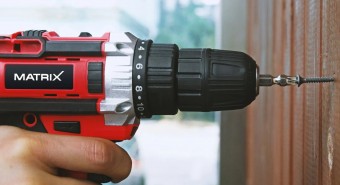
- Speed adjustment. Depending on the specific task and material, the attachment will need to rotate at different speeds, so speed adjustment is essentially a must-have for any drill.
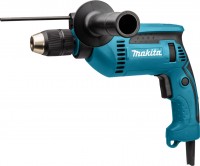
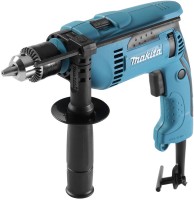
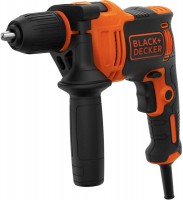
- Additional handle. To hold the drill at the required angle and as steadily as possible, an additional point of control is definitely necessary. It is also essential for safety to have an additional handle, especially when using the drill as an angle grinder or sander.
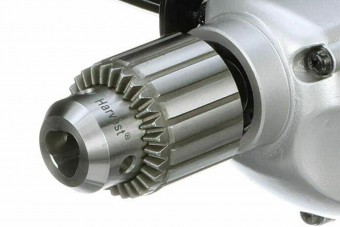
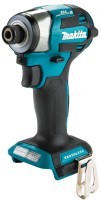
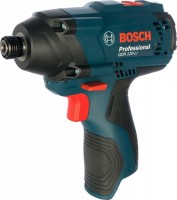
- Chuck design. Some attachments are installed in the chuck, while others replace it. Sometimes the standard chuck must also be replaced with a ratchet. Therefore, for greater comfort and faster operation, the best option is a drill with a quick-change chuck. You can also consider a keyless chuck mechanism, although this is not always relevant, as it does not provide a reliable grip.
- Power button lock. The presence of a power lock button depends on the type of work being performed, but it certainly cannot hurt. It is useful for sanding, polishing, cutting, and converting the drill into a stationary tool, when both hands are needed to hold the tool or workpiece and control the direction.




4. Range of attachments for expanding a drill’s capabilities
After studying all the details, all that remains is to understand what functionality may be needed now or in the future. Most attachments are quite affordable, so building up a stock for the future is not a problem even with a limited budget. Let’s take a closer look at the entire range.
4.1 Angle grinder attachment
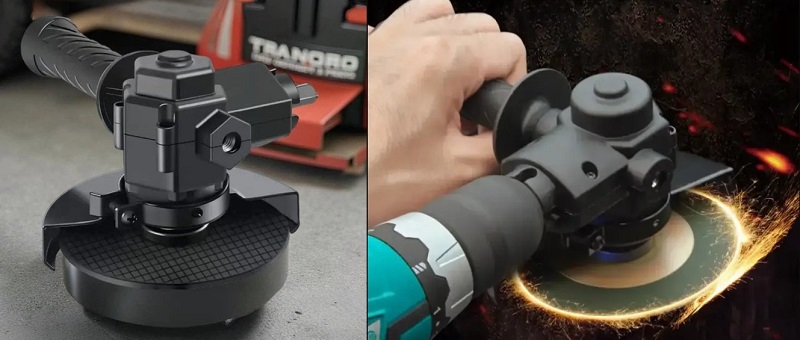
A special module with a gearbox inside that changes the direction of rotation. It is compatible with standard abrasive discs and other common consumables used with angle grinders. It allows you to perform a wide range of tasks: grinding, polishing, chasing, and cutting.
4.2 Grinding and polishing attachment
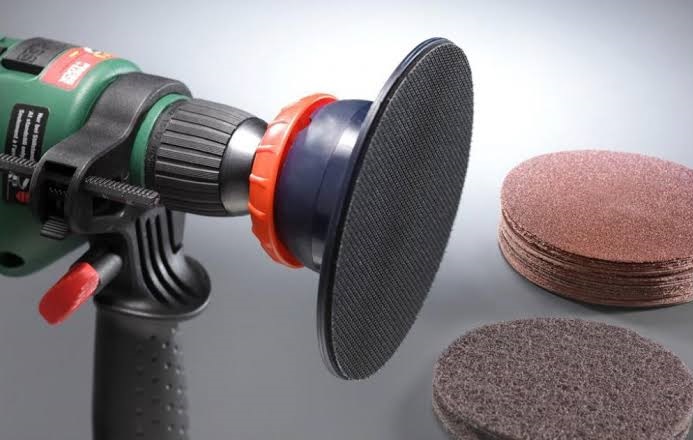
A simple and inexpensive option for the initial and final treatment of various surfaces where jeweler-level precision is not required. In essence, it is a platform with a hook-and-loop surface to which discs of the appropriate diameter and purpose are attached. In this case, maintaining control over movements is somewhat more difficult than with an angle grinder.
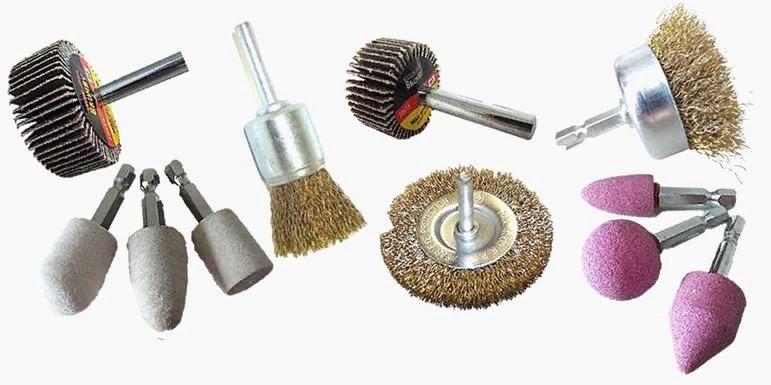
4.3 Sanding attachment
There can be many options depending on the desired result. The main purpose is rough surface preparation for subsequent treatment.
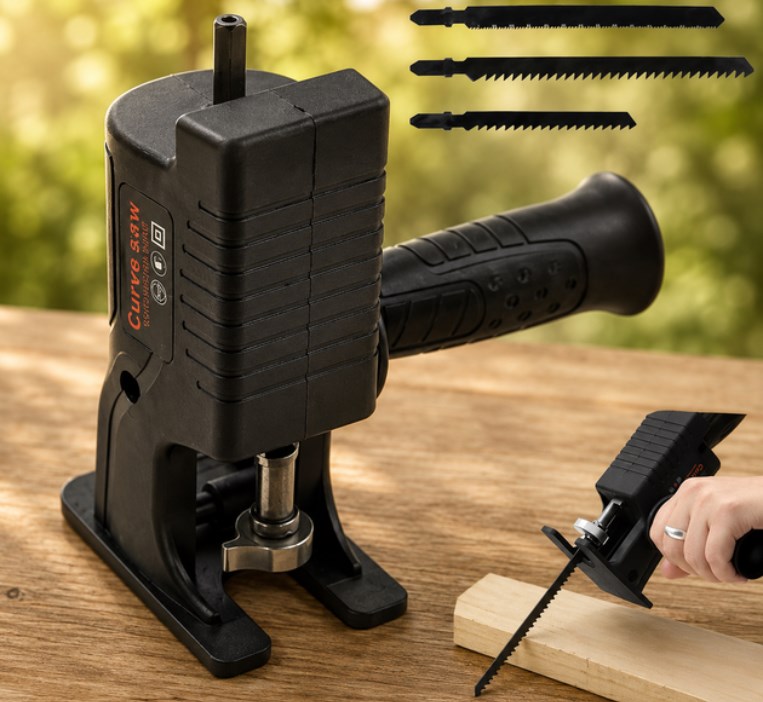
4.4 Jigsaw attachment
This is a gearbox unit that converts rotary motion into reciprocating motion. For sawing, use standard blades depending on the material and the desired cut quality.
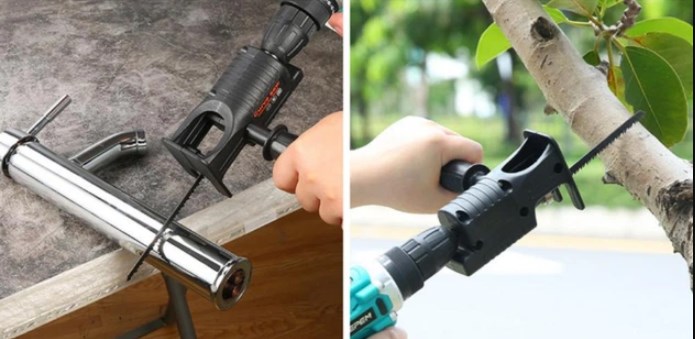
An excellent solution for maintaining a garden plot when combined with cordless drills or screwdrivers.
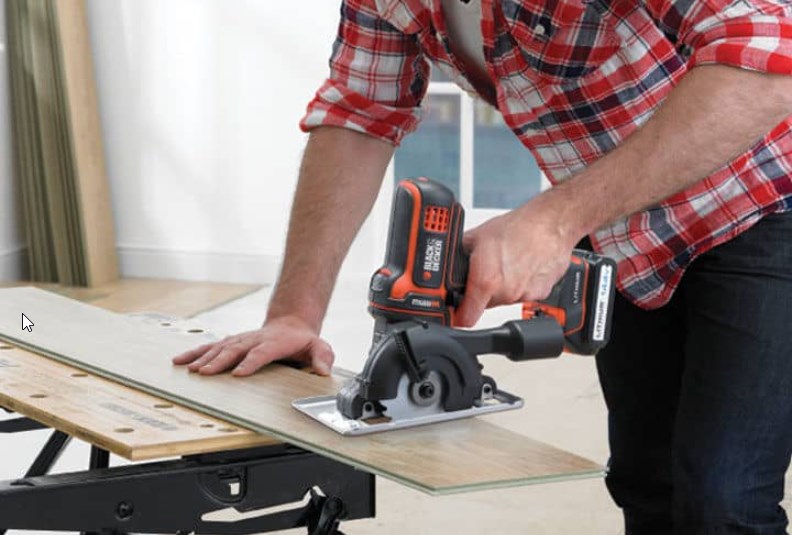
4.5 Circular saw attachment
A useful accessory for cutting thin wood, approximately 20 mm thick, and adjusting the size and shape of wooden flooring and finishing materials. However, it requires precise control of movements and does not guarantee the accuracy of a full-fledged sawing station of any format.
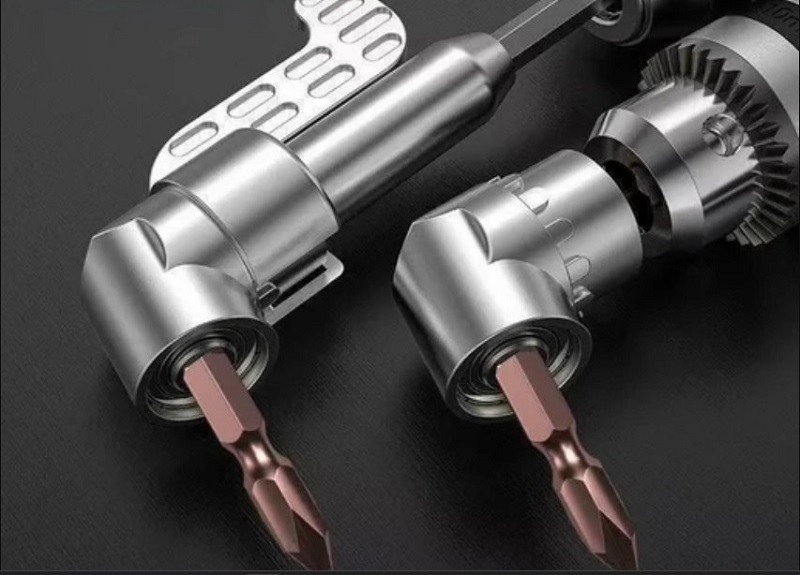
4.6 Right-angle adapter
A simple mechanism for convenient installation of structures, furniture assembly, and work in hard-to-reach places. Attachments are available both as solid units and flexible adapters.
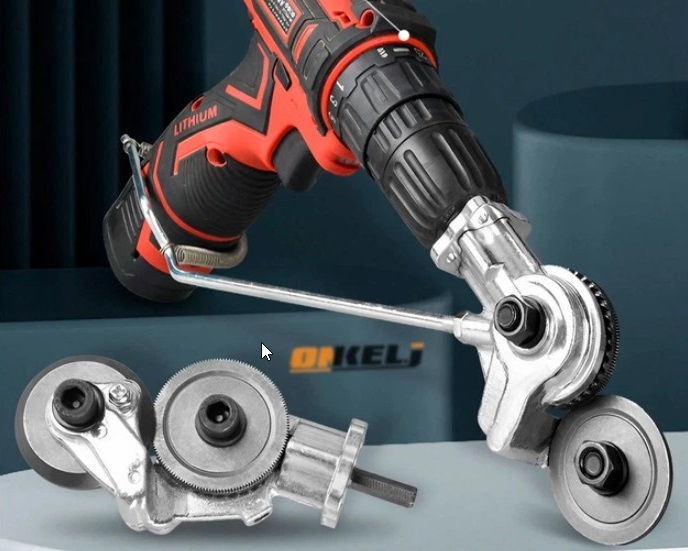
4.7 Sheet metal cutter
An advanced attachment for cutting intricate shapes from sheet metal approximately 1 mm thick. An effective tool for professionals involved in car body restoration and simple welding and repair work.
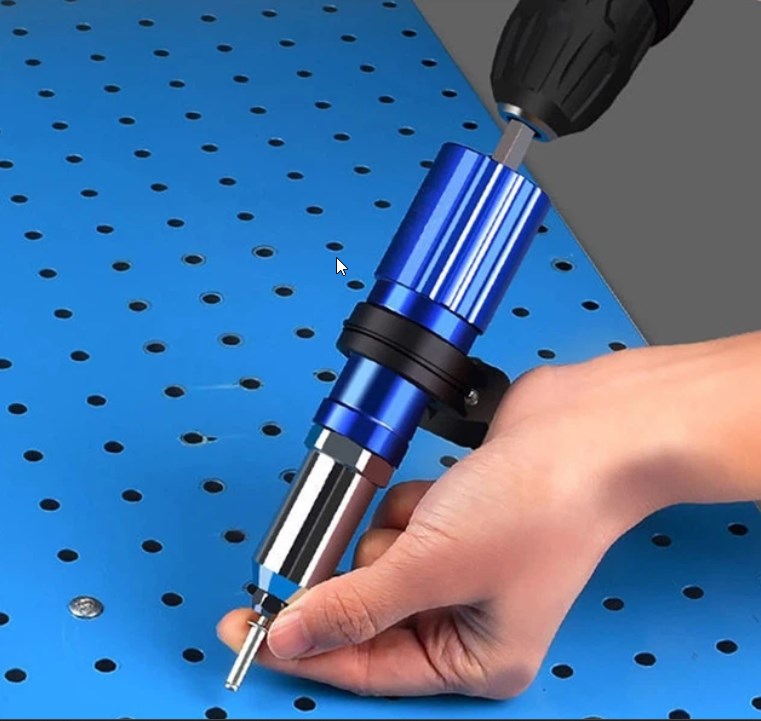
4.8 Riveter attachment
Not the most popular, but very effective attachment for joining materials and structures of different types where welding, self-tapping screws, and similar methods cannot be used. It is also useful for vehicle repairs and cladding work.
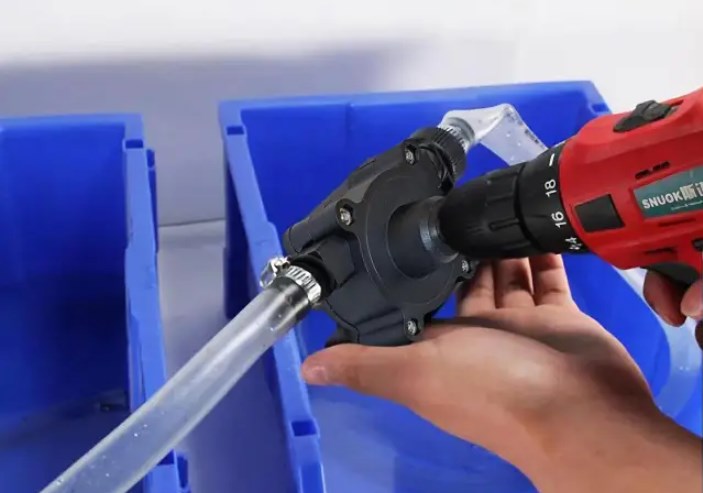
4.9 Pump attachment
An interesting home module that can help pump out spilled liquid (for example, after a water heater leak), fill a children’s pool, water flowers under the window, and much more. Keep in mind that the volume and duration of operation are severely limited and cannot compare with conventional pumps. It will also be impossible to create the pressure needed to lift water even a couple of meters. Any direct contact between the attachment or drill and water must be avoided for safety.
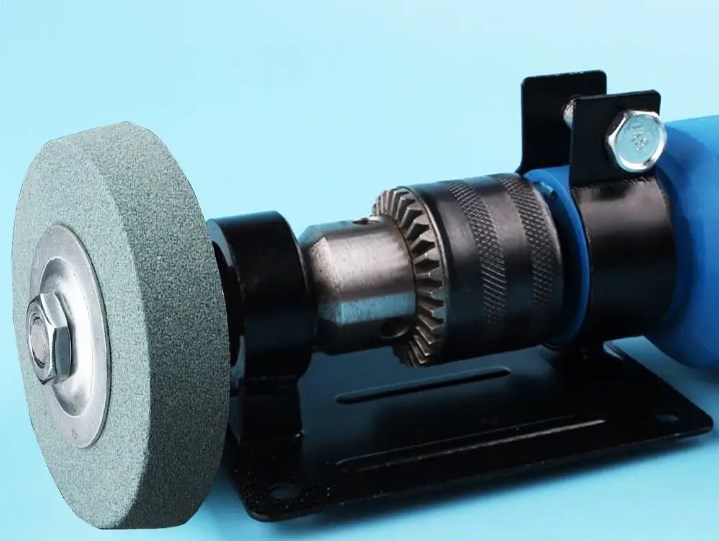
4.10 Grinding machine
A simple but essential household accessory for maintaining the cutting properties of garden, kitchen, and household tools: a shovel, hoe, axe, saw, knife, scissors, and so on.
4.11 Mixer attachment
A basic accessory that makes mixing paint with tint and preparing concrete or putty at home very simple and quick.

5. Conclusion
From the wide variety of available attachments, you can easily create a personalized set of functions at minimal cost and turn seemingly complex household tasks into convenient and fast solutions.
Articles, reviews, useful tips
All materials